Corporate Gifting
Corporate Gift Kitting vs Bulk Shipping: Which Is Better?
比較企業禮品 kitting 與 bulk shipping,分析客製飲品容器的包裝、人工、配送、追蹤、時程、例外處理與完整專案成本。
Corporate gift kitting and bulk shipping are two different distribution models for branded drinkware. Kitting assembles the complete gift before it is sent to each recipient or destination. Bulk shipping sends drinkware in larger cartons to one warehouse, office, event, or internal team for later distribution. The right choice depends on recipient addresses, timing, personalization, packaging, handling capacity, and total program cost—not on freight price alone.
Quick answer: Choose corporate gift kitting when recipients are distributed, the package must arrive ready to open, the kit contains multiple items, or personalization and address-level tracking matter. Choose bulk shipping when the order goes to one or a few locations, the buyer has receiving and distribution capacity, the contents are standardized, and lower per-unit handling cost is more important than individual convenience. A hybrid model often works best for mixed audiences.
The decision is operational, not merely cosmetic. A premium tumbler delivered individually needs stronger unit protection, a validated address, a shipping label, and an exception process. The same tumbler delivered by pallet to one office may use bulk cartons and be handed out by an internal team. Both models can be correct, but they create different responsibilities after production.
What is the difference between kitting and bulk shipping?
Kitting is the process of picking and assembling two or more approved components into one defined package. A corporate drinkware kit may contain a branded tumbler, compatible lid, accessory, message card, insert, and gift box. The kit is checked as a unit before it is shipped. Kitting may occur at the manufacturer, a fulfillment partner, or the buyer’s own facility.
Bulk shipping is the movement of finished drinkware in larger cartons or pallets to a consolidated destination. The recipient-level work happens after arrival. An HR team, event coordinator, distributor, or warehouse may sort the units, add inserts, place them in bags, or distribute them to departments and individuals.
| Decision factor | Corporate gift kitting | Bulk shipping |
|---|---|---|
| Distribution | Individual recipients or many locations | One or a few consolidated locations |
| Packaging | Complete ready-to-open kit | Protective bulk carton or pallet packaging |
| Personalization | Easier to apply by recipient or group | Usually handled after receipt |
| Internal labor | Lower after delivery | Higher at the buyer’s location |
| Address control | Shipment-level data and tracking | Destination-level data and receiving |
| Best fit | Remote employees, client gifts, campaign sends | Offices, events, warehouses, internal distribution |
| Main risk | Address, exception, and parcel damage | Internal labor, sorting, and missed handoffs |
| Cost profile | More handling and parcel charges | More receiving and distribution work |
The corporate gift drinkware fulfillment guide explains the controls shared by both models: approved product, inventory, pack-out, shipping data, quality checks, exceptions, and reconciliation.
When is corporate gift kitting the better choice?
Kitting is usually the better choice when the recipient should receive a complete and consistent experience without doing assembly work. It is especially useful for remote employee welcome kits, client appreciation gifts, partner campaigns, executive packages, event follow-up shipments, and programs with multiple inserts or accessories.
Kitting also helps when the buyer does not have a receiving team capable of sorting thousands of units. The fulfillment partner can match the kit version to the recipient group, apply labels, include the correct message, and provide tracking at the shipment level. That shifts operational work upstream and makes the package easier for the recipient to use.
A kit should have a written bill of materials and a version-controlled pack-out. If a campaign includes a standard kit, an executive kit, and an international kit, each version should identify its components, packaging, insert, label rule, and ship method. Treating variations as informal instructions is a common cause of missing accessories and wrong inserts.
Kitting is not automatically premium or more reliable. It introduces more touches, more picking decisions, and more packaging steps. It works when those steps are designed, checked, and measured. The sample approval checklist is useful because the approval should show the complete kit rather than only the drinkware body.
When is bulk shipping the better choice?
Bulk shipping is usually the better choice when the goods are going to one warehouse, office, event venue, or distribution partner and the buyer has the people, space, and process to distribute them. It is practical for conferences, employee events, office openings, dealer meetings, trade-show giveaways, and standardized orders where recipients do not need individual personalization.
Bulk shipping can reduce unit handling and parcel charges because the shipment is consolidated. It may also reduce the amount of individual packaging required when the buyer intends to hand out the items in person. However, the apparent freight saving should be compared with receiving labor, temporary storage, sorting, internal transport, event setup, packaging supplies, and the cost of damaged or missing units.
A bulk shipment still needs a receiving plan. Define carton labels, units per carton, pallet configuration, delivery appointment, contact person, counting method, damage evidence, and the location where inventory will be held. If the event team receives a mixed pallet with no carton-level identifiers, the internal distribution cost can become higher than expected.
Bulk shipping is a poor fit when the recipient list is distributed and the buyer expects the manufacturer or fulfillment partner to handle individual delivery. Sending the full order to one office may look inexpensive until someone has to re-pack and ship 500 separate gifts.
How do kitting and bulk shipping compare on total cost?
Kitting generally increases fulfillment handling and individual shipping cost while reducing buyer-side assembly and sorting labor. Bulk shipping generally reduces consolidated freight and pack-out cost while increasing receiving, storage, internal distribution, and local delivery work. Compare the full program cost, not the supplier’s unit price or the carrier’s first quote.
A useful comparison has two columns: external supplier cost and buyer-side operating cost. Include product packaging, kit assembly, inserts, labels, carton handling, freight, parcel delivery, receiving labor, storage, sorting, event delivery, address correction, returns, and replacement units. The cheapest model is the one with the lowest complete cost at the required service level.
| Cost line | Kitting model | Bulk shipping model |
|---|---|---|
| Unit packaging | Often higher for presentation | May be lower for bulk protection |
| Assembly | Fulfillment partner charges pick and pack | Buyer or partner sorts after receipt |
| Freight | More parcel or multi-location shipments | Consolidated freight to fewer destinations |
| Labels | Recipient-level labels | Carton, pallet, or destination labels |
| Receiving labor | Lower at recipient or buyer site | Higher at consolidated destination |
| Storage | Fulfillment inventory or staged kits | Buyer needs space for bulk cartons |
| Personalization | Applied during final pack-out | Added after receipt, if possible |
| Returns | Shipment-level exceptions | Buyer handles internal or recipient returns |
| Tracking | Often available by recipient | Usually available by destination |
The landed cost calculator guide provides a framework for putting these lines into one comparable model. Show committed costs, estimates, one-time charges, recurring charges, and buyer labor separately. A low quoted unit price is not proof of a low program cost.
Illustrative cost comparison
Consider 500 branded drinkware gifts. In a kitting model, the program includes unit boxes, an insert, assembly, labels, parcel shipments, and an exception allowance. In a bulk model, the program uses master cartons sent to one office, while the buyer pays for receiving, sorting, local distribution, and extra packing materials. The numbers below are illustrative and should be replaced with supplier and carrier quotes.
| Illustrative cost | Kitting to recipients | Bulk to one office |
|---|---|---|
| Product and decoration | $3,000 | $3,000 |
| Presentation packaging | $500 | $250 |
| Assembly and quality check | $750 | $150 |
| Freight and delivery | $2,250 | $650 |
| Buyer receiving and distribution labor | $150 | $1,000 |
| Local or parcel re-shipping | Included in freight estimate | $450 |
| Exception and replacement allowance | $250 | $175 |
| Illustrative program total | $6,900 | $5,675 |
The bulk model appears lower in this example, but it also assumes that the office can receive, store, sort, and distribute the gifts. If the office lacks the labor or the event deadline makes internal distribution difficult, the operational value of kitting may justify the additional spend. The decision should be based on the required outcome, not a universal claim that one model is always cheaper.
How does recipient distribution change the decision?
Recipient geography is one of the strongest decision variables. A single office with a known receiving team supports bulk shipping. A distributed workforce with home addresses, multiple time zones, or frequent address changes favors individual kitting and shipment-level tracking.
The number of destinations matters more than the number of units alone. Five thousand tumblers to one distribution center may be a bulk shipment. Five hundred tumblers to five hundred addresses may require individual kitting. A mixed audience—300 units to headquarters, 100 to regional offices, and 100 to homes—often calls for a hybrid plan.
Validate the recipient file before the final pack-out. Required fields may include name, company, address lines, city, state, postal code, country, email or phone for exceptions, kit version, and personalization text. Lock the file at an agreed time and document how late changes are handled. Address corrections and duplicate records can consume the apparent savings of either model.
For direct-to-recipient delivery, define who owns undeliverable packages, address changes, carrier claims, returns, replacements, and privacy-sensitive label errors. For bulk delivery, define who owns the internal handoff from receiving dock to department, event room, or distribution table.
How does timing affect kitting vs bulk shipping?
Kitting is useful when gifts must arrive at different times or align with an employee start date, client meeting, event registration, or campaign launch. It allows the program to stage completed kits and release them by date or recipient group. It also reduces the need for the buyer to coordinate last-mile shipments during the same week as the event.
Bulk shipping is useful when one delivery window and one destination simplify the operation. It can be efficient for a trade show or all-hands event where the goods are received, counted, and distributed on a known day. The risk increases when the buyer has little time between delivery and the event.
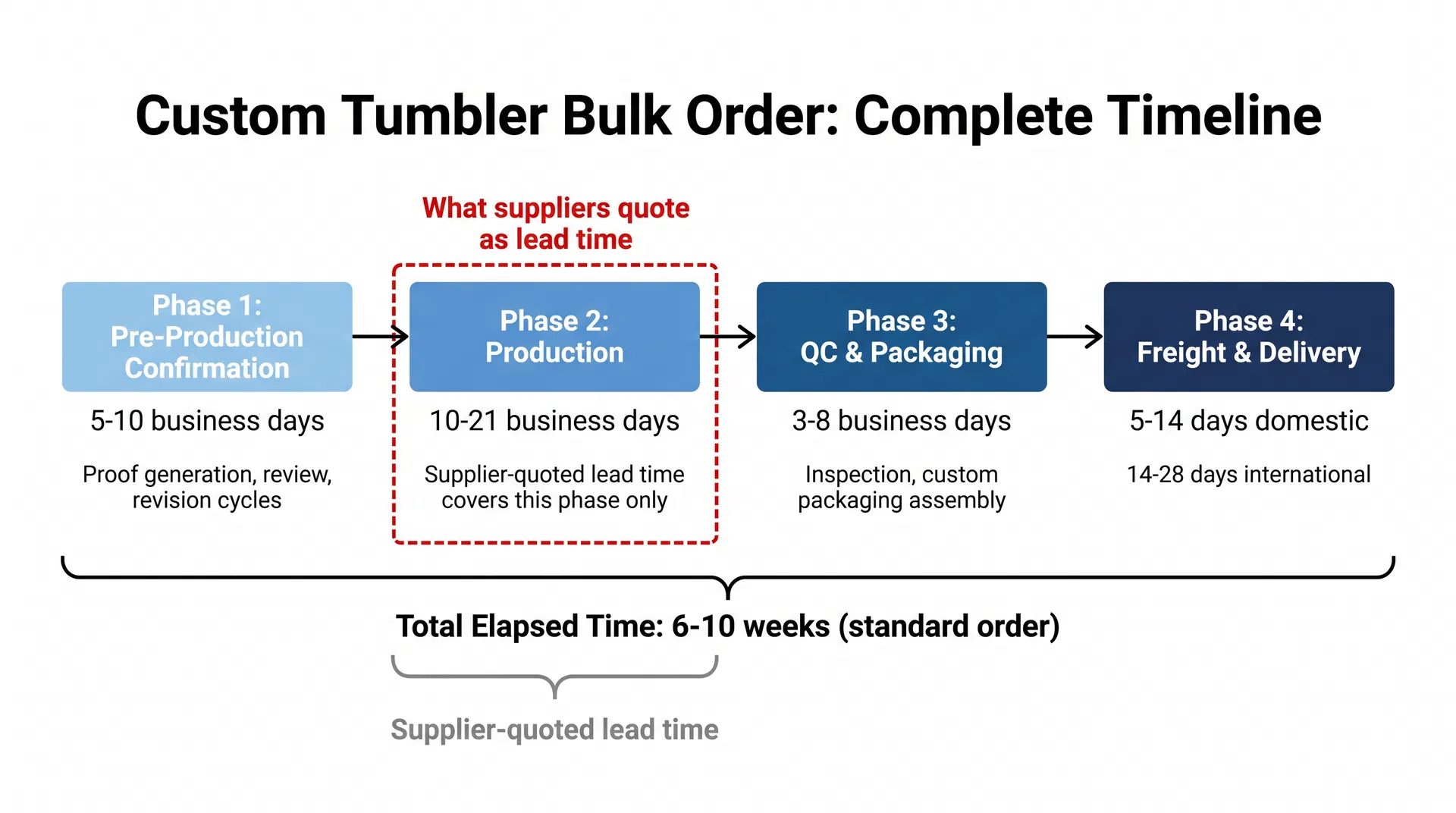
Build schedule protection into either model. Include production completion, quality inspection, packaging, receiving, carrier pickup, transit, appointment delivery, address correction, and replacement time. Supplier-quoted lead time should not be treated as the full time from approval to recipient receipt. The quoted lead-time boundary guide explains why pre-production, post-production, and logistics phases must be separated.
| Timing question | Kitting implication | Bulk shipping implication |
|---|---|---|
| When must the product be ready? | Before the first release wave | Before the consolidated delivery appointment |
| Can shipments be staggered? | Usually easier by recipient group | Requires internal storage and release |
| What happens after a delay? | Individual recipients may need proactive updates | Event or office delivery may be missed |
| How much buffer is needed? | Address and parcel exception buffer | Receiving and internal distribution buffer |
| Who monitors tracking? | Fulfillment or program team | Buyer or office receiving team |
Do not choose bulk shipping simply because the event date is far away. A late bulk delivery can leave no time for sorting, while a staged kitting program may expose problems earlier and allow correction before the ship window.
How does packaging differ between the two models?
Kitting requires unit-level protection and presentation. The package must hold the drinkware, lid, accessory, and insert in the correct order and survive parcel handling. Bulk shipping requires carton and pallet protection, readable carton identification, stacking rules, and a receiving method that prevents units from being lost or mixed.
The final pack-out should be approved using the actual distribution channel. A gift box that works for a hand-delivered office kit may need additional protection for residential parcel delivery. A bulk carton that works on a pallet may not be suitable for a volunteer event team that must carry individual units to a room.
Packaging components should be documented when they contact the drinkware or could affect the product surface. The FDA identifies packaging components, adhesives, colorants, and other materials as examples of food contact substances in relevant circumstances, and states that a food contact substance that is a food additive must be authorized for its intended use before being marketed in the United States.1 Confirm intended use and documentation with the responsible compliance professional rather than relying on a generic “food-safe” description.
In a kitting program, label and insert errors are visible recipient-level failures. In a bulk program, a carton label or mixed-SKU error can affect an entire office or event. Both models need a controlled packaging version and a change-approval process.
What is a hybrid fulfillment model?
A hybrid model uses bulk shipping for predictable consolidated destinations and kitting for recipients or groups that need individual delivery. For example, a company may send 1,000 standard tumblers to headquarters for an event, 200 complete welcome kits to remote employees, and 50 executive gifts with special packaging.
Hybrid planning requires separate rules. Create a destination matrix that identifies quantity, kit version, packaging, shipping method, recipient data, delivery date, owner, and exception process. Do not let a “hybrid” label hide three different undocumented operations.
| Destination group | Recommended model | Control priority |
|---|---|---|
| One event venue | Bulk shipping | Carton count, appointment, event receiving |
| Headquarters departments | Bulk or bulk plus internal kitting | Department labels and internal handoff |
| Remote employees | Individual kitting | Address validation, tracking, returns |
| VIP clients | Individual premium kitting | Pack-out approval and exception response |
| Regional offices | Consolidated by office | Carton labels and local distribution |
| New hires over several months | Staged kitting | Inventory aging and replenishment |
The hybrid model is often the most realistic for corporate programs because recipients do not share one distribution requirement. It can control cost without forcing every group into the highest-touch option.
How should procurement choose the right model?
Use a decision scorecard rather than choosing from a single price line. Score recipient distribution, personalization, packaging, buyer labor, deadline risk, tracking need, storage capacity, return complexity, and total landed cost. Weight the factors that matter to the program.
| Question | Favors kitting | Favors bulk shipping |
|---|---|---|
| Are destinations numerous? | Yes | No |
| Must each package be ready to open? | Yes | No |
| Is personalization required? | Yes | No or handled centrally |
| Does the buyer have warehouse labor? | No | Yes |
| Is there one delivery location? | No | Yes |
| Is the order standardized? | Less important | Very important |
| Is shipment-level tracking required? | Yes | Not usually |
| Is internal storage limited? | Yes | No |
| Is the event in one place? | Not necessarily | Often |
| Are returns recipient-specific? | Yes | Less often |
Ask each supplier or fulfillment partner to quote the same scope. The custom drinkware RFQ template can be extended with a fulfillment section covering kit assembly, packaging, storage, labels, address processing, delivery methods, exception handling, and reconciliation.
Kitting vs bulk shipping checklist
| Planning stage | Required decision |
|---|---|
| Audience | Who receives the drinkware and where? |
| Product | Which body, lid, accessory, decoration, and revision are approved? |
| Kit | Which components belong together and in what order? |
| Packaging | Is the package designed for parcel, pallet, office, or event delivery? |
| Data | Which recipient and destination fields are required and when are they locked? |
| Cost | Are product, fulfillment, freight, labor, storage, returns, and replacements included? |
| Timing | What is the actual recipient or event deadline, including buffers? |
| Quality | Which checks happen at receiving, assembly, pack-out, and release? |
| Exceptions | Who handles shortages, damage, address errors, and late changes? |
| Closeout | How are shipped, returned, damaged, and remaining units reconciled? |
Corporate gift kitting is the stronger choice when the buyer needs a complete recipient-ready experience, distributed delivery, personalization, or low internal handling. Bulk shipping is the stronger choice when the order is standardized, consolidated, and supported by a capable receiving and distribution team. A hybrid model is often best when the audience includes events, offices, remote employees, and VIP recipients at the same time.
The correct decision is the one that protects the intended brand experience at a transparent total program cost. Compare both models using the same product specification, packaging standard, delivery boundary, schedule, exception rules, and sellable-unit assumptions. When the handoffs are documented, procurement can choose based on evidence instead of choosing the lowest incomplete quote.
References