Cost Analysis
Custom Drinkware Landed Cost Calculator Guide
客製飲品容器 landed cost 計算指南,涵蓋產品、Logo、包裝、檢驗、運費、關稅、末端配送、可售單位與完整成本公式。
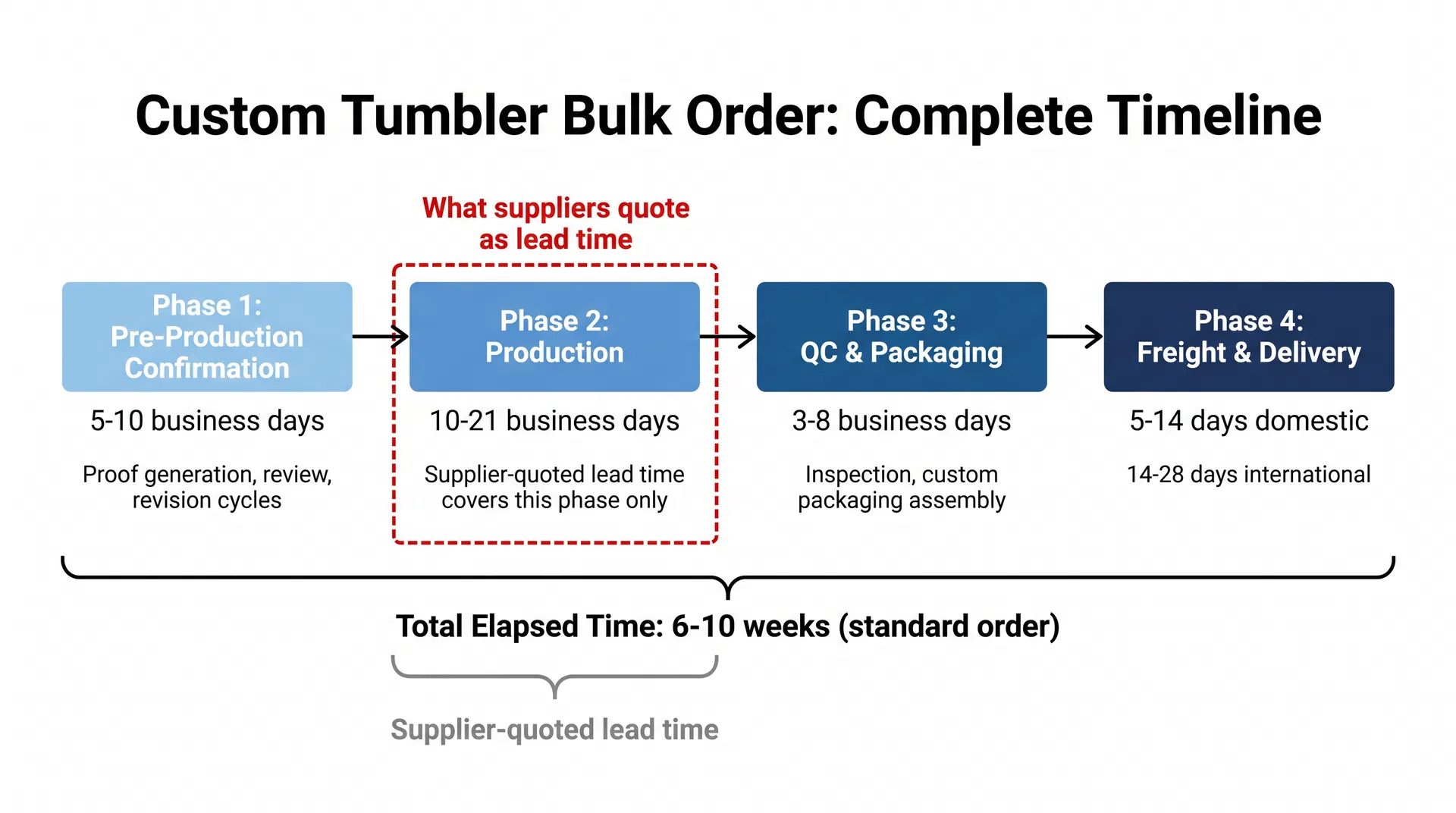
A custom drinkware landed cost calculator estimates the complete cost of getting branded bottles, tumblers, mugs, or gift sets from the supplier to the buyer’s usable destination. It combines product, customization, packaging, inspection, freight, customs, delivery, and other applicable charges instead of treating the supplier’s unit price as the final procurement cost.
Quick answer: Calculate custom drinkware landed cost by adding the quoted product and decoration cost, one-time charges allocated across the order, packaging, inspection, origin handling, international freight, insurance where applicable, customs duties or fees, destination handling, domestic delivery, and approved contingency. Divide the total by the number of sellable units received. Keep taxes, duties, and optional costs separate when the buyer’s accounting treatment differs.
Landed cost matters because a low factory price can become expensive after freight, packaging, customs, inspection, damage, and delivery are added. It also gives procurement a fair way to compare suppliers using different Incoterms, packaging assumptions, shipping methods, or quotation formats. The goal is not to predict every future charge perfectly; it is to expose the cost drivers and assumptions before a purchase is approved.
What is landed cost for custom drinkware?
Landed cost is the total cost required to bring purchased goods to the buyer’s defined destination, ready for the intended use or distribution. For branded drinkware, that destination may be a U.S. warehouse, a fulfillment center, a corporate office, or multiple recipient locations. The definition must state where the cost calculation ends.
Landed cost is different from unit price, invoice value, and total cost of ownership. Unit price is the supplier’s charge for a unit under stated conditions. Invoice value is the amount shown on the commercial invoice. Landed cost adds the costs required to receive the goods. Total cost of ownership may go further by including storage, handling, replenishment, returns, defects, financing, and end-of-life costs over the program.
| Cost concept | What it answers | Typical use |
|---|---|---|
| Unit price | What does the supplier charge per finished unit? | Initial quote comparison |
| Invoice value | What amount is billed under the commercial terms? | Accounting and customs documentation |
| Landed cost | What does each received unit cost at the agreed destination? | Purchase approval and supplier comparison |
| Total cost of ownership | What does the program cost over its complete lifecycle? | Strategic sourcing and recurring programs |
A calculation should not mix these concepts. If a buyer includes warehouse storage or employee fulfillment in one supplier comparison but not another, the result is not comparable. Define the calculation boundary, currency, date, and included costs at the top of the worksheet.
What is the custom drinkware landed cost formula?
A practical formula is: total landed cost equals product cost plus customization plus allocated one-time charges plus packaging plus inspection plus origin handling plus freight and insurance plus customs and destination charges plus domestic delivery plus an approved contingency, less any documented credits. Per-unit landed cost equals total landed cost divided by sellable units received.
The formula is a decision model, not a customs ruling. Duty classification, valuation, tax treatment, broker charges, and Incoterm responsibility should be confirmed with the supplier, customs broker, freight provider, or qualified trade professional. Do not use a calculator to invent a duty rate or treat an estimate as an official classification.
| Formula component | Include in the worksheet | Common question |
|---|---|---|
| Product | Body, lid, gasket, accessories, and finished unit | Is the quoted unit configuration complete? |
| Customization | Artwork setup, decoration, color matching, tooling, and samples | Are setup costs one-time or recurring? |
| Packaging | Unit box, insert, sleeve, protection, master carton, labels | Is packaging included in the quoted unit price? |
| Quality | Sampling, inspection, testing, rework, and reports | Who pays when inspection fails? |
| Origin | Export handling, documentation, terminal, and pickup | Where does the supplier’s price end? |
| Freight | Ocean, air, parcel, fuel or handling surcharges, and insurance | Is the quote based on actual or estimated weight? |
| Customs | Duty, brokerage, entry, fees, and applicable taxes | Which costs are buyer-paid under the term? |
| Destination | Port, warehouse, appointment, storage, and domestic delivery | Is delivery one location or many? |
| Contingency | Approved risk allowance for variable costs | Is this shown separately from committed cost? |
How should product and customization cost be entered?
Start with the complete finished configuration, not only the vessel body. Include the lid, gasket, straw, mouthpiece, carry loop, accessory, and any replacement component included in the delivered unit. The custom drinkware RFQ template shows how to define these requirements before requesting prices.
Enter customization as a separate line when possible. Decoration may include artwork setup, screen or plate charges, engraving setup, color matching, digital proofing, sampling, special coating, and tooling. Some suppliers fold these costs into a unit price; others show them as one-time charges. Normalize both formats before comparing suppliers.
If one-time costs support multiple future orders, decide how to present them. Procurement may show both first-order landed cost and recurring landed cost. First-order cost allocates all setup and development charges across the initial order. Recurring cost removes charges that will not repeat, provided the supplier confirms the tooling, artwork, mold, or packaging design remains usable.
Do not allocate an uncertain future cost across the first order without labeling it. A calculator should show committed cost, estimated cost, and optional cost separately. This gives finance and procurement a clear view of which number is approved and which number still needs confirmation.
How should packaging and sellable units be handled?
Packaging affects both cost and freight. A tumbler shipped in a protective bulk carton may have a lower packaging cost but a different recipient experience from a gift box with an insert. A direct-to-recipient program may need individual labels, kitting, parcel protection, and multiple destination charges.
Include unit packaging, inner protection, master cartons, pallets, inserts, sleeves, labels, and any kitting operation. Confirm whether packaging charges are priced per unit, per carton, per pallet, per order, or as a one-time development fee. Ask whether the carton dimensions and gross weight are estimates or final values because freight estimates can change when packaging changes.
Define sellable units. If an order contains damaged, missing, rejected, or unusable units, dividing by the original purchase quantity understates the cost per usable unit. A practical worksheet can show both ordered-unit landed cost and sellable-unit landed cost. The latter is useful when a quality hold, transit damage, or short shipment affects the program.
The quality control inspection checklist and sample approval checklist help reduce the risk that rejected or nonconforming units distort the final calculation.
How should freight be estimated for drinkware?
Freight should be calculated from the shipment’s actual or estimated cartons, dimensions, gross weight, origin, destination, shipping method, and required receipt date. Drinkware can be freight-sensitive because unit packaging and carton volume may occupy more space than the product weight alone suggests.
Request freight assumptions from the supplier or forwarder. Record whether the quote is based on ocean, air, express parcel, or domestic truck service; whether the charge is actual or estimated; and which surcharges or handling costs are excluded. Ask for the quote validity period because freight and fuel costs can change.
Compare delivery methods by complete cost and deadline, not freight price alone. Air freight may reduce inventory delay but increase landed cost. Ocean freight may reduce transport cost but require earlier purchase and more working capital. A late shipment can create event replacement, expedited domestic delivery, or missed-program costs that do not appear in the original freight line.
Set the destination explicitly. “U.S. delivery” is not a sufficient endpoint for a multi-location corporate order. A warehouse delivery, a residential parcel, an appointment delivery, and a series of office shipments have different handling and last-mile costs.
How should customs duties and fees be treated?
List customs duties, brokerage, entry fees, merchandise processing or similar charges, port or terminal handling, and applicable taxes according to the trade route and commercial terms. Use the duty rate and classification supplied or confirmed by the responsible trade professional; do not guess from a product nickname such as “tumbler” or “water bottle.”
The customs value and duty treatment can depend on classification, origin, valuation, material, components, and the shipment’s documentation. A calculator can hold these inputs and calculate scenarios, but it cannot replace a broker’s or customs specialist’s determination. Record the source, date, and assumptions for each trade input.
Show taxes separately where the buyer’s accounting treatment requires it. Some taxes may be recoverable, while others are a real cost. The same applies to duties, brokerage, and fees. If two suppliers quote different Incoterms, move each quote into the same destination and tax treatment before deciding which is cheaper.
Do not hide uncertain trade costs inside a single “miscellaneous” percentage. Use a visible estimate, identify who owns the charge, and show a low, expected, and high scenario when the value is material to the project.
How does Incoterms responsibility affect landed cost?
Incoterms help define responsibilities, costs, and risks between seller and buyer, but the exact commercial term and shipment arrangement still need to be read carefully. A supplier’s delivered quote may include some logistics and exclude other destination charges. A factory or port quote may leave the buyer responsible for freight, insurance, customs, and domestic delivery.
Ask the supplier to state the named place together with the term. “Delivered” without a named place is ambiguous. Compare each quote by adding the costs required to reach the same destination. If the buyer requires a warehouse delivery, calculate the cost to that warehouse even when the quote is presented as factory pickup or port delivery.
| Quote boundary | Costs that may still need to be added |
|---|---|
| Factory pickup | Export handling, freight, insurance, customs, brokerage, domestic delivery |
| Export port | Main freight, insurance, import charges, brokerage, domestic delivery |
| U.S. port | Port handling, customs, brokerage, storage, domestic delivery |
| U.S. warehouse | Verify whether customs, duties, appointment, and final handling are included |
| Multiple recipients | Kitting, labels, parcel shipping, residential or appointment surcharges |
Use the supplier’s commercial term as an input, not as the final answer. Confirm what the quote includes and ask for a line-by-line breakdown when the term makes comparison difficult.
How should food-contact compliance enter the cost model?
Include the cost of required material records, declarations, testing, laboratory review, or compliance support when the program requires them. The body is not always the only food-contact component. Lids, gaskets, straws, mouthpieces, coatings, adhesives, and colorants may need to be identified and documented for the intended use.
The U.S. Food and Drug Administration states that a food contact substance is a substance that comes into contact with food without being intended to have a technical effect in the food. Under federal law, a food contact substance that is a food additive must be authorized for its intended use before it is marketed.1 The calculator should therefore show compliance work as a requirement and cost line where applicable, rather than assuming a general “food-safe” phrase has no cost or scope.
Intended use matters. A product for room-temperature water may not have the same material and documentation requirements as one intended for hot coffee, acidic drinks, dairy beverages, or high-temperature cleaning. FDA’s food-types and conditions-of-use reference provides the regulatory context for matching use conditions to food-contact substances.2 Escalate unusual materials, temperatures, or claims to a qualified compliance or legal professional.
How should contingency be calculated?
Contingency is an explicit risk allowance, not a substitute for missing quotation data. Use it only after committed costs and estimates are visible. Potential variables include freight volatility, carton dimensional changes, customs estimates, inspection rework, sample revisions, short shipment, damage, and domestic delivery surcharges.
A simple scenario model is more transparent than one unexplained percentage. Show a low case, expected case, and high case. Change only the uncertain variables and keep the product specification constant. This reveals whether the supplier decision changes when freight, duty, packaging, or damage assumptions move.
| Scenario | What changes | Decision use |
|---|---|---|
| Low | Favorable freight, confirmed documents, no rework | Best-case planning, not an approval figure |
| Expected | Current supplier quote and documented assumptions | Base budget and supplier comparison |
| High | Freight or duty range, correction, damage, or delay allowance | Risk approval and escalation threshold |
Contingency should be shown both as a dollar amount and as a percentage of the base cost. A percentage alone can hide whether the risk is freight, customs, packaging, or quality. The buyer can then decide which risk to reduce through a contract term, inspection, packaging trial, insurance, or earlier purchase.
Worked custom drinkware landed cost example
Assume a buyer orders 2,000 branded tumblers. The example is illustrative, not a market quotation or customs calculation. The supplier quotes a finished unit at $5.40, decoration at $0.35 per unit, unit packaging at $0.80 per unit, and a one-time artwork and sample charge of $420. Inspection is $280. Estimated origin and export handling is $160. Freight and insurance are estimated at $1,850. Customs and brokerage are estimated at $1,100. Domestic delivery to the warehouse is $420. The buyer holds a $600 approved contingency.
| Cost item | Calculation | Amount |
|---|---|---|
| Product | 2,000 × $5.40 | $10,800 |
| Decoration | 2,000 × $0.35 | $700 |
| Unit packaging | 2,000 × $0.80 | $1,600 |
| Artwork and sample | One-time | $420 |
| Inspection | Order-level | $280 |
| Origin handling | Order-level | $160 |
| Freight and insurance | Estimate | $1,850 |
| Customs and brokerage | Estimate | $1,100 |
| Domestic delivery | Warehouse delivery | $420 |
| Base landed cost | Sum before contingency | $17,330 |
| Approved contingency | Risk allowance | $600 |
| Planning total | Base plus contingency | $17,930 |
The expected planning landed cost is $8.665 per ordered unit when the contingency is included. If 40 units are rejected or damaged and only 1,960 units are sellable, the planning cost per sellable unit is approximately $9.15. This distinction helps procurement decide whether a quality or packaging control is worth funding.
The example does not state a duty rate or tax treatment. Those values depend on the actual shipment and should be confirmed through the responsible customs and accounting process.
How should a landed cost worksheet be structured?
Create one input section and one calculation section. Inputs should include currency, quantity, SKU, supplier, quotation date, delivery boundary, Incoterm or commercial term, destination, shipment method, carton assumptions, duty input source, tax treatment, and scenario. Calculation lines should include quantity, unit cost, extended cost, source, confidence, owner, and whether the cost is one-time, recurring, optional, or estimated.
| Worksheet field | Example entry |
|---|---|
| Quantity | 2,000 ordered / 1,960 sellable scenario |
| Currency | USD, with exchange-rate date if applicable |
| Delivery boundary | Named U.S. warehouse |
| Quote validity | Supplier quote date and expiration |
| Cost type | One-time, recurring, optional, estimate |
| Source | Supplier quote, forwarder, broker, internal estimate |
| Confidence | Confirmed, estimated, or unresolved |
| Scenario | Low, expected, or high |
| Owner | Procurement, finance, logistics, quality, or broker |
| Review date | Date for refreshing variable inputs |
This structure makes the calculator auditable. If the final cost changes, the team can see which assumption moved instead of debating a single unexplained total.
What mistakes make landed cost calculations unreliable?
The first mistake is comparing product prices without normalizing delivery boundaries. The second is dividing by ordered units when a material number of units is not sellable. The third is forgetting one-time tooling, setup, sample, or packaging-development charges. The fourth is treating a freight estimate as a fixed amount after packaging dimensions change.
Another mistake is hiding duties, fees, taxes, and brokerage inside a broad percentage. The fifth is using a guessed duty rate without documenting classification or source. The sixth is ignoring the cost of inspection, rework, returns, replacements, storage, or domestic delivery. The seventh is calculating the first order and assuming a reorder has the same MOQ, packaging, freight, and setup behavior.
A reliable model is not the one with the most decimal places. It is the one that labels what is confirmed, what is estimated, what is excluded, who owns the input, and when the input should be refreshed.
Copy-and-use landed cost calculator template
Project: [name]
Supplier and quote date: [supplier, date, quote validity]
Destination boundary: [warehouse, fulfillment center, office, or multiple recipients]
Currency and exchange-rate date: [currency, source, date]
Quantity ordered: [units by SKU]
Expected sellable quantity: [units after approved quality and damage allowance]
Product unit cost: [body, lid, accessories]
Customization per unit: [decoration and special finish]
One-time charges: [tooling, artwork, samples, testing, packaging development]
Unit packaging: [box, insert, sleeve, protective components]
Inspection and quality: [sampling, inspection, rework, reports]
Origin handling: [pickup, export documents, terminal, origin charges]
Freight and insurance: [mode, estimate, validity, source]
Customs: [classification, duty estimate, brokerage, fees, source]
Destination handling: [port, warehouse, appointment, storage]
Domestic delivery: [location, service, surcharge assumptions]
Contingency: [dollar amount and reason]
Base landed total: [sum of committed and documented estimated lines]
Planning total: [base total plus approved contingency]
Cost per ordered unit: [planning total ÷ ordered units]
Cost per sellable unit: [planning total ÷ sellable units]
Open assumptions: [items requiring confirmation]
Owner and review date: [person, date]
A custom drinkware landed cost calculator helps the buyer negotiate better because it makes cost drivers visible. The buyer can ask whether packaging can be redesigned, whether a shipment should be consolidated, whether an inspection should occur before packing, whether a reorder can reuse tooling, or whether a delivery date justifies a different freight method.
Use the model before supplier selection, after sample approval, before production release, and when the shipment is ready to book. Refresh variable freight, customs, packaging, and destination inputs rather than carrying old estimates into a new order.
The final number is useful only when its boundary is clear. A transparent landed cost calculation protects the budget, improves supplier comparison, and gives finance, procurement, logistics, quality, and brand teams one shared explanation of what the custom drinkware program really costs.
References