Procurement Template
Custom Drinkware RFQ Template for B2B Buyers
B2B 客製飲品容器 RFQ 報價請求範本,涵蓋產品規格、Logo 客製、包裝、品質檢驗、食品接觸文件、MOQ、交期與完整報價比較。
A custom drinkware RFQ template is a structured request for quotation that gives every supplier the same product, branding, packaging, quantity, timing, compliance, and delivery information. It allows a buyer to compare like-for-like quotes instead of comparing a fully specified delivered price with a low factory-unit price that excludes setup, packaging, inspection, freight, or other required work.
Quick answer: A B2B custom drinkware RFQ should specify the product configuration, materials, capacity, lid, decoration, color, quantity by SKU, packaging, ship-to location, required documents, sample milestones, inspection standard, target delivery date, quote format, and commercial assumptions. Ask suppliers to list exclusions and change triggers so the final quote can be evaluated by total landed cost rather than unit price alone.
An RFQ is not a purchase order and it is not approval to begin production. It is a controlled information request used to discover price, feasibility, lead time, assumptions, and supplier capability. A well-written RFQ reduces clarification cycles before sampling and makes the supplier’s response easier for procurement, finance, brand, quality, and logistics teams to review.
What is a custom drinkware RFQ?
A request for quotation is a buyer’s formal request for a supplier to price a defined scope of goods and services. For custom drinkware, the scope may include a bottle or tumbler, lid components, logo decoration, color matching, tooling, individual packaging, inserts, inspection, carton labeling, freight, and delivery to one or more locations.
The RFQ should make the commercial boundary visible. State whether the requested price is factory pickup, export port, delivered to a U.S. warehouse, or delivered to multiple domestic addresses. State whether duties, brokerage, inspection, tooling, sample charges, setup charges, and replacement parts are included. A supplier cannot produce a comparable quote when the delivery boundary is undefined.
An RFQ also creates a preliminary technical record. The final production specification may change after sampling, but the RFQ should capture the buyer’s starting requirements and the assumptions the supplier used to quote. If a supplier proposes a substitute, the substitute should be shown beside the requested configuration, not hidden in a general note.
What information should a custom drinkware RFQ include?
Include enough information for the supplier to identify the exact product, calculate the required operations, and schedule the work. A product photograph can help communicate the design direction, but it should not replace written dimensions, material, lid, decoration, packaging, and delivery requirements.
| RFQ section | Information to provide |
|---|---|
| Program overview | Project name, buyer, intended audience, use case, and decision deadline |
| Product | Product type, SKU, dimensions, capacity, wall construction, finish, and target weight |
| Lid and accessories | Closure type, gasket, straw, mouthpiece, handle, carry loop, and spare parts |
| Materials | Body, lid, gasket, coating, colorant, adhesive, and other relevant components |
| Decoration | Logo file, process, colors, placement, size, durability expectation, and artwork deadline |
| Quantity | Total units, units by SKU or color, order split, forecast, and possible reorder |
| Packaging | Unit box, insert, sleeve, accessories, master carton, labels, and shipping method |
| Quality | Approved sample, tolerances, inspection stage, defect classes, and sampling plan |
| Compliance | Intended beverage, temperature, food-contact documents, and required declarations |
| Delivery | Ship-to locations, target receipt date, freight assumption, and milestone dates |
| Commercials | MOQ, tooling, sample cost, payment terms, quote validity, exclusions, and change triggers |
The custom drinkware supplier evaluation checklist can be used after the RFQ responses arrive. The RFQ defines what suppliers must answer; the evaluation scorecard defines how the answers and evidence will be compared.
How should the product configuration be written?
Describe the finished configuration from the outside in and from the body through the lid. Start with the product family and intended use, then identify the exact body, size, capacity, material, construction, finish, and color. Continue with the lid, gasket, straw, mouthpiece, carry feature, and any accessory included in the delivered unit.
Write “20-ounce insulated stainless-steel tumbler with slide-lock lid” rather than “premium tumbler.” Write whether capacity is nominal or usable. State whether the unit must fit a standard vehicle cup holder, whether it will hold hot beverages, whether it will be hand-washed or dishwasher-cleaned, and whether a carry loop must support a filled unit.
If the buyer is flexible, separate requirements into three levels. Must-have requirements determine whether the quote is responsive. Preferred requirements help compare alternatives. Acceptable substitutions define what the supplier may propose without delaying the project. This structure gives the supplier room to offer a practical alternative while protecting the buyer from silent changes.
Include a reference image or existing sample only as a supplement. Identify which features in the image are required and which are illustrative. A supplier may reasonably interpret a photograph differently if the RFQ does not define the lid thread, gasket, logo position, base ring, coating, or package.
What materials and compliance information belong in the RFQ?
List the body and every component that may contact the beverage or be handled by the recipient. Depending on the design, this may include stainless steel, plastic or polymer lid parts, silicone gaskets, straws, mouthpieces, coatings, colorants, adhesives, and printed or molded components. Ask the supplier to identify the material basis and available documentation for each relevant component.
The U.S. Food and Drug Administration explains that a food contact substance is a substance that comes into contact with food without being intended to have a technical effect in the food. Under U.S. law, a food contact substance that is a food additive must be authorized for its intended use before it is marketed.1 The RFQ should therefore request documents and intended-use information rather than simply asking a supplier to write “FDA approved.”
State the intended beverage and conditions of use. A reusable water bottle used for room-temperature water is not automatically equivalent to a container used for hot coffee, acidic beverages, dairy drinks, or repeated high-temperature cleaning. FDA reference tables distinguish food types and conditions of use for food-contact substances.2 Ask the supplier to identify any limitation that affects the proposed material or component.
A compliance request should record the document type, issuing party, revision or date, covered component, intended use, and stated limitations. If the project involves unusual materials, high temperatures, regulated claims, or a public sustainability statement, route the final interpretation to qualified compliance or legal counsel.
How should artwork and customization requirements be written?
Attach the logo in the format the supplier requests and provide the brand color reference, preferred decoration process, placement, maximum size, minimum line weight where relevant, and acceptable variation. Identify which surfaces are prohibited because of a seam, grip area, lid movement, curvature, or contact with the mouth.
Do not ask for a “logo on the front” without defining the reference. State the orientation, distance from the base or lid seam, relationship to the handle, and the viewing face. If the logo must align across multiple components, specify the alignment rule and tolerance.
Ask the supplier to quote the decoration method they recommend for the stated substrate and use. Laser engraving, screen printing, UV printing, transfer decoration, and molded or embossed marks have different visual results, setup requirements, durability expectations, and color limitations. The requested quote should identify the process, setup cost, sample method, and whether production uses the same process as the approved prototype.
Add an artwork approval deadline to the RFQ schedule. A supplier cannot begin a controlled production timeline while the logo file, color reference, or placement remains unresolved. The branding technology guide and the sample approval checklist provide useful internal context for this section.
How should quantity, MOQ, and pricing tiers be requested?
Give suppliers the total quantity and the breakdown by SKU, color, lid, logo, and packaging variation. A total of 10,000 units may represent one configuration or ten separate 1,000-unit configurations; the setup and production implications are different.
Ask for at least one planned quantity and one or two decision-useful tiers when the forecast is uncertain. For example, request pricing for the initial order, a higher volume, and a repeat order if the supplier has different MOQ or setup behavior. Do not ask for meaningless volume tiers that the business will never buy.
Separate one-time and recurring costs. One-time costs may include tooling, artwork setup, color matching, prototype sampling, testing, and packaging development. Recurring costs may include the finished unit, decoration, package, insert, inspection, freight, and other per-unit services. Ask the supplier to state whether a tooling or setup cost is reused for a reorder.
Request the price by SKU and by delivery scope. A blended unit price can hide the fact that one color or lid configuration has a much higher MOQ. The quote should identify currency, validity period, payment milestones, tax or duty assumptions, and what happens when the quantity changes.
How should packaging and delivery be specified?
Describe the complete distribution path. State whether the units will ship in bulk to one warehouse, in individual gift boxes to offices, or directly to recipients. Identify the number of destinations, expected parcel service, labeling requirements, carton limits, and any kitting or insert operation.
Ask the supplier to quote unit packaging and master-carton packaging separately. Define the box material, print or label, insert, protective film, accessory position, unit count, carton dimensions, gross weight, stacking direction, and shipping marks where known. If the package is part of the recipient experience, request a physical packaging sample rather than approving only a digital rendering.
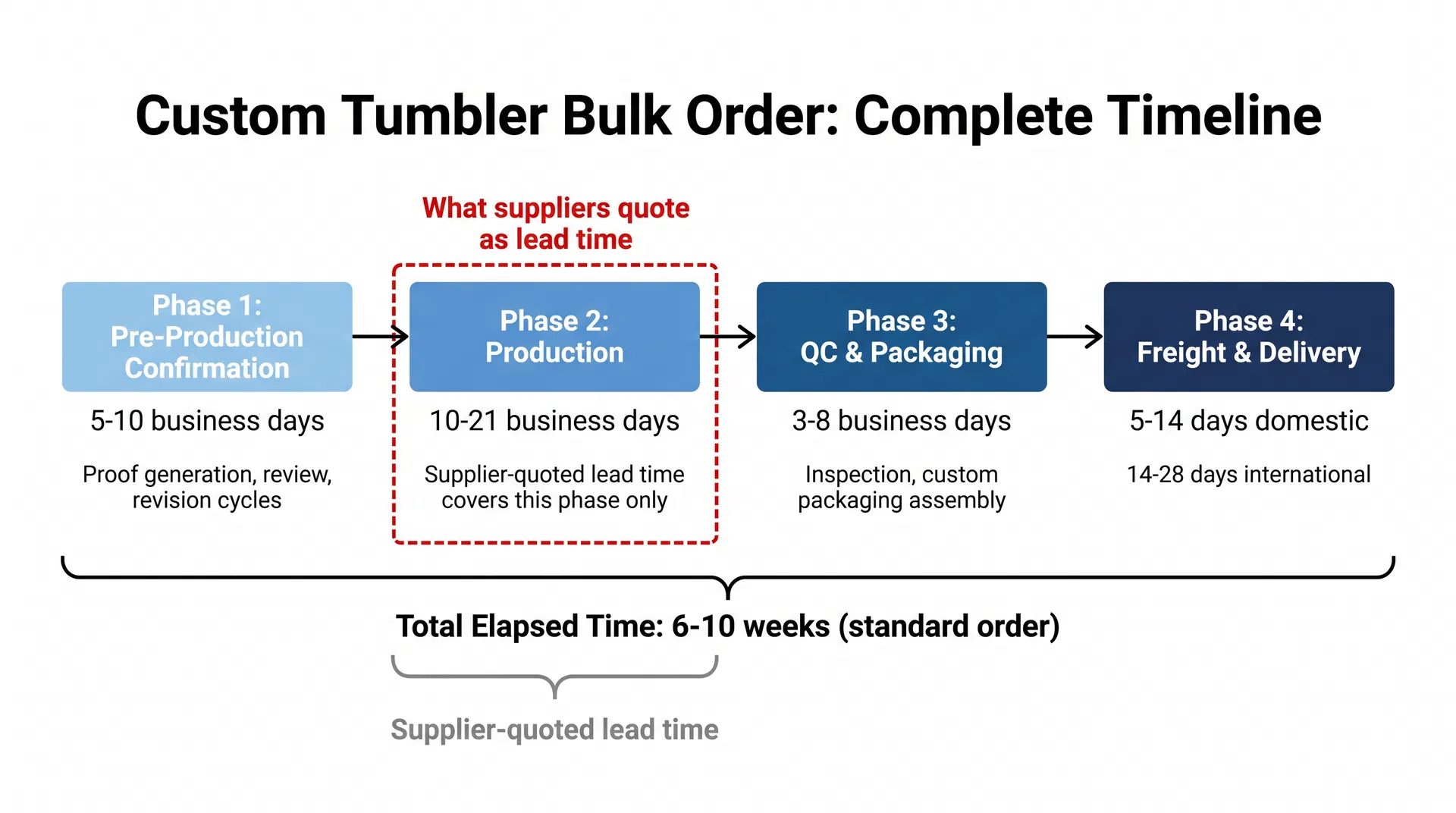
Use a receipt date rather than only a ship date when the project has an event or employee start-date requirement. Ask the supplier to break out specification, sample, production, inspection, packaging, export handling, freight, customs, domestic delivery, and receiving. The quoted lead-time boundary guide explains why a short production quote may exclude the phases that determine when the buyer actually receives the order.
What quality requirements should an RFQ state?
Tell the supplier what must be inspected and when. A practical request covers material and component identity, dimensions, capacity, lid fit, leakage, opening and closing, decoration placement, color and finish, package fit, carton count, and shipping marks. If the buyer has an approved sample, identify it by revision and require the supplier to use it as the visual and functional reference.
Define defect classes before requesting a final price. A critical defect may involve safety, contamination, or essential sealing function. A major defect may involve a wrong lid, wrong artwork, large leak, missing component, or materially damaged surface. A minor defect may be a limited cosmetic variation accepted within a written tolerance. The exact acceptance rule should be agreed with the supplier and inspection provider.
Specify the inspection stage and sampling method. A pre-production sample confirms the configuration. An in-process check catches a process problem early. A pre-shipment inspection evaluates the finished lot. A receiving check confirms the shipment arrived as expected. The quality control inspection checklist explains why a generic quality certificate is weaker than lot-specific evidence.
If the buyer intends to use an AQL or other sampling standard, state the applicable plan or ask suppliers to identify their proposed plan. Do not imply that sampling means zero defects. Critical characteristics may need dedicated functional checks even when other attributes use sampling.
What should suppliers return with their quotation?
Make the response format explicit so buyers can compare answers quickly. Request an itemized price sheet, technical deviations, assumptions, exclusions, sample plan, production timeline, document list, packaging description, shipping terms, quote validity, payment terms, and a named account owner.
| Supplier response field | Required answer |
|---|---|
| Product response | Confirmed configuration or clearly marked deviation |
| Unit price | Price by SKU, quantity tier, and delivery scope |
| One-time charges | Tooling, setup, artwork, samples, testing, and packaging development |
| MOQ | MOQ by product, color, lid, logo, package, and reorder |
| Samples | Sample type, cost, timing, and production equivalence |
| Lead time | Start point, phase duration, receipt estimate, and assumptions |
| Quality | Inspection stage, sampling, defect rules, and report included |
| Compliance | Component documents, intended use, limitations, and availability |
| Packaging | Unit package, carton, labeling, and distribution assumptions |
| Deviations | Any substitution, unavailable feature, or unresolved question |
| Commercial terms | Currency, validity, payment, freight, duties, and change triggers |
| Ownership | Sales contact, quality contact, and escalation path |
Require suppliers to answer “not included” rather than leaving a cell blank. Blank fields create false comparability because one supplier may have included a service while another silently excluded it.
How should an RFQ timeline be structured?
Set milestone dates for RFQ release, supplier questions, quote submission, shortlist, sample request, artwork approval, pre-production approval, production, inspection, packaging, shipment, and receipt. Allow enough time for the buyer to review a sample and for the supplier to correct a deviation.
State which dates are fixed and which are estimates. An event date or employee onboarding date may be fixed; a quotation date or sample transit time may be an estimate. Ask suppliers to identify the latest date by which the buyer must approve artwork or sample to protect the receipt date.
Include a contingency path. Ask what can be accelerated, what cannot be shortened, what substitute options are acceptable, and when the supplier must notify the buyer of risk. A supplier that gives a precise date without identifying assumptions may be less reliable than one that gives a range with a credible control plan.
How should RFQ responses be compared?
Normalize every quote into the same commercial and technical scope before scoring. Compare the requested configuration, approved or proposed substitutions, one-time charges, recurring charges, packaging, inspection, freight, duties or taxes where applicable, payment terms, lead time through receipt, and reorder conditions.
| Comparison area | Question to ask |
|---|---|
| Scope match | Is the supplier quoting the requested configuration or an alternative? |
| Cost completeness | Are setup, samples, packaging, inspection, freight, and other costs visible? |
| Quality confidence | Is there lot-specific evidence and a clear approval process? |
| Delivery confidence | Does the schedule include all phases and escalation points? |
| Compliance confidence | Are component documents matched to intended use? |
| Reorder practicality | Can the same configuration be reproduced at a practical MOQ? |
| Risk ownership | Does the quote state who owns exceptions, changes, and claims? |
A low unit price can be commercially unattractive when it requires a larger MOQ, separate packaging order, unquoted setup cost, or expensive expedited freight. The correct comparison is the cost and risk of receiving the approved product at the required location and time.
What are common custom drinkware RFQ mistakes?
The first mistake is sending only a product photograph and quantity. The second is asking for a delivered price without defining the destination, packaging, or delivery service. The third is requesting a logo without artwork, placement, color, and durability requirements. The fourth is using “food safe” as a substitute for component-level documentation and intended-use review.
Another mistake is requesting a lead time that starts at an undefined point. A supplier may count from deposit, artwork approval, sample approval, material arrival, or production release. State the required receipt date and ask the supplier to expose the start point and every included phase.
A final mistake is treating the RFQ as a final specification. Sampling, testing, and brand approval may change the configuration. The RFQ should make change control visible: which changes require buyer approval, which changes change price or date, and who may authorize an exception.
Copy-and-use custom drinkware RFQ template
Project name: [name]
Buyer and contact: [company, procurement owner, quality owner]
Intended use: [corporate gift, employee kit, event, retail, travel, other]
Product and SKU: [bottle, tumbler, mug, cold cup, other]
Body specification: [material, construction, dimensions, capacity, finish, color]
Lid and accessories: [closure, gasket, straw, mouthpiece, handle, carry loop]
Decoration: [artwork file, process, colors, placement, size, durability requirement]
Quantity: [total units, units by SKU/color/lid/package, forecast and reorder expectation]
Packaging: [unit box, insert, protective components, master carton, labels]
Compliance: [beverage type, temperature, required material records and declarations]
Quality: [approved sample, tolerances, test requirements, defect classes, inspection plan]
Ship-to and delivery: [location or locations, receipt date, freight assumptions]
Supplier response required: [itemized price, MOQ, samples, timeline, deviations, documents, terms]
Quote deadline: [date]
Artwork deadline: [date]
Sample approval deadline: [date]
Commercial assumptions and exclusions: [supplier to complete]
A strong custom drinkware RFQ makes the supplier’s work easier because it removes ambiguity before the quote is calculated. It makes the buyer’s decision stronger because the responses can be compared across one defined scope. Most importantly, it creates a clean bridge from commercial inquiry to sample approval, inspection, shipment, and replenishment.
The objective is not to write the longest document. It is to write the smallest complete document that prevents the expensive misunderstandings: wrong configuration, incomplete packaging, unsupported compliance claims, unrealistic delivery dates, and quotes that cannot be compared.
References