B2B Procurement
Quoted Lead Time Boundary Trap
The number a supplier quotes as lead time is almost never the number a procurement team should use when calculating their order deadline. This is not a…
The number a supplier quotes as lead time is almost never the number a procurement team should use when calculating their order deadline. This is not a supplier communication failure. It is a definitional gap that exists in nearly every custom drinkware transaction, and it produces the same outcome with remarkable consistency: gifts that arrive after the event they were ordered for, or relationships that receive the wrong signal because the program launched late and had to be compressed or simplified to meet a deadline that was already missed before the order was placed.
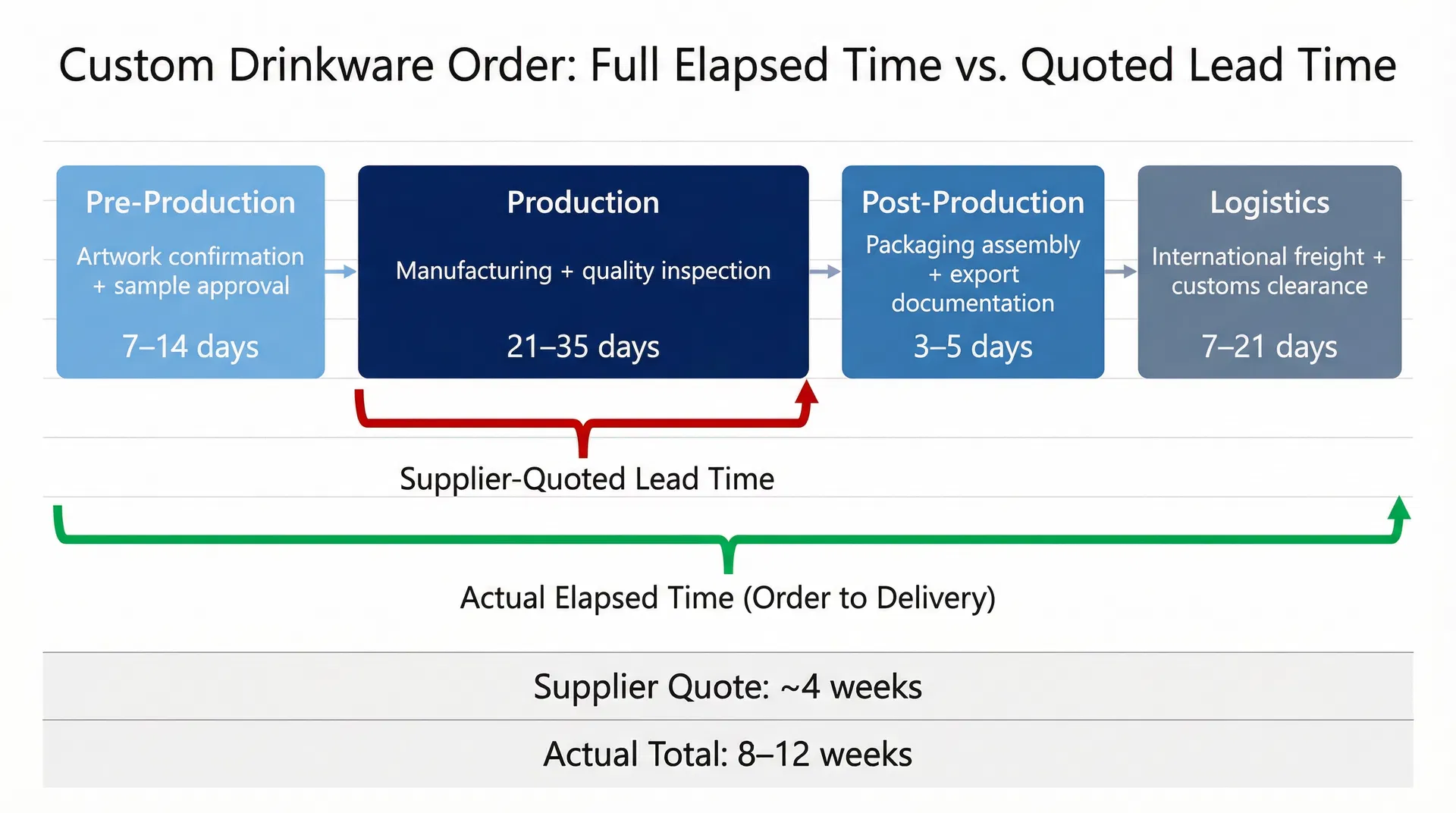
When a supplier quotes four weeks for a custom stainless steel tumbler order, that four weeks typically refers to production time — the period from confirmed purchase order and approved artwork to finished goods ready for outbound shipment at the factory. It does not include the time required to reach that starting point, and it does not include the time required to travel from that ending point to the recipient's desk. Both of those phases have their own timelines, and both are invisible in the quoted number.
The pre-production phase is where the most time is lost, and where the losses are most difficult to predict. Before production can begin, the artwork needs to be submitted, reviewed, and confirmed by the factory. For a straightforward logo on a standard tumbler, this might take two to three days. For a multi-color design, a custom color match, or a logo that requires reformatting for the specific decoration method being used, the artwork confirmation can take a week or more. Once artwork is confirmed, the factory typically produces a physical sample or a detailed digital proof for buyer approval. If the buyer approves immediately, this adds two to three days. If the buyer requests changes — which happens in the majority of first-time orders — each revision cycle adds another two to three days. Two revision rounds, which is not unusual, add four to six days to a timeline that the procurement team was not counting.
The post-production phase is the second invisible timeline. After production is complete, the finished tumblers need to be assembled into their final packaging configuration, inspected, and prepared for export. If the packaging is a custom gift box — which is the appropriate choice for a relationship gift program — the packaging assembly adds two to three days. Quality inspection, if conducted properly, adds another one to two days. Export documentation and customs clearance at origin adds one to two days. None of this is unusual, and none of it is included in the supplier's quoted production lead time.
The logistics phase is the most variable and the most frequently underestimated. International freight from manufacturing origin to U.S. destination ranges from five to seven days for air freight to twenty-one to thirty-five days for ocean freight. The choice of shipping mode is typically determined by the budget, but in programs where the order was placed too late, the procurement team discovers that the only way to meet the deadline is to use air freight — at a cost that was not in the original budget and that may not be approved in time to prevent further delays. The freight cost escalation is a secondary consequence of the original timeline miscalculation, but it is often the point at which the problem becomes visible to budget holders who were not tracking the order status.
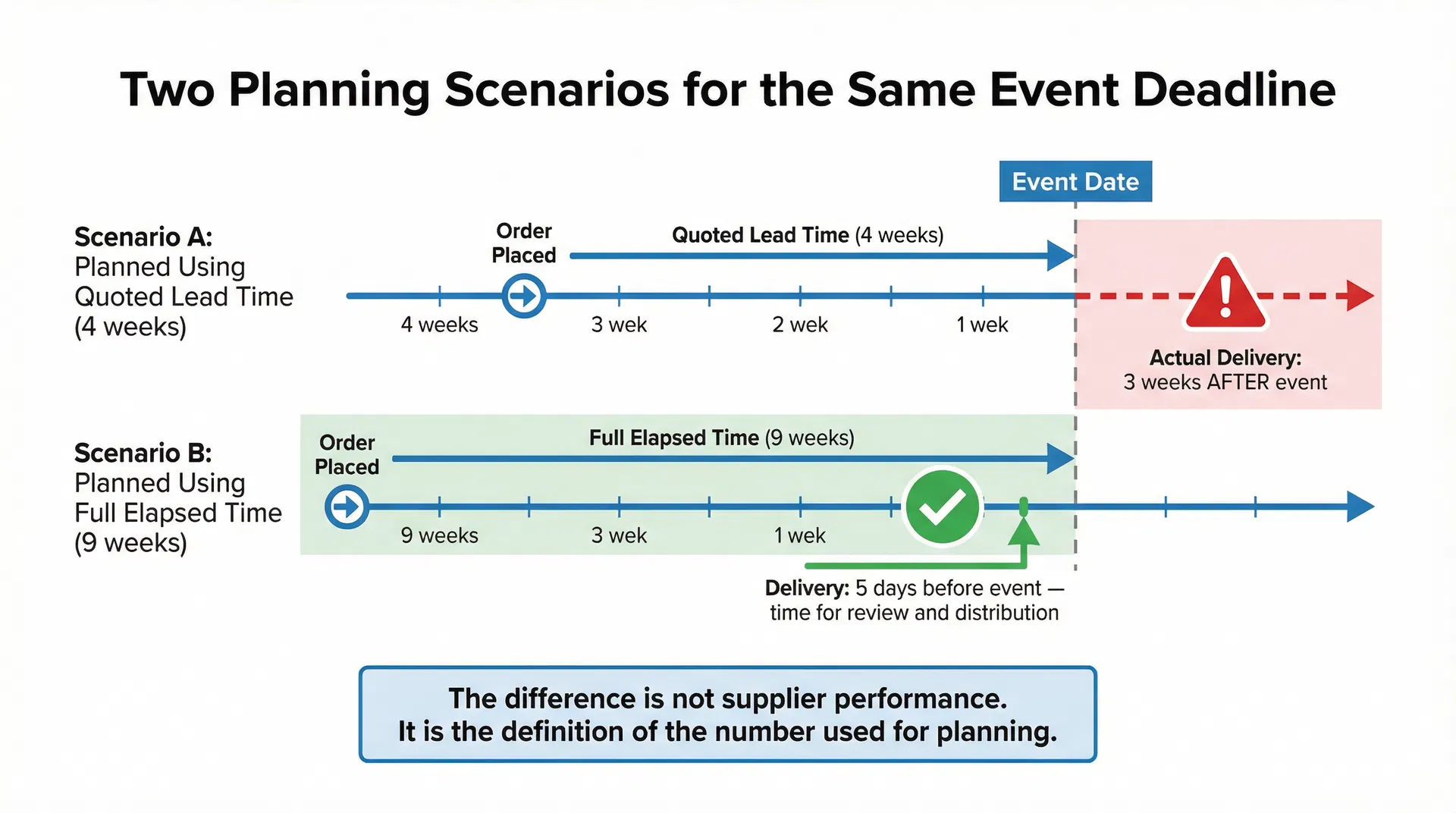
The compounding structure of these phases is what makes the quoted lead time boundary trap particularly damaging. Each phase has its own minimum duration, and the phases are sequential: production cannot begin until pre-production is complete, shipping cannot begin until post-production is complete. A four-week production quote with two weeks of pre-production, one week of post-production, and two weeks of ocean freight produces an eight-to-nine-week actual elapsed time. An organization that placed the order six weeks before the event deadline, believing the four-week quote provided adequate buffer, will receive the tumblers one to three weeks after the event has concluded.
The practical correction is not complicated, but it requires a different question to be asked at the point of supplier engagement. Instead of asking "what is your lead time," the question that produces a usable number is "how many calendar days from today until the goods are delivered to our U.S. address, assuming we submit approved artwork within 48 hours." That question forces the supplier to account for all phases, including the ones they do not normally include in a quoted lead time. The answer will typically be significantly longer than the production lead time alone, and it will be the number that actually matters for planning purposes.
For organizations running annual corporate gift programs with custom stainless steel drinkware, the timing question connects directly to the broader question of which gift types best serve different relationship objectives — because the answer to that question determines the level of customization required, and the level of customization required determines how much pre-production time needs to be built into the schedule. A standard logo engraving on a catalog tumbler has a shorter pre-production phase than a custom color match on a proprietary shape. The gift type decision and the timeline decision are not independent.
The most consistent pattern in programs that experience delivery failures is not that the supplier was slow or that logistics were unpredictable. It is that the procurement team calculated their order deadline using the supplier's quoted production lead time as if it were the total elapsed time from order placement to delivery. The supplier's number was accurate for what it described. The problem was that what it described was not the same thing as what the procurement team needed to know.