Supplier Evaluation
Custom Drinkware Supplier Evaluation Checklist for B2B Buyers
B2B 客製飲品容器供應商評估清單,涵蓋樣品、品質控管、工廠產能、食品接觸文件、客製包裝、交期、報價與補貨能力。
A custom drinkware supplier evaluation checklist is a documented way to compare suppliers on product fit, quality evidence, production capacity, communication, compliance, packaging, delivery control, and total cost. It prevents a procurement team from selecting a supplier because of a low unit price while overlooking a weak sample process, unclear materials, unstable lead time, or poor replenishment support.
Quick answer: Evaluate a custom drinkware supplier in eight categories: specification fit, sample control, quality system, factory capability, food-contact documentation, customization and packaging, delivery reliability, and commercial transparency. Score the evidence—not the sales presentation—and require the supplier to identify assumptions, exclusions, change-control rules, and the person accountable for the order before comparing quotations.
The best supplier is not automatically the largest factory or the cheapest quote. The right supplier is the one that can repeatedly produce the approved configuration, document what is being supplied, communicate exceptions early, and support the business after the first shipment. A corporate drinkware program should therefore evaluate the supplier as an operating system rather than as a catalog page.
What is a custom drinkware supplier evaluation?
A supplier evaluation is a structured review of whether a manufacturer or sourcing partner can meet a defined drinkware requirement over the full order lifecycle. The lifecycle includes inquiry, specification, quotation, sampling, artwork approval, production, inspection, packaging, shipping, receiving, claims, and replenishment.
A supplier should be evaluated against the exact program. A one-time conference order has different risks from an employee welcome-kit program that replenishes every month. A premium executive gift has different tolerances from a high-volume giveaway. A direct-to-recipient parcel requires different packaging evidence from a pallet shipped to one warehouse.
The evaluation should distinguish claims from proof. “High quality” is a claim. An approved sample, component list, inspection report, defect log, and corrective-action record are evidence. “Fast delivery” is a claim. A phase-by-phase timeline with assumptions, historical ranges, and escalation ownership is stronger evidence.
| Evaluation category | Core question | Evidence to request |
|---|---|---|
| Specification fit | Can the supplier produce the exact body, lid, material, logo, and package? | Technical sheet, sample, drawings, component list |
| Sample control | Can approval decisions be translated into production requirements? | Sample revision, approval record, tolerances, artwork file |
| Quality system | How are defects detected, classified, corrected, and prevented? | QC checklist, sampling plan, inspection report, corrective action |
| Factory capability | Can the production line support the quantity and configuration? | Process description, capacity assumptions, equipment or line evidence |
| Compliance | Can the supplier identify food-contact components and use limits? | Material records, declarations, applicable authorization basis |
| Delivery control | What exactly does the quoted lead time include? | Phase timeline, shipping assumptions, contingency and escalation plan |
| Commercial clarity | What is included in the price and what can change it? | Itemized quote, MOQ, tooling, packaging, freight, payment terms |
| Continuity | Can the supplier support a reorder or approved replacement? | SKU record, revision history, spare-part and replenishment process |
How should a buyer compare supplier specifications?
Start by sending every shortlisted supplier the same RFQ. The request should define the product body, capacity, wall construction, lid type, materials, colors, decoration, packaging, quantity, ship-to locations, target date, beverage use, required documents, and acceptance expectations. A product photograph is not a complete specification because it does not define hidden components, tolerances, or packaging.
Ask the supplier to identify every assumption. If the supplier assumes a standard lid, stock color, shared mold, printed insert, or factory-selected packaging, that assumption should appear in the quote. An assumption hidden inside a low price becomes a change order later.
Compare like with like. One quote may include an individual box, logo setup, inspection, and delivery to one U.S. address. Another may quote an undecorated unit at the factory gate. The lower unit price is not necessarily the lower landed cost. Normalize the quote into product, customization, packaging, quality, logistics, duties or taxes where applicable, and other required services.
The custom water bottle bulk procurement guide explains why material, lid, decoration, compliance, MOQ, packaging, and landed cost must be evaluated together. The same principle applies to tumblers, mugs, and multi-component drinkware programs.
What sample evidence should a supplier provide?
Require a physical sample path that matches the decision being made. A stock sample can demonstrate general shape but cannot prove the final logo or packaging. A digital mockup can show intended artwork but cannot prove seal performance or physical color. A decorated prototype can show branding but may not represent the final production process. A pre-production sample is the most useful release gate when it uses the final configuration.
Ask the supplier to label each sample with a revision or reference number. The approval record should identify the body, lid, gasket, accessories, material, finish, logo process, logo position, packaging, and test results. If a supplier cannot explain how an approved sample is controlled during production, the sample is not yet a reliable procurement control.
Test the sample as recipients will use it. Check sealing in realistic orientations, lid operation, cleaning access, carrying, drinking comfort, capacity, and packaging fit. If the program uses hot beverages, cold beverages, a straw, a carry loop, or direct-to-recipient parcel shipping, include those conditions in the evaluation.
The custom drinkware sample approval checklist provides a detailed approval structure. A supplier that welcomes documented sample criteria is generally easier to manage than one that relies on informal “looks good” approval.
How should a buyer evaluate supplier quality control?
Evaluate quality control by asking what the supplier checks, when it checks it, how it records defects, and what happens when the lot fails. A credible answer should cover incoming materials, in-process assembly or decoration, final inspection, packaging, and corrective action. It should also distinguish critical, major, and minor defects.
Ask for a sample inspection report with sensitive commercial details removed if necessary. The report should show the inspected lot, sample size or inspection method, tested characteristics, results, photographs, defect classification, and release decision. A generic quality certificate without lot-specific evidence is a weaker signal than a practical inspection record.
Confirm that the approved sample and specification are used together. Quality inspectors need measurable references for capacity, dimensions, logo position, color, lid fit, leakage, packaging, and component presence. A report that only states “appearance acceptable” does not protect the brand from a wrong artwork revision or a shifted logo.
The custom drinkware quality control inspection checklist explains how to structure traceability, material checks, functional tests, defect classes, packaging inspection, and sampling. Supplier evaluation should review whether the vendor can execute those controls consistently, not simply whether it owns a certificate.
What factory capability questions matter for B2B drinkware?
Capacity should be evaluated against the exact configuration and delivery window, not a general statement such as “we can produce 100,000 pieces.” Ask which line, body, lid, decoration process, packaging operation, and inspection resources will support the order. A supplier may have sufficient total capacity but insufficient capacity for a special lid, custom color, individual packaging, or multiple SKUs running in one window.
Clarify the difference between theoretical capacity and available capacity. Theoretical capacity describes what a line could produce under ideal conditions. Available capacity accounts for existing orders, setup changes, maintenance, material arrival, artwork approval, quality holds, and the buyer’s requested ship date.
Ask how the supplier handles multi-SKU orders. Changing body colors, lid types, logo files, or packaging inserts can create setup and inspection windows. A supplier that treats every SKU as interchangeable may understate the schedule. A supplier that provides a phase timeline and identifies changeover constraints gives procurement a more realistic basis for planning.
Factory capability also includes escalation. Ask who decides when a component is unavailable, a sample fails, a production lot is delayed, or a shipping carton is damaged. A named account owner and a defined escalation path reduce the time between an exception and a business decision.
How should food-contact documentation be evaluated?
Request component-level documentation for every part that contacts the beverage. The stainless-steel body is only one component. The lid, gasket, straw, mouthpiece, coating, colorant, adhesive, and internal surface may also matter depending on the configuration and intended use.
The FDA describes a food contact substance as a substance that comes into contact with food without being intended to have a technical effect in the food. Under U.S. law, a food contact substance that is a food additive must be authorized for that use before marketing.1 The supplier evaluation should therefore ask what each food-contact component is, what intended use is covered, and what limitations apply.
Use conditions matter. A room-temperature water bottle and a hot-fill beverage container may not have the same documentation requirements. FDA reference tables distinguish beverage categories and conditions such as room-temperature filling, refrigerated storage, and hot filling.2 A supplier that gives one generic statement for every use case should be asked to clarify the scope.
Do not ask for or publish a vague “FDA approved product” claim when the evidence is a supplier declaration, a material record, or an authorization relevant to a particular component and use. Record the document name, issuing party, revision or date, covered component, intended use, and any limitation. Regulatory review should be escalated to qualified counsel or a compliance specialist when the program has unusual materials, temperatures, or claims.
How should customization and packaging capability be scored?
Customization capability should be judged by repeatability and control, not by the number of decoration methods listed in a catalog. Ask which process will be used on the specified substrate, how artwork is approved, how color is matched, how logo position is measured, and how decoration durability is tested.
A supplier should explain how it controls artwork revisions. The file name, color reference, placement, scale, and approval date should be tied to the production order. If a supplier cannot tell which artwork revision will reach the line, the risk is not solved by a low setup fee.
Packaging must be evaluated as part of the product. Ask for the individual package, insert, accessory arrangement, master carton, labels, unit count, stacking direction, and parcel or pallet handling assumptions. A supplier that can decorate a tumbler but cannot protect it through the chosen distribution channel is not providing a complete solution.
The packaging coordination guide explains why late packaging decisions can create quality and delivery problems. Include packaging samples and transit checks in the supplier evaluation when the order is a gift, welcome kit, executive package, or direct shipment.
How should lead time and delivery reliability be evaluated?
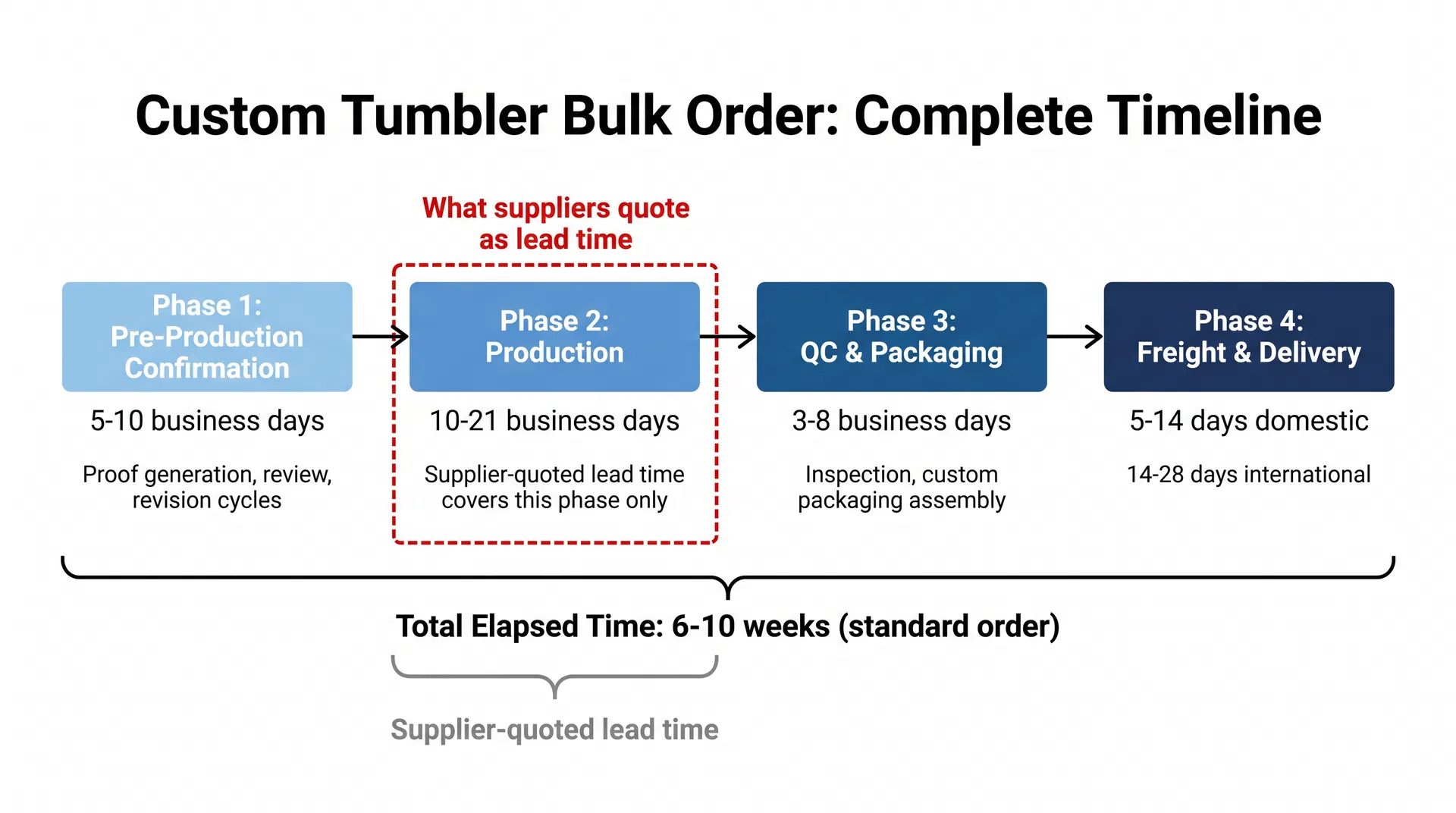
Ask the supplier to divide lead time into specification confirmation, artwork approval, sampling, material preparation, production, inspection, packaging, export handling, freight, customs, domestic delivery, and receiving. “Production lead time” is only one part of the date the business cares about.
Require the supplier to state which phase begins the clock. Some quotes start after deposit, some after artwork approval, and some after a pre-production sample is accepted. These starting points are not interchangeable. The quoted lead-time boundary guide explains how an apparently short quote can exclude the phases that determine the actual arrival date.
Ask for the supplier’s response when a phase moves late. A useful delivery plan includes a decision date, responsible owner, alternative freight or packaging options, and a communication cadence. It should also identify what cannot be accelerated, such as tooling, curing, material arrival, inspection, or customs processes.
For recurring programs, evaluate replenishment reliability separately from the first order. Ask whether the supplier retains the approved configuration, whether the original lid and decoration remain available, how substitutions are approved, and what minimum quantity applies to a reorder. The B2B drinkware replenishment strategy connects supplier continuity to inventory and SKU control.
How should supplier quotes be scored?
Use a weighted scorecard only after every supplier answers the same questions and submits comparable evidence. A simple starting model can assign the greatest weight to specification and quality fit, followed by delivery control, compliance, commercial clarity, and communication. The weights should reflect the program’s actual risk.
| Category | Suggested starting weight | What earns a strong score |
|---|---|---|
| Product and sample fit | 20% | Exact configuration, clear sample revisions, measurable tolerances |
| Quality control | 20% | Lot traceability, functional tests, defect classes, corrective action |
| Delivery control | 15% | Phase timeline, assumptions, contingency, escalation owner |
| Compliance documentation | 15% | Component-level records matched to intended use |
| Customization and packaging | 10% | Repeatable artwork, finish, inserts, cartons, transit evidence |
| Total landed cost | 10% | Itemized quote with exclusions and change triggers |
| Communication and continuity | 10% | Named owner, response process, SKU and reorder records |
These percentages are a planning model, not a universal procurement rule. A regulated, hot-beverage, or executive-gifting program may give compliance or appearance a higher weight. A high-volume event may give capacity and packaging more weight. The important discipline is to define the weights before seeing which supplier has the lowest price.
Avoid false precision. A supplier with a score of 84.2 is not necessarily better than one with 83.7 if the underlying evidence is inconsistent. Use the scorecard to expose gaps and trigger questions. Require a written explanation for any very low score, missing document, unresolved sample deviation, or price assumption.
What are red flags in a custom drinkware supplier evaluation?
The clearest red flag is a supplier that answers commercial questions quickly but cannot answer configuration, testing, documentation, or change-control questions. Other red flags include a quote that omits packaging and freight assumptions, a sample that is not labeled or traceable, a request to approve from photographs only, a generic “food safe” claim without component scope, and a lead time that begins at an undefined point.
Be cautious when a supplier changes the lid, material, coating, logo process, or package without reopening approval. A substitute may be reasonable, but it must be identified, tested, documented, and approved. An unannounced substitution is a process failure even if the final unit looks acceptable.
A supplier that refuses to provide any inspection evidence may still be able to produce a product, but the buyer has less control over the outcome. The appropriate response is not automatically rejection; it is to define the missing evidence, add an inspection requirement, or reduce the order risk before committing.
Final supplier evaluation checklist
| Decision area | Questions to answer before purchase |
|---|---|
| Exact product | Is the body, lid, material, capacity, color, and accessory set defined? |
| Sample | Is the approved physical configuration traceable by revision? |
| Branding | Is the artwork, placement, color, and durability method measurable? |
| Quality | Are inspection stages, defect classes, sampling, and corrective action defined? |
| Compliance | Are food-contact components and intended-use documents identified? |
| Packaging | Is the unit and master-carton configuration approved for the distribution channel? |
| Lead time | Does the timeline include all phases through receiving? |
| Commercials | Are MOQ, tooling, packaging, freight, duties, payment, and change triggers clear? |
| Continuity | Can the supplier support a reorder, replacement part, or approved substitution? |
| Accountability | Is a named owner responsible for exceptions and release decisions? |
A supplier evaluation is complete when the procurement team can explain not only why a supplier was selected, but also what evidence supports the selection and what conditions would trigger a review. The goal is not to eliminate every manufacturing risk. The goal is to make the important risks visible while the business still has options.
The strongest supplier relationship begins with a clear specification, a disciplined sample, a realistic schedule, documented quality evidence, and transparent commercial assumptions. Those controls improve the first order and make the next order easier to repeat.
References