Procurement Strategy
B2B Drinkware Replenishment Strategies: Safety Stock and Reorder Points
B2B 品牌飲品容器補貨策略,涵蓋安全庫存、再訂購點、替換瓶蓋與零件、SKU 控制、多地配送、供應商報告與食品接觸合規。
B2B drinkware replenishment is the process of keeping the correct branded bottles, tumblers, lids, gaskets, packaging, and decoration configurations available after the first corporate order. It is not simply a repeat purchase. A replenishment program must preserve the approved product specification while responding to new hires, events, damaged units, office expansions, seasonal demand, and changes in delivery lead time.
Quick answer: The most reliable B2B drinkware replenishment strategy is to separate demand into planned usage, replacement demand, and launch or event demand; maintain a SKU-level record for every body, lid, color, logo, and packaging configuration; set a reorder point using expected demand during replenishment lead time plus safety stock; and hold a controlled reserve of compatible replacement parts. Reorder only after the current stock position—not just the warehouse count—falls below the trigger.
This approach prevents two common failures. The first is a stockout that forces a rushed substitute with the wrong lid, color, logo size, or packaging. The second is excess inventory that looks available in a spreadsheet but cannot be used because it belongs to an old brand identity, an obsolete product revision, or a different office program. Procurement, HR, marketing, fulfillment, and finance should therefore treat replenishment as a controlled product system rather than an informal reorder email.
What is B2B drinkware replenishment?
B2B drinkware replenishment is the planned replacement or restocking of branded drinkware after an initial purchase. It can include complete bottles or tumblers, spare lids, gaskets, straws, mouthpieces, presentation boxes, inserts, shipping cartons, and undecorated reserve units. The objective is continuity: the next shipment should match the approved product, branding, quality standard, and delivery requirement unless a change is intentionally approved.
The word “replenishment” covers several different demand patterns. A company may order a steady quantity every month for employee onboarding. It may order a large quantity before a sales conference. It may need a small emergency batch after a warehouse incident. It may also need replacement components because a lid was lost while the stainless-steel body remains usable. These demands have different forecast accuracy, lead-time exposure, and minimum-order implications.
A replenishment record should identify the finished-product SKU and the component relationships. For example, a 20-ounce bottle with a black flip-top lid, white laser-engraved logo, and individual kraft box should not be grouped with the same bottle body carrying a straw lid or a different artwork version. The supplier may consider them related items, but the end user and procurement team experience them as different products.
Why do corporate drinkware programs run out of stock?
Corporate drinkware stockouts usually result from incomplete demand definitions rather than a single supplier mistake. The initial order may cover the event headcount but omit new hires, breakage, late registrations, executive replacements, and samples for regional offices. The inventory record may count units without distinguishing the lid, logo version, or packaging format. Finally, the reorder decision may begin after stock reaches zero even though production and freight require several weeks.
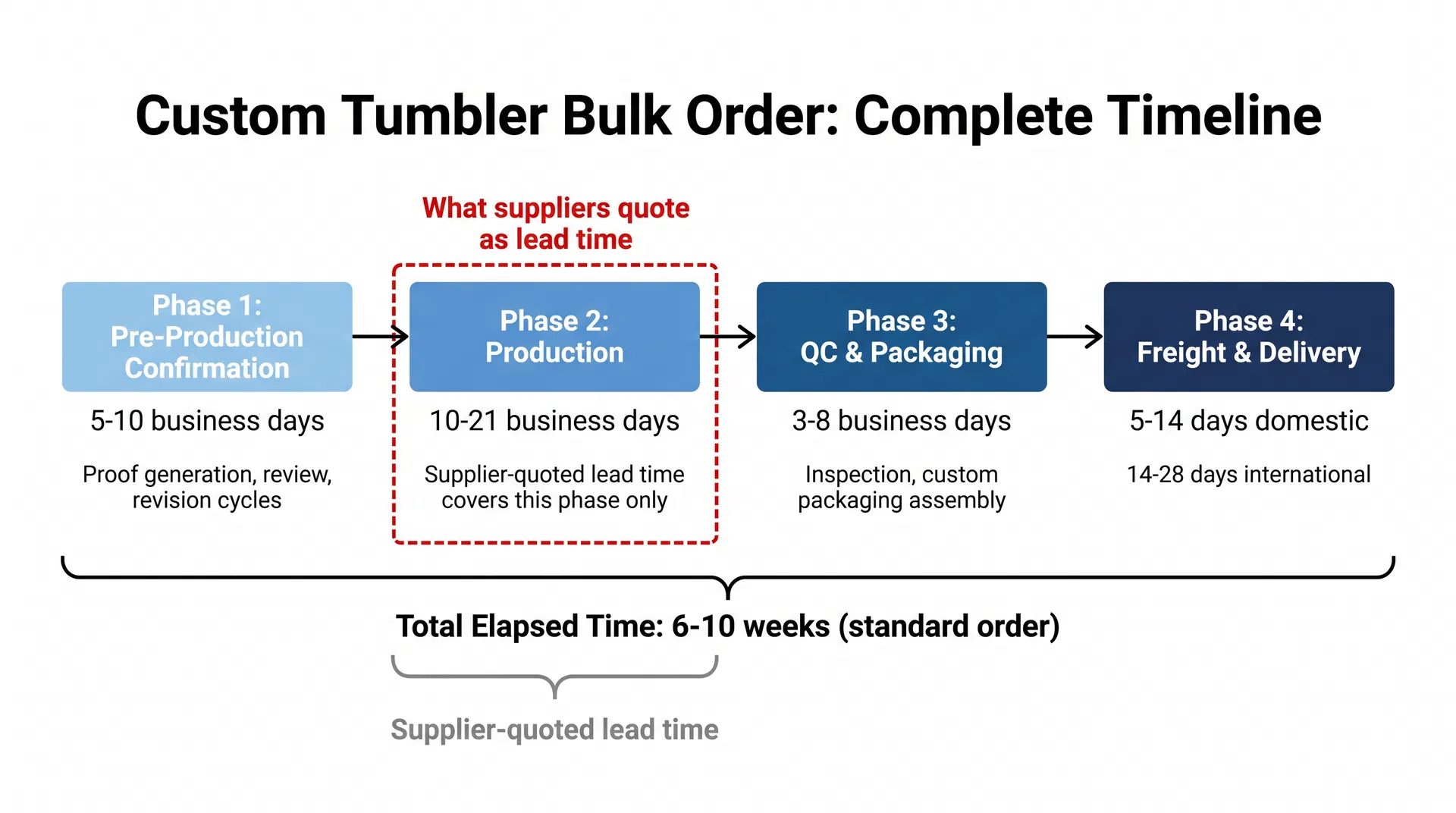
A quoted production lead time is not the same as the replenishment lead time. The full interval may include specification confirmation, artwork approval, sample review, production, inspection, packaging, export handling, international freight, customs, domestic distribution, and internal receiving. The bulk custom bottle procurement guide explains why the arrival date must be planned across these boundaries rather than from a supplier’s production estimate alone.
Supplier continuity also depends on the approved configuration. If the original lid is discontinued, the substitute may require a new fit test, a different carton insert, a revised logo position, and a new internal approval. A procurement team that waits until the last units are being distributed has little time to complete those checks.
What is the difference between safety stock and a reorder point?
Safety stock is the extra inventory held to absorb uncertainty in demand or replenishment. The reorder point is the inventory position at which a new order should be released. Safety stock is a buffer; the reorder point is a trigger that includes expected usage while the next order is in transit.
A practical starting formula is:
Reorder point = average demand during replenishment lead time + safety stock
If a company uses 18 complete drinkware units per business day, the replenishment lead time is 30 business days, and the approved safety stock is 120 units, the reorder point is 660 units. The calculation is not a prediction that exactly 660 units will be consumed. It is a control signal that says a new order should begin while enough inventory remains to cover the expected lead-time demand and known uncertainty.
The formula should use the right unit of measure. If a program distributes complete bottles, the finished-product reorder point should be measured in complete bottles. If the company also holds spare lids, the lid reorder point should be measured in compatible lids. A spare-lid reserve cannot be used to fulfill a complete-bottle requirement unless the body, decoration, packaging, and assembly plan are also available.
A simple formula is useful, but it should not create false precision. Demand may be irregular, supplier lead time may vary by season, and an annual conference can distort the average. Record the assumptions beside the number: the demand window, business-day convention, lead-time basis, service objective, and whether the reserve includes replacement or event demand.
How should a company calculate B2B drinkware safety stock?
Calculate safety stock from the risks that matter to the program. These risks include demand variability, lead-time variability, artwork approval delays, customs or freight disruption, damage during receiving, and the time required to approve a replacement configuration. A small office onboarding program may need a modest reserve, while a national campaign with a fixed launch date may need a larger reserve or a second approved source.
A practical method is to define a service horizon. Ask how many additional days of demand the business wants to protect, then multiply that horizon by average daily usage. A company using 12 units per business day that wants 15 protected business days would begin with 180 units of demand-based safety stock. Add a separate allowance for known replacement demand if damage and loss are not already included in usage.
The important governance decision is not the exact first number. It is the review rule. Recalculate usage after each major campaign, compare actual supplier lead time with the quoted lead time, and adjust the reserve when the operating conditions change. A safety stock number that was appropriate for a single office may be inadequate after the program expands to remote employees and multiple fulfillment locations.
Do not hide slow-moving inventory inside safety stock. Safety stock should be compatible, usable, and intentionally held. Old artwork, discontinued colors, mismatched lids, and damaged presentation boxes are not protection against a stockout. They are separate disposition or write-off issues that should remain visible.
Which items should be stocked as complete units and which as spare parts?
Stock complete units when the recipient needs a ready-to-distribute gift, when decoration is difficult to reproduce in small quantities, or when the product is tied to a specific event date. Stock spare parts when a small component can restore the value of a more expensive or highly branded body without replacing the entire item.
A typical replacement structure may include complete bottles, complete tumbler lids, gaskets, straws, mouthpieces, and packaging materials. The correct mix depends on failure patterns. If users frequently lose lids but rarely damage the body, a lid reserve may deliver better continuity than additional complete bottles. If the logo is applied to a lid and the lid is not interchangeable, the reserve must match the exact decoration and color specification.
| Inventory layer | Stock when | Main control question |
|---|---|---|
| Complete decorated unit | New-hire, event, or executive demand is scheduled | Does the unit match the approved body, lid, logo, and packaging? |
| Undecorated body | Decoration can be repeated reliably and small-batch decoration is practical | Can the approved logo and finish be reproduced without a new setup? |
| Spare lid | Lid loss or damage is common and the lid is interchangeable | Does it fit the exact bottle revision and gasket system? |
| Gasket or seal | The component is removable and is a frequent wear or loss item | Is the material, size, and intended food-contact use documented? |
| Straw or mouthpiece | The program uses multi-part straw lids | Can the component be cleaned, replaced, and identified by SKU? |
| Presentation packaging | Individual distribution or gifting is part of the program | Does the insert fit the current lid and accessory configuration? |
The custom lid comparison guide shows why a lid is a functional system rather than a cosmetic add-on. Replenishment planning should preserve the opening mechanism, seal, cleaning design, and user experience that were approved in the first order.
How should procurement control multiple drinkware SKUs?
Use a configuration record that describes every variable capable of changing fit, function, appearance, or fulfillment. At minimum, record the supplier model, body material, capacity, finish, body color, lid family, lid color, gasket or straw configuration, decoration method, artwork revision, packaging format, and approved sample reference.
Give every sellable or distributable configuration a stable internal SKU. Do not rely on a product name such as “blue bottle” because that label can conceal several versions. A SKU should remain traceable when the marketing campaign, department, office, or supplier contact changes. Link the SKU to photos of the body, lid underside, open position, logo placement, package insert, and master carton marking.
A change-control rule is equally important. A supplier should not substitute a lid, finish, material, carton, or decoration method because the new option appears visually similar. The change may affect food-contact documentation, leak performance, cleaning instructions, carton fit, or brand consistency. If a substitute is necessary, create a new approval record and identify whether it is compatible with existing replacement parts.
The custom logo water bottle guide provides the broader procurement context for materials, decoration, compliance, packaging, MOQ, and landed cost. Replenishment adds one further requirement: the specification must remain stable enough to support future orders.
How should a company plan replenishment for employee onboarding?
For employee onboarding, forecast demand from the hiring plan and distribution calendar instead of using last year’s total alone. Separate confirmed hires, expected hires, transfers, replacements, and delayed start dates. A monthly or quarterly forecast is usually more actionable than an annual number because it reveals when inventory must arrive at the warehouse or fulfillment center.
Define a standard welcome-kit configuration. If remote employees receive a bottle by parcel and office employees receive it in person, the drinkware may be identical while the packaging and fulfillment requirements differ. Keep the finished-product SKU separate from the distribution method so the organization can change shipping operations without accidentally changing the approved bottle.
Hold a launch reserve before the hiring cycle begins. If the organization cannot tolerate a new employee receiving a late or mismatched kit, the reserve should cover the time needed to react to forecast error and supplier delay. If the program permits a temporary substitute, document the acceptable substitute before the shortage occurs. Emergency decisions made under deadline pressure tend to create inconsistent branding and unplanned freight cost.
How should replenishment work for conferences and seasonal events?
Event replenishment should be managed backward from the in-hand date. Start with the date the products must be received at the event location, then subtract domestic distribution, freight, quality inspection, packaging, production, artwork approval, and internal review. Add an explicit buffer for weekends, holidays, sample corrections, and address changes.
Do not order only to the registration count. Include staff, speakers, VIP recipients, late registrations, damage, shipping loss, and post-event follow-up. The reserve should be visible in the event budget so that it is not mistaken for excess purchasing. If the event has several locations, define whether the reserve is held centrally or allocated to each site.
When different events use different logos, treat the artwork version as a separate demand stream. Combining the quantities may create an attractive total MOQ while still producing small and expensive runs for each logo. Ask the supplier to show the minimum order and setup cost per artwork version, lid color, and packaging format.
What should a replenishment supplier report every month?
A useful supplier report connects inventory, production, quality, and logistics. It should show open purchase orders, confirmed quantities, planned production dates, inspection status, packed quantities, shipping status, expected arrival, and any exception that could change the arrival date. It should identify the exact SKU rather than describing an order as “tumblers.”
The report should also show component availability. A complete unit can be delayed because a lid, gasket, insert, or carton is missing even when the body is finished. Ask the supplier to report shortages at the component level and to identify whether the issue affects all units or only one configuration.
Quality information should remain linked to the approved sample. Record inspection findings for leaks, lid function, decoration placement, color, finish, packaging, and carton condition. If a defect is accepted as a deviation, document who approved it and whether the deviation applies only to that lot or becomes a permanent specification change.
For multi-location fulfillment, include the destination and quantity by site. A central total can look complete while one regional office is short and another has excess. Replenishment visibility must therefore operate at both the program level and the location level.
How does compliance affect replacement lids and drinkware parts?
Replacement parts should be evaluated as components that may contact beverages, not as generic accessories. The FDA defines a food contact substance as a substance that comes into contact with food without being intended to have a technical effect in the food. This includes food packaging and components.1
FDA’s inventory explains that food contact substances are authorized by identity, intended use, and conditions of use. The presence of a material in an inventory does not mean every application is automatically authorized; the applicable regulation and conditions must be reviewed.2 For replenishment, request documentation that identifies the actual material and intended use for the gasket, straw, mouthpiece, lid, coating, or other beverage-contact component.
Do not assume that a replacement part is compliant simply because the original finished product was accepted. A changed supplier, polymer, colorant, adhesive, temperature range, or intended beverage can change the documentation required for the component. Keep material and compliance records connected to the SKU and revision level.
What is the most reliable B2B drinkware replenishment workflow?
A controlled workflow has five stages. First, define demand by use case and location. Second, freeze the approved product and component specification. Third, calculate inventory position and compare it with the reorder point. Fourth, release the order early enough to cover the complete replenishment lead time. Fifth, inspect, receive, reconcile, and update the forecast.
Inventory position is more useful than physical stock alone. A practical inventory-position calculation is:
Inventory position = on-hand usable stock + confirmed inbound stock − committed demand
Exclude quarantined, damaged, obsolete, or incompatible units from usable stock. Treat inbound stock as confirmed only when the quantity, configuration, and expected arrival are credible. Committed demand includes approved requisitions, scheduled events, and reserved kits that have not yet been distributed.
The final receiving step should verify both quantity and identity. Count complete units and components separately. Confirm the lid, gasket, decoration, packaging, and carton markings against the approved record. Update the inventory system with the actual received quantity and any quality hold instead of closing the purchase order against the supplier’s packing list alone.
Final decision framework for B2B drinkware replenishment
A strong replenishment program begins before the first order is delivered. Define the product as a configuration, not a generic bottle. Separate planned usage from replacement and event demand. Calculate a reorder point from lead-time demand plus an intentional safety stock. Track inventory position rather than on-hand quantity. Hold compatible replacement parts where they can prevent complete-unit failure. Finally, keep the product, compliance, quality, and packaging records connected to the same SKU and revision.
The best replenishment strategy is not the one with the largest reserve. It is the one that protects the business from the specific failures it cannot tolerate while keeping obsolete and incompatible inventory visible. When procurement, marketing, HR, operations, and the supplier use the same specification and trigger rules, branded drinkware remains consistent across onboarding, events, offices, and future reorders.
References