Bulk Procurement
Custom Water Bottles with Logo in Bulk: B2B Buying Guide
批量客製 Logo 水瓶的 B2B 採購指南,涵蓋材質、瓶蓋系統、裝飾工藝、食品接觸合規、包裝、MOQ、總到岸成本與補貨規劃。
Quick answer: When ordering custom water bottles with a logo in bulk, choose the bottle around the recipient’s use environment before comparing unit prices. Specify the vessel material, capacity, lid system, coating, decoration method, packaging, testing evidence, delivery pattern, and reorder plan in writing. For corporate programs that require long service life and a premium finish, an insulated stainless-steel bottle with a mechanically reliable lid and laser-engraved mark is often the safest baseline. Event, school, fitness, and high-volume programs may justify different materials and imprint methods.
The phrase “custom water bottles with logo bulk” sounds like a product search. For a procurement team, it is a system-design problem.
A buyer may begin with a catalog image and a target quantity, but the delivered result depends on decisions that are not visible in that image. The bottle body must fit the recipient’s daily environment. The lid must match how the bottle will travel. The coating must accept the selected decoration. The packaging must protect the product without creating unnecessary fulfillment cost. The compliance documents must apply to the actual material and intended use—not merely to a similar item from the supplier’s catalog.
When these decisions are made together, a bulk order becomes repeatable. When they are handled one at a time, the team often discovers the conflict after artwork approval or production has started.
First define what kind of custom water bottle you are buying
This guide addresses reusable drinkware customized with a company, school, team, event, or program logo. It does not address single-use bottled water with a custom paper or film label. Search results frequently mix those two product categories even though their supply chains, shelf-life issues, shipping economics, and environmental considerations are different.
A reusable branded bottle is a durable product. Its perceived value is shaped by repeated handling, cleaning, transport, and temperature changes. That makes the lid interface, interior surface, coating, logo durability, and replacement strategy more important than they would be for a disposable beverage container.
The procurement team should therefore begin with four questions: Who will use the bottle? Where will it be carried? What beverage and cleaning conditions will it face? How long should the product continue representing the brand? The answers narrow the specification more effectively than beginning with color or price.
Match the bottle format to the use environment
There is no universal “best” bottle. A 32-ounce insulated bottle may be ideal for a field crew and inconvenient for a conference attendee. A lightweight plastic sports bottle may suit a one-day event and underperform as an executive onboarding gift. A glass bottle can communicate clarity and design sensitivity in a controlled office environment but introduces a different breakage and parcel-shipping risk.
| Program context | Practical starting format | Specification priority | Frequent buying error |
|---|---|---|---|
| Corporate onboarding | 18–24 oz insulated stainless-steel bottle | Finish consistency, leak resistance, understated branding | Choosing by gift-box appearance before testing daily carry |
| Conference or event | Lightweight 20–24 oz bottle | Fast distribution, simple closure, visible imprint | Buying a complex lid that slows packing and creates lost parts |
| Field and construction team | 24–32 oz durable bottle | Impact resistance, grip, one-hand access, capacity | Selecting a narrow, delicate finish designed for desk use |
| Fitness or recreation program | 20–28 oz squeeze or sports format | Flow rate, easy cleaning, secure cap | Treating “BPA-free” as a complete material specification |
| School or campus program | Durable bottle sized for bags | Closure security, name identification, age-appropriate use | Ignoring replacement lids and ownership identification |
| Executive or client program | Premium insulated bottle | Refined finish, restrained logo, presentation packaging | Maximizing imprint size and making the product feel promotional |
This context-first approach prevents false comparisons. Two bottles with the same capacity can serve different programs because the diameter, mouth opening, lid mechanism, carry loop, wall construction, coating, and packaging footprint are different.
For teams comparing bottles with tumblers, the custom tumblers bulk order guide explains the parallel decisions around material, decoration, sample approval, and production timing. The critical distinction is portability: a bottle is usually expected to close securely and travel, so the lid system carries more operational risk.
Treat the lid as a product system, not an accessory
In bulk water-bottle programs, buyers often spend most of the evaluation time on the body and logo while accepting the standard lid. That reverses the practical risk. The lid contains moving interfaces, seals, threads, vents, straws, hinges, and small components. Each feature can improve convenience, but each also creates another point that must be assembled, cleaned, and tested.
A screw cap with a fixed carry loop is simple and generally easy to understand. A flip-straw lid supports one-hand use but needs a reliable valve, hinge, straw connection, and cleaning path. A chug lid increases flow but must be evaluated for closure security. A multi-function lid may look valuable in a presentation but create unnecessary complexity for a broad recipient group.
The correct review is physical. Fill the approved sample, close it, invert it, place it on its side, carry it in a bag, reopen it after temperature change, and clean it using the method recipients are likely to use. A visual proof cannot validate any of those functions.
Replacement planning belongs in the same decision. If the bottle is intended for long-term employee use, ask whether spare lids, seals, or straws can be ordered separately and whether the lid design will remain available for the program’s expected duration. A durable body paired with a non-replaceable closure creates a shorter effective product life.
Specify the material by component and intended use
“Stainless steel,” “plastic,” and “aluminum” are category labels, not complete specifications. A finished bottle may contain a metal inner vessel, an exterior coating, a polypropylene lid, a silicone seal, an internal straw, adhesive, ink, and packaging materials. The buyer needs to know which claims apply to which component.
For premium insulated bottles, buyers commonly specify 304 stainless steel for the food-contact inner wall because it provides a familiar baseline for corrosion resistance and repeated beverage use. The 304 versus 201 stainless-steel guide explains why a vague “stainless” description is insufficient when the product is expected to remain in service.
Plastic formats can reduce weight and unit cost, but the polymer, additives, colorants, intended temperature range, and cleaning instructions still matter. Aluminum can be light and visually distinctive, yet the internal liner becomes part of the food-contact system. Glass provides a neutral interior and premium feel but changes drop protection and parcel packaging requirements.
The U.S. Food and Drug Administration defines a food-contact substance broadly enough to include packaging components, cookware, adhesives, and colorants that contact food. When a food-contact substance is a food additive, it must be authorized for its intended use before U.S. marketing; the FDA review considers migration and toxicology data.1 For buyers, the practical lesson is not to request a generic “FDA certificate.” Request documentation that identifies the tested component, material, standard or regulatory basis, laboratory, report date, model or construction, and intended conditions of use.
This distinction is important because a report for a bottle body does not automatically establish the status of a lid, seal, liner, coating, or ink. Documentation should be matched to the production specification before approval, not collected after the goods are ready to ship.
Choose the logo method for service life, not only color count
The decoration method determines how the brand behaves on the bottle’s surface. It also affects setup, sampling, production speed, artwork limitations, and durability.
| Decoration method | Strong use case | Main advantage | Main risk to evaluate |
|---|---|---|---|
| Laser engraving | Powder-coated or metal bottles for long-term use | Permanent, restrained mark without an applied ink layer | Color depends on coating and exposed substrate; fine details need testing |
| Screen printing | Bold one- or limited-color programs | Efficient, recognizable branding at volume | Adhesion and abrasion depend on ink, coating, cure, and use conditions |
| UV printing | Multi-color logos and detailed graphics | Color flexibility and photographic detail | Applied surface layer should be tested for handling and cleaning exposure |
| Wrap printing | Large visual coverage and campaign graphics | High-impact branding across more of the vessel | Distortion, seam alignment, taper, and curved-surface registration |
| Pad printing | Smaller logos on curved or irregular areas | Useful on shapes where flat printing is difficult | Imprint size and color consistency can be constrained |
The drinkware branding technology guide provides a broader explanation of engraving and printing methods. For a bulk bottle program, the approval should include the actual bottle color, coating, logo size, location, and method. A digital mockup confirms placement intent; it does not prove adhesion, contrast, edge sharpness, or curved-surface distortion.
Logo scale deserves restraint. A trade-show bottle may need distance visibility. An employee or client bottle often benefits from a smaller mark that preserves the product’s perceived value. The program objective—not the maximum printable area—should decide the imprint.
Understand what “bulk pricing” includes and excludes
Bulk pricing usually lowers the product’s unit cost by distributing setup and production costs across more units. It does not make every additional feature free, and it does not mean the lowest visible price is the lowest program cost.
The relevant comparison is landed program cost: the bottle, lid, decoration setup, per-unit imprint, personalization, sample, packaging, kitting, quality inspection, freight, duties where applicable, domestic delivery, and replacement reserve. A supplier offering a lower bottle price may quote decoration, packaging, or freight separately. Another may include a simpler lid or thinner presentation carton. Without a shared scope, the totals are not comparable.
| Cost layer | What to define before comparing quotes | Why it changes the result |
|---|---|---|
| Base bottle | Material, capacity, wall construction, finish, lid | Similar-looking models may not be equivalent |
| Decoration | Method, colors, positions, size, setup, personalization | Artwork complexity can alter setup and cycle time |
| Sampling | Digital proof, blank sample, decorated sample, freight | A “free proof” is not a functional production sample |
| Packaging | Individual protection, presentation box, insert, master carton | Packaging can have separate minimums and tooling |
| Logistics | Incoterm, international freight, duty, final-mile distribution | Unit price alone does not show delivered cost |
| Reserve stock | Damage allowance, late recipients, replacement lids | Exact-to-headcount ordering can create emergency reorders |
MOQ should also be read at the correct level. A supplier may quote a total product MOQ while applying separate minimums per bottle color, lid color, logo version, personalization batch, or packaging design. A 1,000-unit order divided into four colors and five office locations is not operationally identical to one 1,000-unit configuration delivered to one warehouse.
Plan the approval sequence before requesting a delivery date
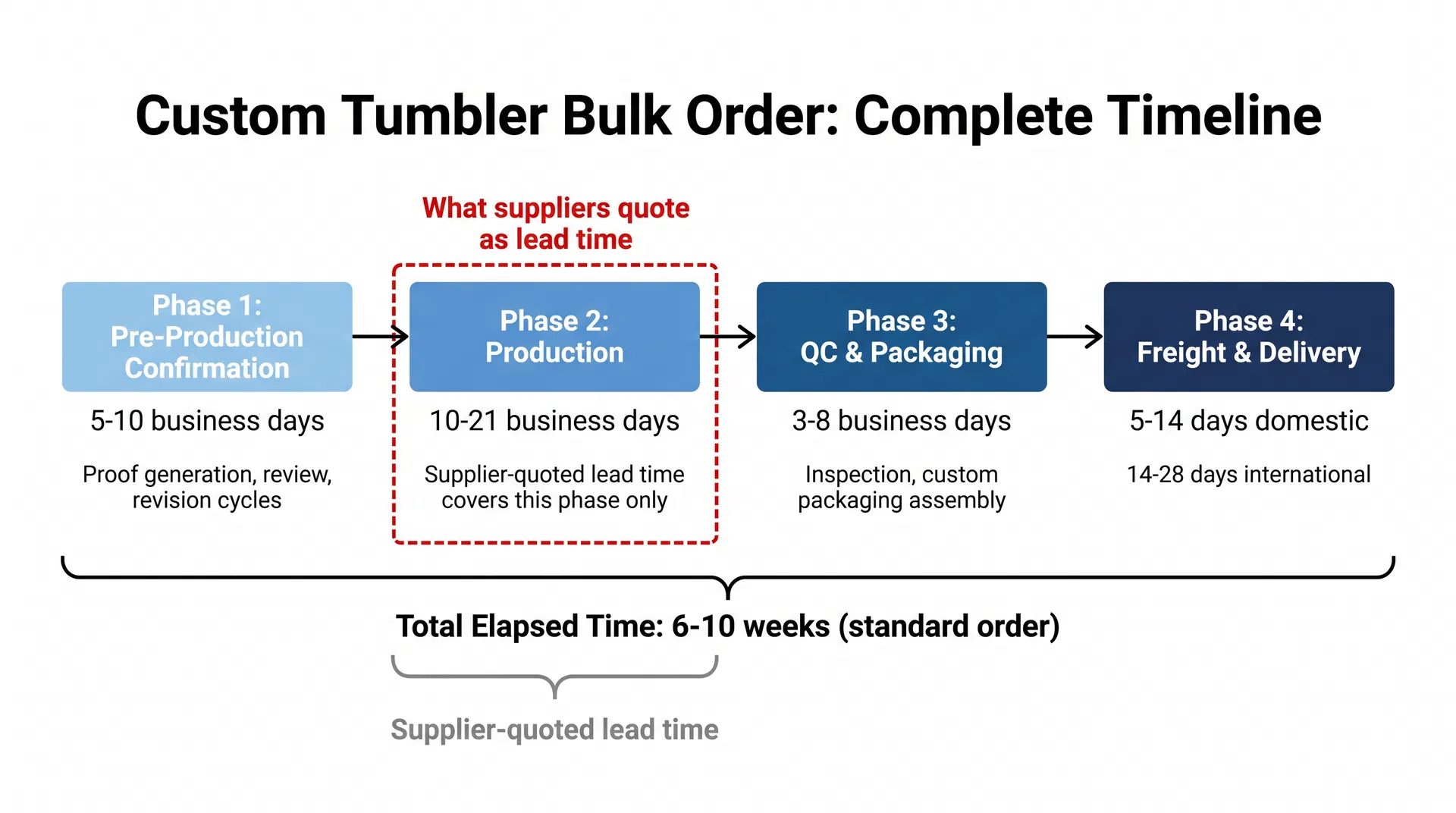
A quoted production lead time often begins after artwork, sample, deposit, and specifications are approved. The business timeline begins earlier and ends later. It includes internal brand review, sample transit, corrections, packaging production, inspection, freight, customs when applicable, domestic distribution, and individual delivery.
The procurement schedule should therefore identify a required arrival date and work backward through each approval boundary. The most effective risk control is a single specification record that HR, marketing, procurement, operations, and the supplier can all read. Informal approval in separate email threads makes it difficult to identify which lid, finish, color, and packaging version is final.
Packaging must be designed in parallel with the bottle. The product dimensions, lid projection, carry loop, accessory set, and decoration orientation determine the insert and box. The packaging-afterthought analysis explains why delaying this decision can create MOQ conflicts, timeline compression, and a visible quality-tier gap.
For multi-location delivery, clarify whether the supplier will ship bulk cartons to one fulfillment center or create individual parcels. A bottle that survives master-carton transport may still move inside a presentation box when shipped alone. The transit layer and presentation layer have different jobs and should be tested accordingly.
Make sustainability claims specific enough to verify
A reusable bottle may support a waste-reduction program, but the product should not be described with broad environmental language that the company cannot substantiate. The Federal Trade Commission’s Green Guides caution marketers against unqualified claims such as “green” or “eco-friendly.” They also state that partial recycled-content claims should clearly disclose the proportion, such as “made from 30% recycled material.”2
For procurement, that means asking four precise questions. What percentage is claimed? Which component contains it? Is the percentage based on post-consumer, pre-consumer, or another defined source? What evidence supports the final marketing language? A recycled-content claim for the bottle body should not be presented as though every lid, seal, coating, and package contains the same material.
The same discipline applies to recyclability. Collection and processing availability differ by material and market, while a multi-material finished product may not follow the same pathway as its primary vessel material. Specific, qualified language is more credible than a broad green badge.
Convert the program into a supplier-ready brief
A strong request for quotation lets suppliers price the same project. It defines the recipient group and use environment; bottle style and capacity; dimensions or cup-holder requirement; body, inner wall, lid, seal, liner, and coating materials; preferred decoration method; artwork size and location; color standard; test and documentation expectations; individual packaging; carton configuration; destination pattern; required arrival date; initial quantity; variant quantities; reserve stock; and expected reorder cadence.
The brief should also state which variables are open to supplier recommendation. A factory may be able to improve lead time by using an existing lid platform, reduce risk by changing the logo method, or consolidate colors to meet efficient batch sizes. Those recommendations are useful only when they are made against a clearly stated objective.
Before approval, request a written deviation list. If the quoted item differs from the brief in material, capacity, lid, color, imprint, packaging, testing, or schedule, the difference should be visible rather than buried in a model number. Silence should not be treated as compliance.
The buying standard for a repeatable bulk bottle program
The best custom water bottles with a logo are not selected by price alone. They are selected by fit: fit with the recipient’s environment, fit between body and lid, fit between coating and decoration, fit between compliance evidence and intended use, and fit between packaging and delivery method.
That standard produces a program the company can reorder with confidence. It also makes supplier comparison fairer because every quote answers the same operational question. Once the bottle, lid, decoration, evidence, packaging, quantity, and timeline are defined as one system, bulk purchasing becomes less about browsing options and more about controlling the outcome.
References