Corporate Gifting
The Packaging Afterthought Trap: Why Last-Minute Packaging Decisions Cost More Than Money
企業禮品採購中,將包裝視為成本項目而非規格決策的常見誤判。本文從資深企業採購顧問視角,分析為何包裝後置決策會導致 MOQ 不一致、品質層級落差及交期計算遺漏。

Packaging is the part of a corporate gifting program that almost every procurement process handles last and least carefully. The product is selected first, the supplier is qualified, the decoration method is confirmed, the unit price is negotiated, and then — usually at the point where the purchase order is being finalized — someone asks about the box. By that stage, the packaging decision has already been constrained by choices made earlier in the process. The product specification is locked. The supplier relationship is established. The budget has been allocated. What remains is a packaging decision made under conditions that were never designed to produce a good packaging outcome.
The first consequence of this sequencing is a minimum order quantity mismatch that most procurement teams encounter only after they have committed to a product order. Custom packaging — a branded gift box, a magnetic closure presentation case, a rigid sleeve with tissue paper — typically carries its own MOQ, which is set by the packaging manufacturer independently of the product supplier. A gifting program ordering 150 custom insulated tumblers may find that the packaging supplier's MOQ for a branded gift box is 300 units, or 500, or more. The procurement team now faces a choice between paying a significant small-batch premium to match the product quantity, ordering excess packaging that will sit in storage, or substituting a standard packaging solution that was not part of the original program design. None of these outcomes was anticipated when the product decision was made. All of them were made inevitable by the sequencing.
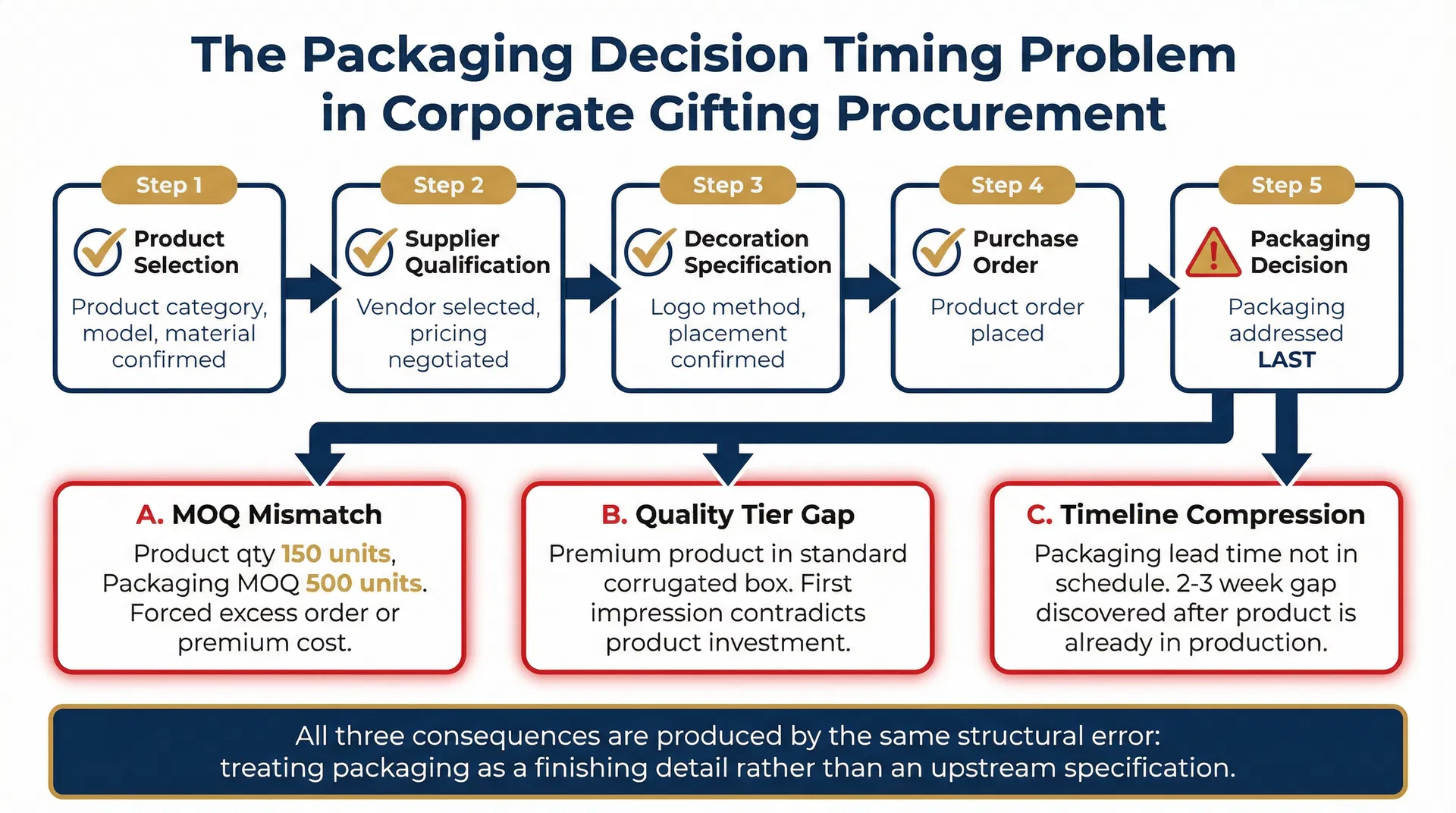
The second consequence is more difficult to quantify but more consequential for the relationship outcome. A premium custom stainless steel tumbler — 18/8 food-grade steel, vacuum insulated, with precision laser engraving — arrives at the recipient's office in a standard brown corrugated shipping box. The product inside is exactly what was specified. The packaging communicates something entirely different: that the sender's investment in the gift ended at the product level. The recipient's first physical interaction with the gift is the box, not the tumbler. The packaging is the first quality signal, and it shapes the perception of what is inside before the lid comes off. A product specification that was designed to signal relationship investment is being introduced by packaging that signals operational efficiency. These two signals are not compatible, and the packaging signal arrives first.
This is not a subjective aesthetic concern. It reflects a structural reality about how gifts are evaluated in a B2B relationship context. The recipient is not evaluating the tumbler in isolation. They are evaluating the entire object as it arrived — the packaging, the presentation, the tissue paper or lack of it, the way the product was positioned inside the box. A procurement process that treats packaging as a cost line item rather than a specification decision will consistently produce a gap between the product quality tier and the packaging quality tier. That gap is read by recipients as a signal about the sender's attention to detail, and by extension, about the sender's likely attention to detail in the business relationship itself.
The third consequence operates at the timeline level and is the one most likely to create a visible operational failure. When packaging is treated as a late-stage decision, its production timeline is not incorporated into the program's overall delivery schedule. A procurement team that has correctly calculated the product lead time — sample approval, production, quality check, shipping — has typically not added the packaging lead time on top of it. Custom packaging requires its own sample approval cycle, its own production run, and its own delivery to the assembly point where it will be combined with the product. For a program with a fixed delivery deadline, discovering that the packaging requires an additional two to three weeks of production time after the product has already been ordered is a timeline failure that cannot be recovered without either rushing the packaging at significant cost or substituting a standard solution that undermines the program's intended quality level.
The underlying problem is that packaging is treated as a downstream decision when it is structurally an upstream one. The packaging specification — the format, the material, the branding treatment, the interior presentation — needs to be determined at the same stage as the product specification, not after it. The two specifications are interdependent in ways that only become visible when they are handled sequentially: the packaging MOQ affects the total program cost, the packaging lead time affects the delivery schedule, and the packaging quality tier affects the relationship signal that the product was designed to deliver. Treating them as separate decisions made at different stages of the procurement process is the structural error that produces all three consequences.
The correction is not complicated in principle. It requires treating the packaging brief as part of the product brief, issued to the supplier or packaging vendor at the same time as the product specification, with the same lead time expectations and the same quality tier requirements. For a custom drinkware program, this means specifying the gift box format, the interior presentation, and the branding treatment before the product order is placed — not after. It means confirming that the packaging MOQ is compatible with the product order quantity before committing to either. And it means building the packaging production timeline into the program's overall delivery schedule from the beginning, not discovering it at the end.
The question of which gift types serve which business needs is often answered entirely at the product level. In practice, for custom drinkware programs intended to function as relationship investments rather than promotional distributions, the packaging specification is as consequential as the product specification. A program that gets the product right and the packaging wrong has not delivered a relationship gift. It has delivered a premium product in a standard box — and the standard box is what the recipient will remember first.
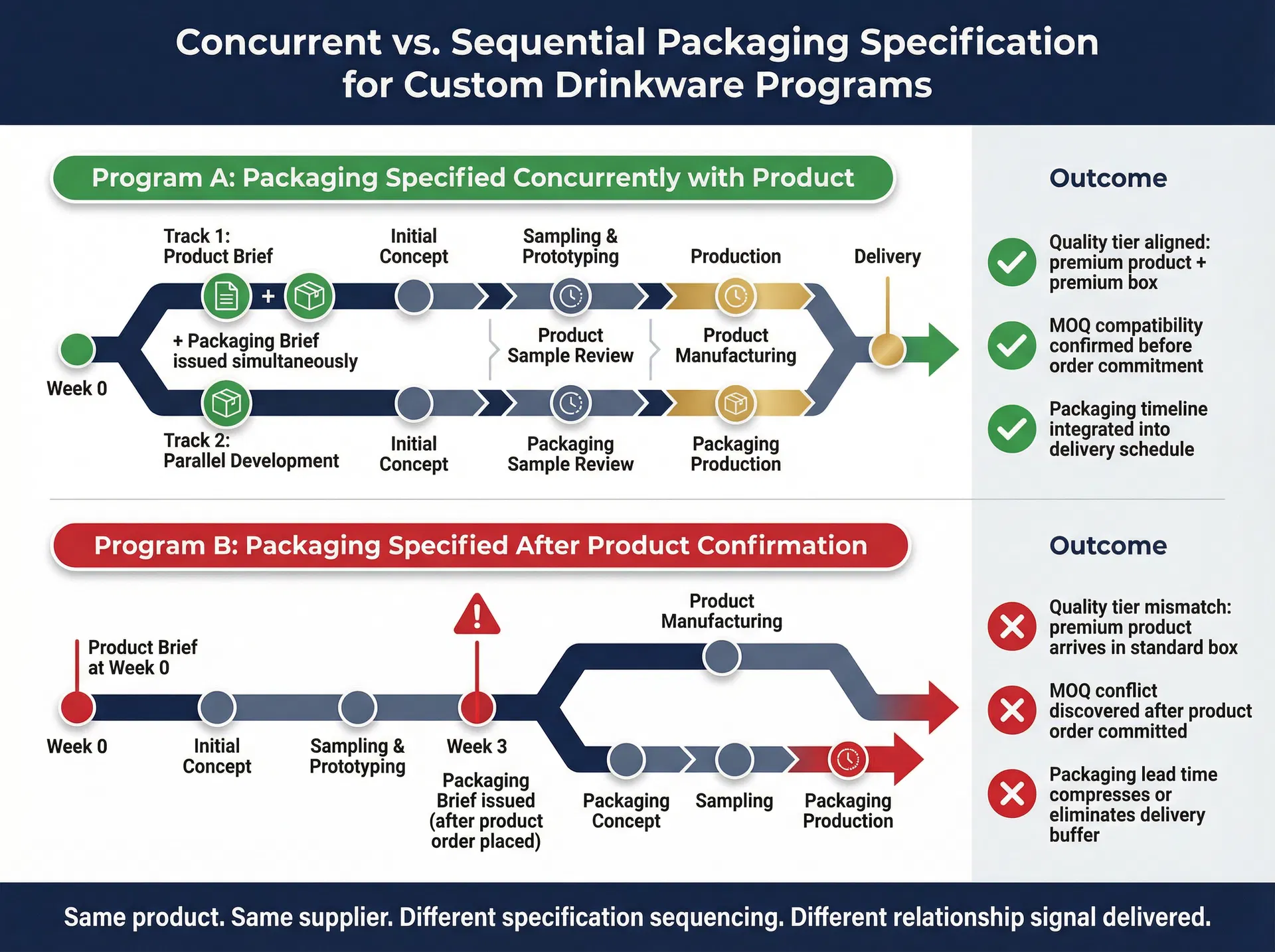
The companies that manage this consistently well are not running more sophisticated procurement processes. They are running procurement processes where the packaging decision is never treated as a finishing detail. The packaging brief is part of the initial specification. The packaging supplier is qualified alongside the product supplier. The packaging timeline is part of the program timeline from day one. The result is not just a better-looking gift. It is a program where the relationship signal that was intended at the product selection stage is actually delivered — because the packaging that introduces the product was designed to support that signal rather than contradict it.