Procurement Guide
Custom Tumblers Bulk Order: The Complete Procurement Guide for U.S. Businesses
美國企業批量訂購客製化保溫杯的完整採購指南,涵蓋最小訂購量、材料選擇(304 vs 201)、裝飾方法(雷射雕刻 vs UV 印刷)、交期和包裝選項。

Custom Tumblers Bulk Order: The Complete Procurement Guide for U.S. Businesses
When a U.S. company places a bulk order for custom tumblers, the decision looks straightforward on the surface: choose a product, upload a logo, confirm a quantity, and wait for delivery. In practice, the procurement path between that first decision and a successful delivery involves a series of specification choices that most buyers encounter without adequate preparation. This guide is written for procurement managers, marketing coordinators, and operations teams who are responsible for executing custom drinkware orders at scale — and who need to understand not just what to order, but how the ordering process actually works.
Understanding Minimum Order Quantities (MOQ)
The first number most buyers encounter when researching custom tumblers is the minimum order quantity. MOQ structures vary significantly depending on the supplier type and the customization method being used.
For standard catalog items with single-color logo printing, domestic promotional product distributors typically offer MOQs starting at 24 to 50 units. For laser engraving on stainless steel, MOQs from direct manufacturers generally begin at 100 to 250 units, with meaningful price breaks occurring at 500, 1,000, and 2,500 units.
The critical point that buyers frequently misunderstand is that MOQ applies per SKU — meaning per distinct product variant. An order for 500 tumblers split across three color options is not a 500-unit order from a pricing and production standpoint. It is three separate 167-unit orders, each priced at the lower-volume tier. This distinction can add 20 to 35 percent to the per-unit cost of what appears on paper to be a large order. Understanding how MOQ per-variant pricing works in practice before finalizing a product selection is one of the most consequential steps in bulk tumbler procurement.
| Order Quantity | Typical Price Range (Laser Engraved, 20oz) | Notes |
|---|---|---|
| 50–99 units | $18–$28 per unit | Small batch; limited supplier options |
| 100–249 units | $14–$22 per unit | Standard MOQ tier for most manufacturers |
| 250–499 units | $11–$17 per unit | First meaningful price break |
| 500–999 units | $9–$14 per unit | Mid-volume tier |
| 1,000–2,499 units | $7–$11 per unit | High-volume pricing begins |
| 2,500+ units | $5.50–$9 per unit | Factory-direct pricing |
Note: Prices vary by material grade, wall construction, lid type, and decoration method. The above ranges are indicative for 18/8 stainless steel with single-location laser engraving.
Choosing the Right Product Specification
Material Grade: 304 vs. 201 Stainless Steel
The most consequential specification decision in a bulk tumbler order is material grade, and it is also the one most frequently obscured by supplier descriptions. 304-grade (18/8) stainless steel contains 18 percent chromium and 8 percent nickel, producing a corrosion-resistant, food-safe surface that maintains its appearance under daily use. 201-grade steel contains significantly less nickel and is more susceptible to rust, particularly at weld points and in contact with acidic beverages.
Suppliers quoting at the lower end of the price range are almost always working with 201-grade material. The visual difference between a 304 and 201 tumbler is not apparent at the time of delivery. It becomes apparent after 6 to 18 months of use, when recipients begin noticing rust spots at the base or around the lid seal. For corporate gifting programs where the goal is sustained brand visibility, a tumbler that degrades visibly within its first year is a net negative for the brand it carries.
Capacity and Lid Configuration
The 20-ounce and 30-ounce sizes account for the majority of corporate bulk orders in the U.S. market. The 20-ounce format is preferred for desk use and indoor environments; the 30-ounce format is more common for commuter and outdoor contexts. Lid configuration — whether the tumbler uses a sliding closure, a straw lid, or a push-button mechanism — affects both the use context and the price point.
For corporate gifting programs targeting mixed recipient lists, the 20-ounce tumbler with a sliding lid represents the broadest-use specification: suitable for hot and cold beverages, compatible with standard cup holders, and appropriate across professional environments.
Decoration Method: Laser Engraving vs. UV Printing
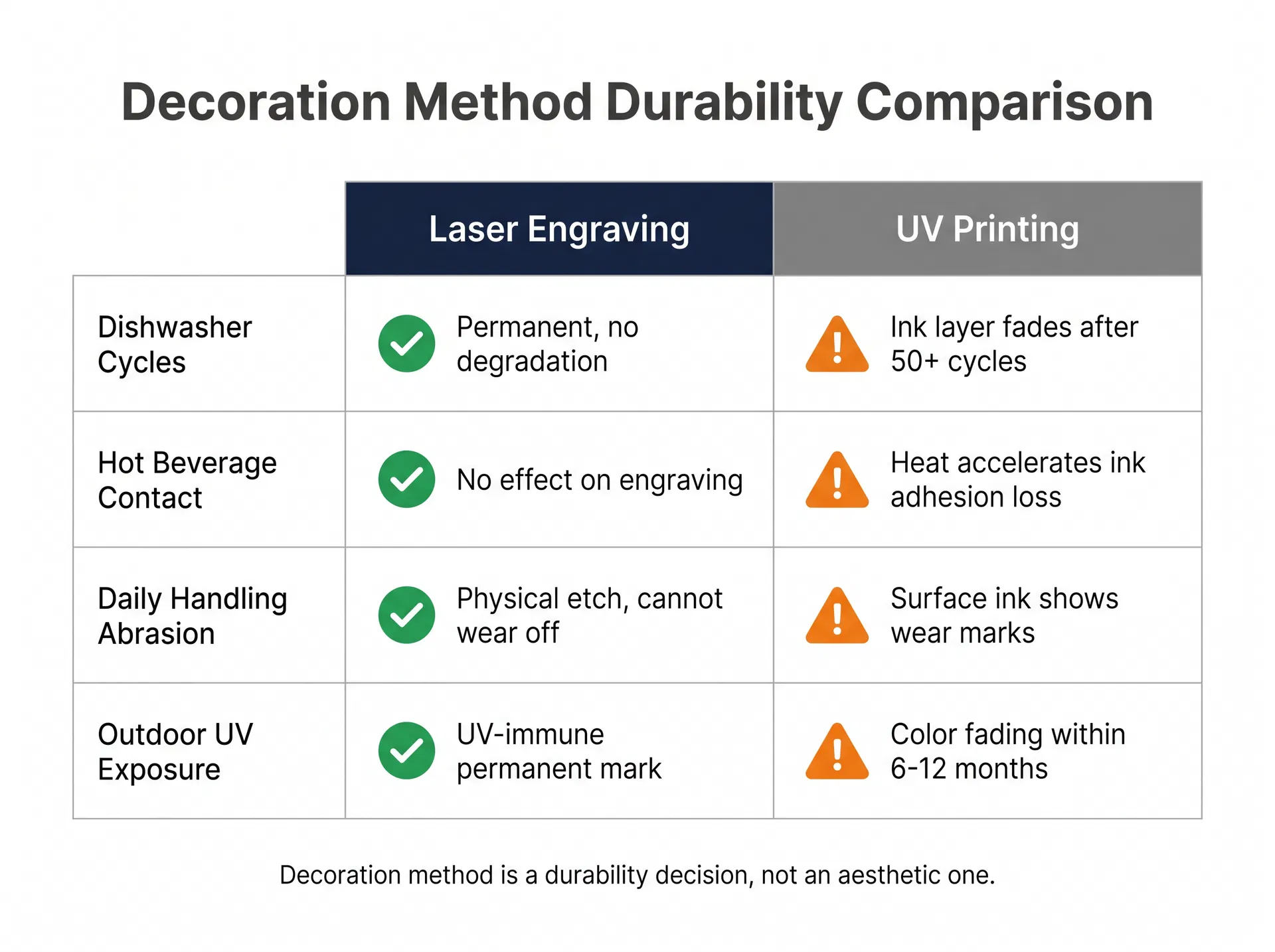
The choice between laser engraving and UV printing is not primarily an aesthetic decision — it is a durability decision. Laser engraving removes material from the surface of the tumbler to create a permanent mark that cannot fade, peel, or wash off. UV printing applies an ink layer to the surface that adheres through a curing process but remains susceptible to abrasion, dishwasher heat, and prolonged UV exposure.
For bulk orders intended for daily use by recipients who will wash their tumblers regularly, laser engraving is the specification that maintains brand integrity over the product's usable life. UV printing is appropriate for lower-frequency-use items or situations where full-color reproduction is required and the use environment is controlled. The cost difference between the two methods narrows significantly at volumes above 500 units, making engraving the more defensible choice for most corporate programs.
The Complete Timeline for a Bulk Tumbler Order
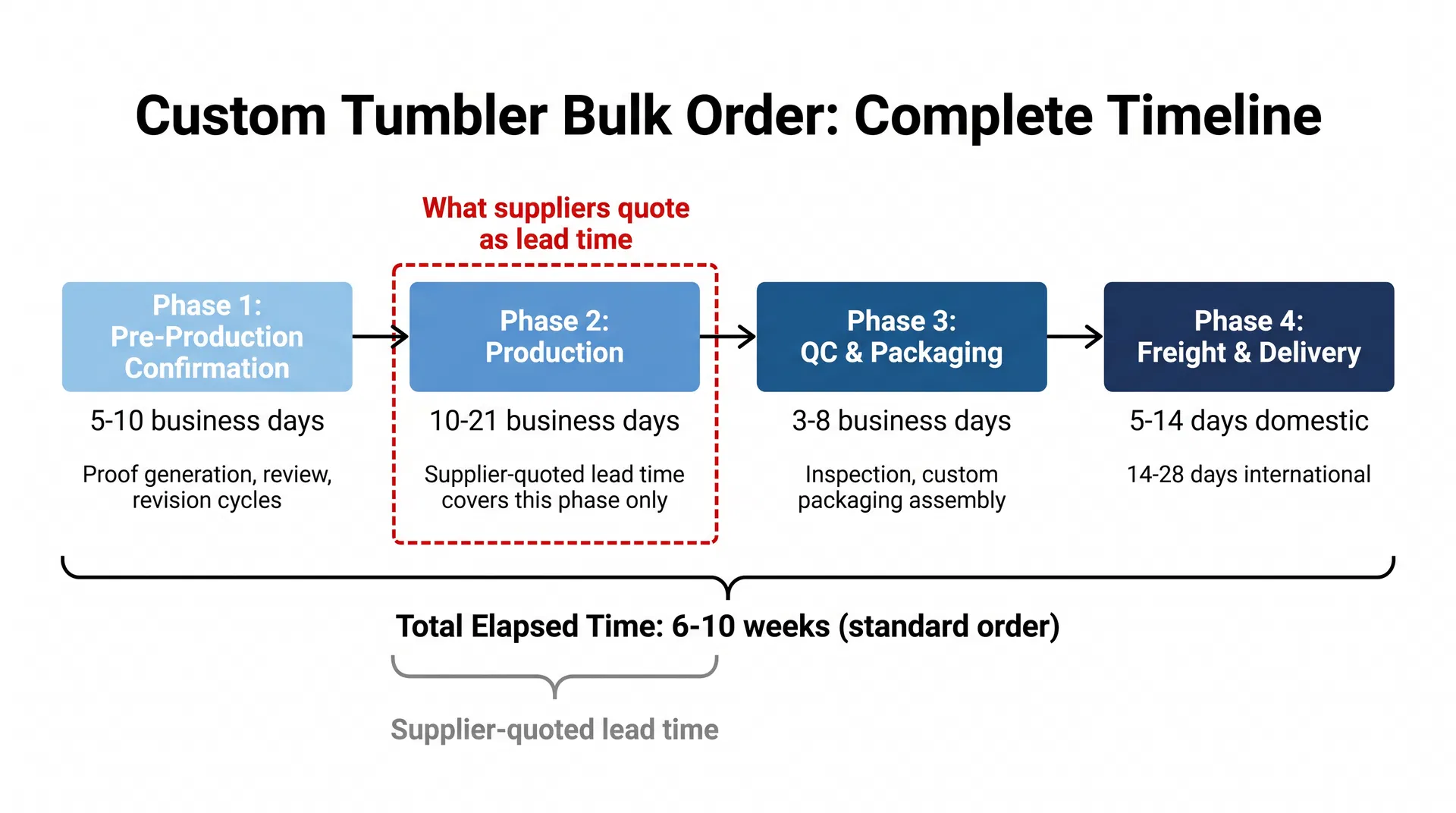
One of the most consistent sources of procurement failure in custom drinkware programs is timeline miscalculation. Buyers calculate from the supplier's quoted production lead time — typically 10 to 21 business days — and work backward from their event or distribution date. This calculation omits three additional phases that are part of every custom order.
Phase 1: Pre-Production Confirmation (5–10 business days) After an order is placed, the supplier generates a digital proof showing the logo placement, size, and finish on the selected product. This proof requires review and approval before production begins. If the proof requires revision — incorrect Pantone matching, logo scaling issues, placement adjustments — each revision cycle adds 2 to 3 business days. Orders with complex logos or multi-location decoration frequently require two or three proof iterations.
Phase 2: Production (10–21 business days) This is the phase suppliers quote as "lead time." It covers the actual manufacturing and decoration run. At peak periods — October through December, and May through June — production queues extend, and the quoted lead time may increase by 30 to 50 percent.
Phase 3: Quality Inspection and Packaging (3–5 business days) Before shipment, completed units undergo inspection and are packed for transit. For orders that include custom gift packaging — individual boxes, tissue paper, ribbon — this phase extends to 5 to 8 business days.
Phase 4: Freight and Delivery (5–14 business days domestic; 14–28 days international) Domestic ground freight from a U.S. fulfillment center to the delivery address adds 3 to 7 business days. For orders manufactured overseas and shipped to a U.S. port, ocean freight adds 14 to 21 days, plus customs clearance of 3 to 7 days.
The practical implication: a buyer who needs tumblers delivered by a specific date should work backward from that date using the total elapsed time across all four phases — not the production lead time alone. For a standard 500-unit order with custom packaging, the realistic planning window from order placement to delivery is 6 to 10 weeks under normal conditions.
Packaging: A Specification Decision, Not a Finishing Step
The packaging specification for a bulk tumbler order is most productively treated as a concurrent decision alongside product selection, not a downstream choice made after the product is confirmed. This matters for two reasons.
First, packaging has its own MOQ structure. Individual gift boxes, custom-printed sleeves, and branded tissue paper are typically produced in minimum quantities of 250 to 500 units. An order for 150 tumblers that requires individual gift boxes will either pay a premium for a below-MOQ packaging run or be forced to order excess packaging. Neither outcome is visible at the time the product order is placed.
Second, packaging quality communicates the same brand signals as the product itself. A premium laser-engraved tumbler delivered in a standard brown corrugated box arrives as a commodity item regardless of the product's specification level. The unboxing experience — the first physical interaction a recipient has with the gift — is determined entirely by the packaging. For corporate gifting programs targeting client relationships or executive recipients, packaging specification is not a cost optimization variable. It is a brand specification variable.
Supplier Selection: What to Evaluate Beyond Price
The price-per-unit comparison that drives most bulk tumbler sourcing decisions captures only a fraction of the relevant variables. Buyers who select suppliers based on unit cost alone frequently encounter costs that were not in the original quote: setup fees, proof revision charges, packaging differentials, and expedited production premiums.
A more complete supplier evaluation framework includes four dimensions: material transparency (will the supplier confirm 304-grade steel in writing and provide test documentation?), decoration method clarity (is the engraving depth and method specified, or described only as "laser engraving"?), timeline accountability (does the quoted lead time include pre-production confirmation, or does it begin after proof approval?), and packaging integration (can the supplier manage packaging specification and assembly, or does packaging require a separate vendor relationship?).
For U.S. companies placing bulk orders, the distinction between a domestic distributor and a direct manufacturer matters primarily for timeline and specification control. Domestic distributors offer faster communication and easier returns but typically source from the same overseas manufacturers at a margin markup. Direct manufacturer relationships offer better pricing at volume and more control over specification but require longer planning windows and more active quality management.
Common Mistakes in Bulk Tumbler Procurement
The most frequently recurring errors in custom tumbler bulk orders share a common structure: they are decisions that appear correct at the time they are made and reveal their consequences only after production is complete or delivery has occurred.
Accepting a material substitution without documentation is the most costly. A supplier who quotes 304-grade steel and delivers 201-grade material has not necessarily acted in bad faith — the substitution may have occurred at the factory level without the distributor's knowledge. Requiring a material certification document before approving production is the only reliable protection.
Approving a proof under time pressure is the second most common source of remakes. The proof approval step is the last point at which specification errors can be corrected without cost. A logo that appears correctly scaled on a digital proof may be positioned incorrectly relative to the tumbler's seam, or may be sized for a different product than the one ordered. Taking the time to verify proof accuracy against the physical product specification — not just the visual rendering — prevents the majority of remake situations.
Treating the order confirmation as the start of the production clock is the third. Production begins after proof approval, not after order placement. Buyers who calculate their timeline from order confirmation and then experience a three-day proof revision cycle arrive at their event or distribution date short by exactly those three days.
Planning Your Bulk Order: A Practical Timeline Reference
For teams planning a custom tumbler program, the following backward-planning framework provides a realistic order placement target based on required delivery date:
- Required delivery date minus 2 weeks: absolute latest order placement for domestic production with standard packaging, assuming no proof revisions
- Required delivery date minus 4 weeks: recommended order placement for domestic production with custom packaging
- Required delivery date minus 8 weeks: recommended order placement for overseas production with standard packaging
- Required delivery date minus 12 weeks: recommended order placement for overseas production with custom packaging and multiple proof revision cycles
These windows assume normal production queue conditions. For orders placed between October and December, or in the 6 weeks preceding major U.S. holidays, add 2 to 3 weeks to each window.
The investment in planning time is not a procurement formality. It is the variable that determines whether the same budget produces a specification-appropriate product delivered on time, or a compromised specification delivered under pressure. Custom tumblers ordered with adequate lead time can be specified correctly, proofed thoroughly, packaged appropriately, and delivered with time for distribution planning. The same order placed four weeks too late produces a different product at a higher effective cost — not because the supplier changed, but because time pressure forces every subsequent decision.