Customization Process
The MOQ Per-Variant Assumption Trap
Most procurement conversations about minimum order quantities end with a number—500 units, 1,000 units, perhaps 250 units if the supplier is flexible. The…
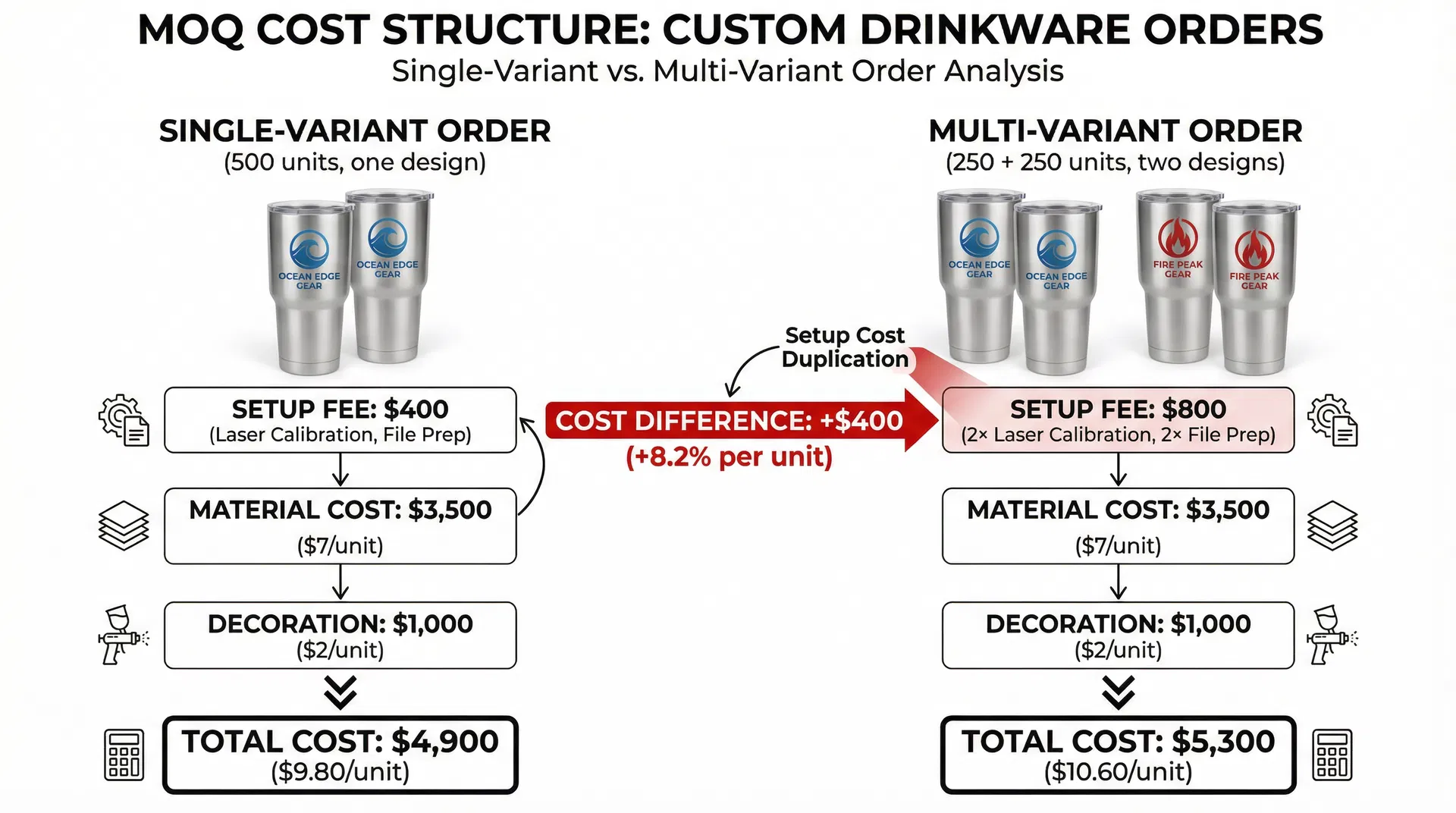
Most procurement conversations about minimum order quantities end with a number—500 units, 1,000 units, perhaps 250 units if the supplier is flexible. The buyer notes this threshold in their RFQ spreadsheet, calculates unit economics, and moves forward assuming they understand the cost structure. Then, during artwork submission, they mention they need 250 units of Design A with the blue logo and 250 units of Design B with the red logo. This is where I, as a factory project manager coordinating production schedules across multiple decoration lines, have to explain that the 500-unit MOQ they negotiated applies per design variant, not as a total order threshold that can be split across multiple SKUs. The conversation that follows typically involves recalculating budgets, revising timelines, or consolidating designs—all of which could have been avoided if the MOQ discussion had clarified per-variant requirements from the beginning.
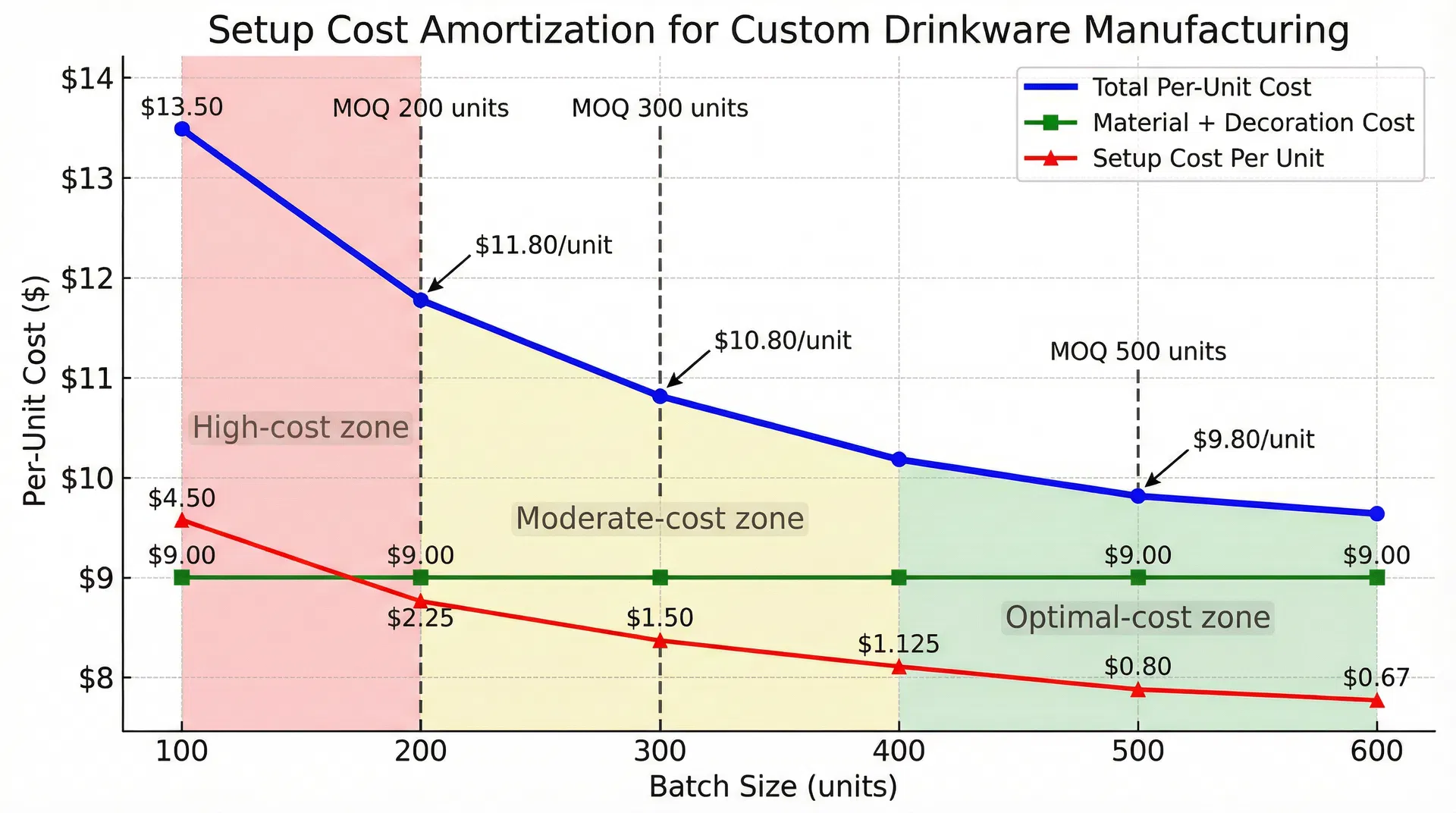
The core misunderstanding stems from treating MOQ as purely a purchasing minimum rather than recognizing it as a production batch optimization point. When a supplier quotes a 500-unit MOQ for custom stainless steel tumblers with laser engraving, that number exists because 500 units justify the setup costs, material procurement lead times, and production line allocation required to manufacture that specific design economically. Setup costs include creating digital engraving files, calibrating laser parameters for the chosen substrate, and configuring quality control checkpoints for that particular logo placement and size. These setup activities occur once per design variant, not once per total order. When you request 250 units each of two different designs, you're not dividing a single 500-unit production run into two portions. You're requesting two separate 250-unit production runs, each carrying its own setup burden and each falling below the threshold where unit economics remain viable.
In practice, this is often where customization process decisions start to be misjudged. A procurement manager successfully negotiates a supplier's 1,000-unit MOQ down to 500 units, feeling satisfied with the concession. They budget $8.50 per unit based on the supplier's quote, calculating a total project cost of $4,250 for 500 tumblers. Then they submit artwork showing three color variants of their logo—corporate blue for the sales team, forest green for operations, and burgundy for executive leadership—requesting 167 units of each variant. The supplier responds with a revised quote: $5,800 total, or $11.60 per unit. The buyer is confused and frustrated. They met the 500-unit MOQ. Why did the price increase by 36%?
The answer lies in how decoration methods scale with batch size. Laser engraving, the most common decoration method for stainless steel drinkware, requires digital file preparation for each design variant. While the logo artwork might be identical across all three color variants, each color requires a separate engraving pass because the laser parameters (power, speed, frequency) must be adjusted to achieve consistent depth and contrast on powder-coated surfaces of different colors. Dark blue powder coating absorbs laser energy differently than light green powder coating, requiring recalibration between batches. This recalibration takes 15-20 minutes per color variant and produces 3-5 test pieces that are scrapped to verify parameter accuracy. For a single 500-unit batch, this setup time represents 2-3% of total production time. For three 167-unit batches, setup time climbs to 8-10% of production time because you're repeating the calibration process three times.
Material procurement introduces another layer of per-variant complexity. Custom powder-coated tumblers require the supplier to order specific color batches from their coating subcontractor. Powder coating suppliers typically have their own MOQs, often measured in kilograms rather than units. A 500-unit order of blue tumblers might require 12 kg of custom blue powder, which the coating supplier sells without issue. But when you split that order into 167 units each of three colors, you're requesting 4 kg of blue, 4 kg of green, and 4 kg of burgundy. Many coating suppliers won't sell 4 kg batches of custom colors at the same per-kilogram price they charge for 12 kg batches. The factory either absorbs higher material costs on the smaller color batches or passes those costs to the buyer through adjusted unit pricing.
This creates a cascading effect through the supply chain. The factory's MOQ isn't arbitrary; it's derived from the MOQs and batch economics of their upstream suppliers. When you request multiple design variants that don't align with those batch sizes, you're asking the factory to absorb inefficiencies that their pricing structure wasn't designed to accommodate. Some factories will agree to this arrangement and quietly adjust pricing to cover the additional costs. Others will accept the order at the original price and then struggle to maintain profitability, which often manifests as quality shortcuts or delayed deliveries when the factory prioritizes more profitable orders over yours.
The per-variant MOQ reality becomes even more pronounced with screen printing, where physical setup costs are higher than digital methods like laser engraving. Screen printing requires creating mesh screens for each color in the design—a fixed cost typically ranging from $80-150 per screen depending on mesh count and frame size. A two-color logo requires two screens. If you order 500 tumblers with a two-color logo, the $160 screen cost (assuming $80 per screen) represents $0.32 per unit. If you order 250 tumblers each with two different two-color logos, you need four screens total ($320), and the per-unit screen cost doubles to $0.64. This doesn't account for the additional setup time required to mount, align, and test each screen before production begins—a process that takes 30-45 minutes per color per design.
UV printing offers more flexibility for multi-variant orders because it's a digital process that doesn't require physical screens. However, UV printing still carries per-variant costs through color calibration and curing parameter optimization. Different logo designs with different color densities require different UV exposure times to ensure proper ink adhesion and durability. A logo with large solid color blocks cures faster than a logo with fine text and gradient effects. The factory must produce test prints for each design variant to verify that colors match Pantone specifications and that ink adhesion passes tape tests (where adhesive tape is pressed onto the printed surface and removed—if ink lifts off, adhesion is inadequate). These test prints consume 5-8 units per design variant, which becomes significant when you're ordering 200 units each of four variants (32 units consumed in testing, or 6.4% of the total order).
The batch fragmentation also affects quality consistency in ways that buyers don't anticipate. When a factory produces 500 units of a single design in one continuous run, they establish stable process parameters and maintain consistent quality across the entire batch. Laser power, engraving speed, and focus depth remain constant. Material properties (powder coating thickness, substrate hardness) are uniform because all 500 units come from the same material lot. When you split that into three 167-unit batches produced on different days or different shifts, you introduce batch-to-batch variation. The second batch might use powder-coated tumblers from a different material lot with slightly different coating thickness, requiring laser parameter adjustments that create subtle visual differences compared to the first batch. These differences are often imperceptible when batches are viewed separately, but become noticeable when units from different batches are placed side by side—exactly what happens when your sales team, operations team, and executive team compare their tumblers at a company event.
I've managed enough of these situations to recognize the pattern. The buyer's finance team approved the purchase based on the quoted unit price multiplied by 500 units. Nobody accounted for the $800-1,200 in additional setup fees or the 15-20% higher per-unit costs that emerge when the order fragments into multiple design variants below per-variant MOQ thresholds. By the time these costs surface, the purchase order is already approved, the production schedule is committed, and the buyer is frustrated that the "final" price doesn't match their budget projection. This creates tension that could have been avoided if the MOQ conversation had explicitly stated: "500 units per design variant" rather than "500 units total."
The specification clarity problem extends beyond just stating MOQ numbers. Supplier quotation templates rarely include fields for "number of design variants" or "SKU breakdown." RFQ documents ask for "total quantity" without prompting buyers to specify how that quantity distributes across colors, logos, or packaging configurations. This creates an information gap where both parties operate under different assumptions until artwork submission reveals the disconnect. The supplier assumed 500 units of a single design. The buyer assumed 500 units total across multiple designs. Neither party explicitly confirmed this assumption because the quotation process didn't prompt the question.
The broader framework for managing these customization decisions addresses supplier selection and compliance verification, but the per-variant MOQ question specifically requires clarification during initial pricing discussions—before artwork is prepared, before samples are produced, and before purchase orders are issued. Waiting until artwork submission to discover per-variant MOQ requirements extends lead time by 7-10 days while revised quotes are prepared and budgets are recalculated. For time-sensitive corporate gifting programs or event-specific promotions, this delay can force buyers to either accept higher costs or eliminate design variants to meet deadlines.
The forced design consolidation that results from per-variant MOQ constraints creates its own set of problems. When a buyer discovers they can't afford 250 units each of three logo variants, they typically consolidate to a single design that all recipients receive. This eliminates the personalization that made multiple variants appealing in the first place—sales teams wanted blue tumblers with their division name, operations teams wanted green tumblers with their safety motto, and executives wanted burgundy tumblers with the company founding year. Consolidating to a single generic design reduces perceived value and recipient engagement, undermining the original purpose of the corporate gifting program. The buyer saved $1,200 in setup costs but sacrificed the customization that would have made the gift meaningful to each recipient group.
Alternatively, some buyers choose to meet per-variant MOQ requirements by ordering more units than they need. Instead of 167 units each of three variants (501 total), they order 250 units each (750 total) to achieve better per-unit pricing. This creates inventory carrying costs and obsolescence risk. The extra 249 tumblers sit in storage for months or years, consuming warehouse space and tying up capital. If the company undergoes a rebrand or logo update, those excess units become obsolete and must be scrapped or donated, representing sunk costs that weren't part of the original budget justification.
The per-variant MOQ trap also affects multi-location distribution strategies. A buyer might plan to order 1,000 tumblers total, with 200 units shipped to each of five regional offices. If each regional office wants a location-specific design (such as city skyline artwork or regional taglines), the buyer is effectively requesting five separate 200-unit orders. If the supplier's per-variant MOQ is 300 units, the buyer faces a choice: eliminate location-specific customization and ship identical tumblers to all locations, or increase the order to 1,500 units (300 per location) and absorb the cost of 500 excess units. Neither option aligns with the original procurement strategy, and both create budget variance that requires executive approval.
The cost escalation from per-variant MOQ constraints is most severe for small-batch corporate programs. A startup with 80 employees might order 100 tumblers for a team-building event, requesting 50 units with the engineering team logo and 50 units with the sales team logo. If the supplier's per-variant MOQ is 100 units, the startup must either order 200 units total (100 per variant, creating 100 excess units for an 80-person company) or eliminate the team-specific customization. For a company operating on tight cash flow, the difference between a $1,200 order (100 units at $12 each) and a $2,000 order (200 units at $10 each) can determine whether the program proceeds at all. The per-variant MOQ effectively prices small companies out of multi-variant customization, limiting their ability to create personalized employee recognition programs.
The solution requires specification clarity at the quotation stage. When requesting quotes for custom drinkware, buyers should explicitly state: "Total quantity: 500 units. Design variants: 3 (250 blue, 150 green, 100 red). Please confirm whether your MOQ applies per variant or per total order." This forces suppliers to clarify their MOQ structure before pricing is finalized. If the supplier responds that MOQ applies per variant and the buyer's quantities fall below that threshold, the conversation can shift to alternative solutions: consolidating variants to meet MOQ, accepting higher per-unit costs for below-MOQ batches, or selecting a different supplier with lower per-variant MOQs.
Some suppliers offer tiered MOQ structures that accommodate multi-variant orders. For example: 500 units per variant for orders with 1-2 variants, 300 units per variant for orders with 3-5 variants, 200 units per variant for orders with 6+ variants. This pricing model recognizes that buyers ordering multiple variants are placing larger total orders and should receive some MOQ flexibility in exchange for that volume. However, these tiered structures are rarely advertised—buyers must ask specifically whether multi-variant discounts are available.
Digital decoration methods like UV printing and direct-to-film (DTF) printing are gradually reducing per-variant MOQ constraints because they eliminate physical setup costs like screens and plates. UV printing can switch between designs by simply loading different digital files, with minimal setup time between variants. This makes UV printing particularly attractive for multi-variant orders, even though the per-unit decoration cost ($2.50-3.50) is higher than laser engraving ($1.50-2.50) or screen printing ($1.00-1.80). For a 500-unit order with three variants, the $1.00 per-unit premium for UV printing ($500 total) may be offset by the elimination of $800-1,200 in additional setup fees that screen printing would require.
The per-variant MOQ assumption trap ultimately reflects a broader pattern in custom manufacturing procurement: buyers focus on total order quantities and unit prices without fully understanding how customization complexity affects production economics. MOQ exists not as an arbitrary purchasing threshold but as the point where setup costs, material procurement minimums, and production efficiency converge to create viable unit economics. When customization introduces multiple design variants, each variant carries its own setup burden and its own MOQ threshold. Treating MOQ as a total order quantity that can be distributed across variants creates cost overruns, forced design consolidation, and quality consistency issues that undermine the original procurement objectives. The solution requires explicit specification of per-variant quantities during initial quotation discussions, allowing both buyers and suppliers to align expectations before artwork preparation begins and before purchase orders commit both parties to production schedules that don't reflect the actual cost structure.