Custom Drinkware Insights
What Is the Customization Process for Custom Drinkware? A Complete Guide for U.S. Corporate Buyers
SEO Title : Custom Drinkware Customization Process Guide for Corporate Buyers
What Is the Customization Process for Custom Drinkware? A Complete Guide for U.S. Corporate Buyers
SEO Title: Custom Drinkware Customization Process Guide for Corporate Buyers
Meta Description: Learn the complete customization process for corporate drinkware orders—from artwork preparation to production approval. Includes FDA compliance, MOQ strategies, and risk mitigation for U.S. buyers.
Why the Customization Process Matters for U.S. Corporate Buyers
When procurement managers evaluate custom drinkware suppliers, the customization process itself often receives less scrutiny than pricing or lead time. This is a strategic error. In our experience working with Fortune 500 companies and mid-market enterprises across the United States, the quality of a supplier's customization workflow directly predicts whether your $25,000 drinkware order arrives on schedule with acceptable quality—or becomes a six-week delay with 15% defect rates. The customization process determines three mission-critical outcomes: whether your brand's Pantone 286C appears as intended on powder-coated stainless steel (color matching failures occur in 8-12% of first-time orders when buyers don't specify substrate-specific color standards), whether your laser-engraved logo maintains legibility after 500 dishwasher cycles (depth and contrast specifications prevent premature fading), and whether your 2,000-unit order clears U.S. customs without FDA detention holds (food-contact compliance documentation must accompany shipments).
The financial stakes are substantial. A poorly managed customization process can transform a $14.50 per-unit base price into an effective $19-21 per-unit cost when accounting for rush re-production fees (typically 50% premium), expedited air freight to recover lost time ($4-6 per unit vs $0.80-1.20 for ocean freight), and internal labor costs for managing supplier corrections. For a 2,000-unit corporate gifting program, this represents $8,000-13,000 in avoidable expenses. More importantly, customization failures create reputational risk—distributing tumblers with faded logos or ceramic mugs with lead-contaminated glazes (California Prop 65 violations) damages brand perception among employees, clients, or event attendees. Understanding the customization process allows buyers to identify high-risk suppliers during the RFQ phase, negotiate protective contract terms (such as 2-3% replacement allowances for vacuum seal defects in double-wall insulated products), and establish quality control checkpoints that prevent defects from reaching end recipients.
For U.S. corporate buyers specifically, the customization process intersects with regulatory compliance requirements that international suppliers often misunderstand or underestimate. FDA food-contact material regulations (21 CFR 177.1520 for polypropylene lids, 21 CFR 175.300 for stainless steel bodies) require suppliers to provide Certificates of Analysis confirming BPA-free status and migration testing results. California's Proposition 65 mandates lead and cadmium testing for ceramic glazes, with warning label requirements if thresholds are exceeded. IRS gifting rules limit corporate tax deductions to $25 per recipient per year, influencing order quantities and unit pricing strategies. These compliance considerations must be integrated into the customization workflow—not treated as afterthoughts during final inspection.
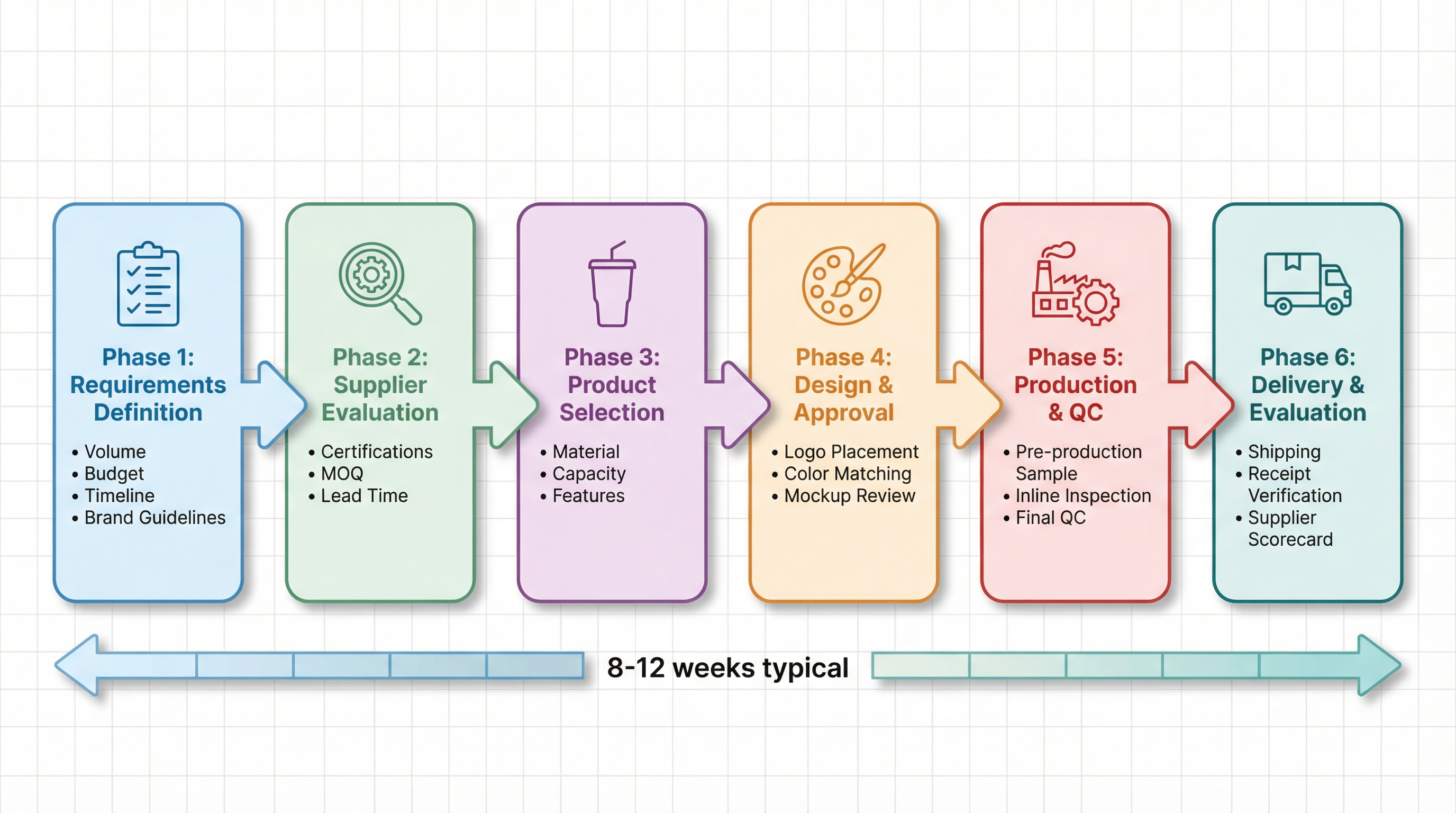
The Six-Phase Customization Workflow for Corporate Drinkware

Phase 1: Supplier Selection and Compliance Verification (Week 0-1)
The customization process begins before artwork is submitted or pricing is finalized. Procurement managers must verify that suppliers can provide FDA compliance documentation, Prop 65 test reports, and production capacity evidence before investing time in design iterations. This verification phase prevents the common scenario where a buyer discovers—eight weeks into a project—that their supplier cannot provide the Certificate of Analysis required for U.S. customs clearance, forcing a last-minute supplier switch and 4-6 week delay.
Request the following documents during initial supplier evaluation: FDA compliance certificates for all materials in contact with beverages (stainless steel body, polypropylene lid, silicone gasket), California Prop 65 test reports for ceramic glazes or powder coatings (lead and cadmium levels must be below 0.5 µg/day and 4.0 µg/day respectively), and production capacity evidence (photos of production lines, current utilization rates, MOQ flexibility). Suppliers who cannot provide these documents within 48-72 hours either lack the necessary certifications or operate at a scale incompatible with U.S. corporate procurement requirements. In our experience, suppliers who delay or deflect compliance documentation requests are 4-5 times more likely to encounter quality control failures or delivery delays during production.
For enterprise buyers working with multi-location distribution requirements (such as shipping 2,000 tumblers to 15 regional offices), this phase should also include logistics capability verification. Confirm whether the supplier can coordinate kitting (grouping items by destination), provide individual tracking numbers for each shipment, and issue consolidated invoices that align with your accounts payable workflows. Fortune 500 procurement departments typically require W-9 forms (for 1099 reporting), insurance certificates (general liability and product liability coverage), and vendor onboarding documentation. Requesting these materials upfront prevents the administrative scramble that occurs when finance teams block payment due to missing paperwork.
Phase 2: Artwork Preparation and Color Specification (Week 1-2)
Once supplier compliance is verified, the artwork preparation phase determines whether your brand's visual identity translates accurately to the chosen drinkware product. The most common customization failure we observe is buyers submitting RGB logo files (designed for screens) when suppliers require vector files with Pantone color specifications (designed for physical printing). This mismatch creates a 3-5 day revision cycle as suppliers request corrected files, delaying proof approval and extending overall lead time.
Prepare the following assets before engaging suppliers: vector logo files in AI, EPS, or PDF format (not JPG or PNG, which are raster formats that pixelate when scaled), Pantone color codes for each logo element (not RGB or CMYK, which vary across printers and substrates), and placement specifications indicating logo size and position (measured in inches or millimeters, not vague terms like "centered" or "large"). For multi-color logos, specify whether gradients or halftones are acceptable—laser engraving and screen printing cannot reproduce gradients, requiring design simplification. If your logo includes fine text or intricate details, request a minimum line width specification from the supplier (typically 0.5-1.0 mm for laser engraving, 1.5-2.0 mm for screen printing) to ensure legibility.
Color matching introduces substrate-specific complexity that buyers often underestimate. Pantone 286C (a corporate blue) appears differently on powder-coated stainless steel, laser-engraved stainless steel, and ceramic glaze due to substrate reflectivity, texture, and chemical composition. Powder coating produces a matte finish that darkens colors by 10-15% compared to Pantone swatches printed on coated paper. Laser engraving removes surface coating to reveal bare metal, creating a monochrome effect (typically silver-gray on stainless steel, white on anodized aluminum). Ceramic glazes require high-temperature firing that can shift colors by 5-20% depending on kiln conditions. To prevent color matching disputes, specify Pantone codes on the intended substrate and request a physical sample before production approval. Digital mockups cannot replicate powder coating texture or laser engraving depth—only physical samples provide accurate color and finish representation.
For orders requiring custom packaging (such as branded gift boxes or foam inserts), this phase should also include packaging artwork preparation. Custom packaging extends lead time by 7-10 days and increases unit costs by $2-4 per item, but significantly enhances perceived value for executive gifting programs or high-profile events. Confirm whether packaging artwork requires separate file preparation (often yes, due to different printing methods) and whether suppliers provide dieline templates (outlines showing foldable edges and printable areas).
Phase 3: Proof Approval Workflow (Week 2-4)
The proof approval workflow establishes the contractual basis for production quality. Once a buyer approves a proof—whether digital mockup or physical sample—the supplier is no longer responsible for design errors, color mismatches, or placement issues. This makes the proof approval phase the most critical quality control checkpoint in the entire customization process. Rushing through proof approval to accelerate lead time is the primary cause of post-production disputes, where buyers demand re-production due to issues they failed to identify during proofing.
The proof approval workflow typically follows a three-stage sequence: digital mockup review (supplier provides Photoshop or Illustrator renderings showing logo placement and approximate colors), physical sample production (supplier manufactures 1-3 units with actual decoration methods and materials), and production approval sign-off (buyer confirms that physical sample meets all specifications and authorizes full production). Each stage serves a distinct purpose. Digital mockups allow buyers to verify logo placement, size, and general layout without incurring sample production costs ($50-150 per sample depending on product complexity). Physical samples reveal substrate-specific color accuracy, decoration method durability, and finish quality that digital mockups cannot replicate. Production approval sign-off creates a contractual reference point—if the final 2,000-unit order matches the approved sample, the supplier has fulfilled their obligations regardless of whether the buyer later decides the color is "too dark" or the logo is "too small."
In our experience working with corporate buyers, the most effective proof approval strategy is to request physical samples for all first-time orders with a new supplier, even if digital mockups appear satisfactory. The $100-300 sample cost is negligible compared to the $8,000-15,000 re-production cost if color matching or decoration quality fails to meet expectations. For repeat orders with established suppliers (where previous orders have validated color accuracy and decoration quality), digital mockups may suffice—but only if the product, decoration method, and logo remain unchanged. Any variation (switching from laser engraving to UV printing, changing logo colors, or selecting a different tumbler model) reintroduces color matching and placement risks that require physical sample validation.
Proof approval timelines vary by supplier responsiveness and buyer decision-making speed. Digital mockups typically arrive within 24-48 hours of artwork submission. Physical samples require 5-10 business days for production and 3-7 business days for international shipping (most drinkware suppliers operate in Asia). Buyers should allocate 2-3 business days for internal review and stakeholder approval—marketing teams, brand managers, and executive sponsors often request revisions that extend this phase. Each revision cycle adds 7-14 days to overall lead time, making it critical to consolidate feedback and provide comprehensive revision requests rather than iterative single-issue corrections.
Phase 4: Production Method Selection and Trade-off Analysis (Week 4-6)
Production method selection determines decoration durability, color range, unit cost, and lead time. The three primary decoration methods for corporate drinkware—laser engraving, UV printing, and screen printing—each offer distinct trade-offs that buyers must evaluate based on brand visibility priorities, budget constraints, and expected product lifespan. Suppliers often recommend the method that maximizes their profit margin rather than the method that best serves the buyer's objectives, making independent evaluation essential.
Laser engraving removes surface coating or etches bare metal to create permanent, monochrome designs. This method offers the highest durability (logos remain legible after 1,000+ dishwasher cycles) and the lowest per-unit decoration cost ($1.50-2.50 per item for single-location engraving). However, laser engraving is limited to monochrome designs (typically silver-gray on stainless steel, white on anodized aluminum) and cannot reproduce gradients, photographs, or multi-color logos. Engraving depth affects contrast and legibility—shallow engraving (0.1-0.2 mm) may fade over time, while deep engraving (0.3-0.5 mm) provides maximum contrast but increases production time and cost. Laser engraving is ideal for corporate gifting programs where longevity and professional appearance outweigh color vibrancy (such as executive gifts, employee recognition awards, or client appreciation programs).
UV printing applies full-color designs using UV-cured inks that bond to stainless steel, ceramic, or plastic surfaces. This method supports unlimited color options, gradients, and photographic images, making it suitable for brand-heavy designs or event-specific artwork. UV printing costs $3-5 per item for full-wrap designs (covering 270-360 degrees of tumbler circumference) and requires 6-8 weeks lead time due to setup complexity. However, UV printing durability is limited—inks typically last 2-3 years with regular use and handwashing, and may fade or peel after 50-100 dishwasher cycles. UV printing is best suited for short-term promotional campaigns (trade show giveaways, seasonal events, limited-edition releases) where visual impact matters more than multi-year durability.
Screen printing transfers ink through mesh stencils to create single-color or multi-color designs on flat or slightly curved surfaces. This method offers moderate durability (500-700 dishwasher cycles before noticeable fading) and moderate cost ($2-3.50 per item for 1-3 color designs). Screen printing works well for ceramic mugs, glass bottles, and plastic tumblers, but struggles with highly curved stainless steel surfaces (such as 20 oz tapered tumblers). Setup costs are higher than laser engraving ($150-300 per color per design) due to screen preparation, making screen printing economical only for orders exceeding 500-1,000 units. Screen printing is ideal for mid-volume orders (1,000-5,000 units) where buyers need 2-3 color logos but don't require full-color photographic reproduction.
The production method selection process should also consider secondary decoration options such as powder coating (applying colored finishes to stainless steel bodies, adding $2-4 per unit and 7-10 days to lead time) and custom packaging (branded gift boxes, foam inserts, or retail-ready displays, adding $2-4 per unit and 7-10 days to lead time). These options enhance perceived value but increase complexity—powder coating introduces additional color matching challenges (as discussed in Phase 2), and custom packaging requires separate artwork preparation and proof approval cycles.
Phase 5: Quality Control Checkpoints and Defect Mitigation (Week 6-10)
Quality control checkpoints prevent defects from reaching end recipients by identifying issues during production rather than after delivery. The most effective quality control strategy involves three inspection points: pre-production sample validation (confirming that the first production unit matches the approved proof), in-line inspection (checking 5-10% of units during production for consistency), and final audit (inspecting finished goods before shipment). Buyers who skip these checkpoints to accelerate delivery often discover defects only after distributing products to employees or clients, creating reputational damage that far exceeds the cost of proactive inspection.
Pre-production sample validation occurs after the supplier completes the first production unit but before mass production begins. This checkpoint confirms that production equipment, materials, and processes replicate the approved proof sample. Request photos or videos of the pre-production sample showing logo placement, color accuracy, and finish quality from multiple angles. If discrepancies are identified (such as logo misalignment, color shifts, or decoration defects), the supplier can adjust equipment settings or replace materials before producing the remaining 1,999 units. Pre-production sample validation prevents the scenario where a buyer discovers—upon receiving 2,000 finished tumblers—that the laser engraving depth is too shallow and logos are barely visible.
In-line inspection checks production consistency by examining 5-10% of units at random intervals during manufacturing. This checkpoint identifies process drift (gradual changes in color, placement, or quality as equipment wears or operators change shifts) before it affects large quantities. For orders exceeding 2,000 units, consider hiring third-party inspection services (such as SGS, Bureau Veritas, or Intertek) to conduct on-site inspections at the supplier's facility. Third-party inspectors charge $300-500 per inspection day but provide independent verification that reduces post-delivery disputes. In-line inspection is particularly important for complex decoration methods (such as full-wrap UV printing or multi-color screen printing) where small variations accumulate over large production runs.
Final audit inspection occurs after production is complete but before goods are shipped. This checkpoint verifies that finished products meet all specifications, packaging is intact, and quantities are accurate. Request detailed inspection reports including photos of representative samples, measurements of logo dimensions and placement, and counts of any defective units. Negotiate a 2-3% replacement allowance in your supplier contract to cover minor defects such as vacuum seal failures in double-wall insulated tumblers (which occur in 2-5% of units due to manufacturing tolerances) or minor scratches in powder coating (which occur in 1-3% of units during handling). This allowance prevents disputes over whether 40 defective units in a 2,000-unit order constitute acceptable quality or require full re-production.
For U.S. corporate buyers, quality control must also include compliance documentation verification. Confirm that suppliers provide FDA Certificates of Analysis (COA) for all food-contact materials, California Prop 65 test reports for ceramic glazes or powder coatings, and Material Safety Data Sheets (MSDS) for any chemical components. These documents must accompany shipments to satisfy U.S. customs requirements and internal procurement policies. Suppliers who cannot provide compliance documentation upon request are likely operating without proper certifications, creating legal and reputational risks for corporate buyers.
Phase 6: Logistics Coordination and Multi-Location Distribution (Week 10-12)
Logistics coordination determines whether your 2,000-unit drinkware order arrives on schedule at the correct locations—or sits in customs detention for two weeks due to missing paperwork. For U.S. corporate buyers, logistics coordination involves four critical tasks: customs clearance preparation (ISF filing, HTS classification, FDA prior notice), freight method selection (ocean vs air, cost vs speed trade-offs), multi-location kitting (grouping items by destination), and delivery scheduling (coordinating with internal events or distribution timelines).
Customs clearance preparation begins 7-10 days before the vessel departs from the origin port (typically in Asia). The Importer Security Filing (ISF) must be submitted to U.S. Customs and Border Protection at least 24 hours before vessel departure—late or inaccurate ISF filings result in $5,000 penalties and cargo holds. The ISF requires detailed information including supplier name and address, consignee name and address, manufacturer name and address, and Harmonized Tariff Schedule (HTS) classification code. HTS classification for stainless steel tumblers typically falls under 7323.93.00 (table, kitchen, or other household articles of stainless steel) with a 3.4% duty rate, but misclassification can trigger customs audits and retroactive duty assessments. Work with a licensed customs broker to ensure accurate ISF filing and HTS classification—broker fees ($150-300 per shipment) are negligible compared to the cost of customs penalties or cargo detention.
Freight method selection involves trade-offs between cost and speed. Ocean freight costs $0.80-1.20 per unit for a 2,000-unit tumbler shipment and requires 14-21 days for transpacific transit plus 7-14 days for customs clearance and inland transport (total 3-5 weeks). Air freight costs $4-6 per unit and requires 5-7 days for transit plus 3-5 days for customs clearance and inland transport (total 1-2 weeks). For orders with flexible timelines (such as annual employee gifting programs planned 3-4 months in advance), ocean freight provides 75-85% cost savings with acceptable delivery windows. For orders with tight deadlines (such as conference giveaways or product launches), air freight justifies the premium to ensure on-time arrival. Avoid the common mistake of selecting ocean freight to save costs, then paying rush air freight premiums when customs delays extend delivery beyond the event date—this results in paying for both ocean freight (sunk cost) and air freight (recovery cost), doubling transportation expenses.
Multi-location kitting is essential for enterprise buyers distributing products to regional offices, retail locations, or event venues. Confirm whether suppliers can group items by destination, apply location-specific labels, and provide individual tracking numbers for each shipment. For example, a 2,000-unit order distributed to 15 regional offices requires kitting into 15 separate shipments (ranging from 80-200 units each) with destination-specific packing lists and tracking information. Suppliers who lack multi-location kitting capabilities will deliver all 2,000 units to a single address, forcing buyers to manage secondary distribution internally—adding 1-2 weeks to delivery timelines and $500-1,500 in internal labor and shipping costs. Negotiate multi-location kitting terms during the contracting phase, including per-destination fees ($50-150 per location) and minimum quantities per destination (typically 50-100 units).
Delivery scheduling coordinates supplier shipments with internal event timelines, warehouse receiving hours, and distribution deadlines. Provide suppliers with specific delivery windows (such as "must arrive between March 15-20" rather than vague "mid-March" guidance) and confirm whether your receiving locations can accommodate pallet deliveries or require hand-carry shipments. For high-profile events (such as conferences, product launches, or executive meetings), build 5-7 day buffer periods to absorb unexpected delays without jeopardizing event timelines. In our experience, 10-15% of international shipments encounter minor delays (1-3 days) due to customs inspections, weather disruptions, or carrier scheduling issues—buyers who plan delivery windows without buffers are forced into expensive last-minute solutions such as courier services or local rush production.
Decision Framework: Matching Customization Complexity to Business Objectives
Not all corporate drinkware orders require the same level of customization complexity. Buyers can optimize cost, lead time, and quality outcomes by matching customization complexity to business objectives—simple logo placement for high-volume employee programs, moderate customization for client gifting, and complex full-wrap designs for limited-edition promotional campaigns. The following framework categorizes customization into three tiers based on decoration method, artwork complexity, and production requirements.

Tier 1 (Simple Customization) involves single-color logo placement using laser engraving on standard stainless steel tumblers or ceramic mugs. This tier offers the fastest lead time (4-6 weeks), lowest decoration cost ($1.50-2.50 per item), and highest durability (1,000+ dishwasher cycles). Simple customization is ideal for high-volume employee recognition programs (500-2,000 units), annual corporate gifting campaigns, or budget-conscious promotional giveaways. The primary limitation is monochrome design—logos must be simplified to single-color versions, and gradients or photographic elements cannot be reproduced. Unit pricing for Tier 1 customization typically ranges from $14-16 per item for 1,000-unit orders of 20 oz stainless steel tumblers with single-location laser engraving.
Tier 2 (Moderate Customization) involves multi-color logo placement using UV printing or screen printing, often combined with custom packaging (branded gift boxes or foam inserts). This tier requires longer lead time (6-8 weeks), higher decoration cost ($3-5 per item for UV printing, $2-3.50 per item for screen printing), and moderate durability (500-700 dishwasher cycles for screen printing, 2-3 years for UV printing). Moderate customization is ideal for client appreciation programs (200-500 units), trade show giveaways with brand-heavy designs, or seasonal promotional campaigns. The primary trade-off is durability—UV printing fades faster than laser engraving, making it unsuitable for long-term employee programs. Unit pricing for Tier 2 customization typically ranges from $18-22 per item for 500-unit orders of 20 oz stainless steel tumblers with full-color UV printing and custom gift boxes.
Tier 3 (Complex Customization) involves full-wrap designs (covering 270-360 degrees of tumbler circumference), custom mold development (for unique shapes or sizes), or specialty finishes (such as electroplating, hydro-dipping, or gradient powder coating). This tier requires extended lead time (10-12 weeks), premium decoration cost ($6-12 per item), and variable durability depending on decoration method. Complex customization is ideal for limited-edition product launches (100-300 units), executive gifting programs with high perceived value requirements, or brand collaborations requiring unique designs. The primary limitation is minimum order quantity—custom mold development requires 1,000-3,000 unit MOQs to amortize tooling costs ($2,000-5,000), making Tier 3 customization economically viable only for large orders or multi-year programs. Unit pricing for Tier 3 customization typically ranges from $25-35 per item for 1,000-unit orders with full-wrap UV printing, custom mold, and specialty finishes.
Buyers should evaluate customization complexity based on three criteria: brand visibility requirements (how important is color accuracy and design detail?), product lifespan expectations (will recipients use these items for 6 months or 5 years?), and budget constraints (what is the acceptable cost per unit?). For example, a Fortune 500 company distributing 2,000 tumblers to employees as part of an annual recognition program should prioritize Tier 1 customization (simple laser engraving) to maximize durability and minimize cost. A tech startup distributing 300 tumblers at a product launch event should consider Tier 2 customization (full-color UV printing with custom packaging) to maximize brand impact despite higher cost and lower durability. A luxury brand creating 100 limited-edition tumblers for VIP clients should evaluate Tier 3 customization (full-wrap design with specialty finishes) to differentiate from standard promotional products.
Enterprise Size Considerations: SMB vs Fortune 500 Procurement
The customization process varies significantly based on enterprise size, procurement workflows, and compliance requirements. Small and mid-sized businesses (SMBs) prioritize flexibility, low minimum order quantities, and credit card payment options, while Fortune 500 enterprises prioritize compliance documentation, multi-location distribution, and purchase order workflows. Suppliers who serve one segment effectively often struggle to accommodate the other, making it critical for buyers to select suppliers aligned with their organizational requirements.

Small and Mid-Sized Business (SMB) Priorities
SMBs typically order 200-1,000 units per campaign and require suppliers who accommodate low MOQs without excessive premiums. The ideal SMB supplier offers 200-500 unit MOQs with per-unit pricing within 15-20% of standard 1,000-unit pricing, accepts credit card payments to simplify procurement workflows, and provides single-location shipping to avoid distribution complexity. SMBs often lack dedicated procurement teams, making supplier responsiveness and simplified ordering processes more valuable than extensive customization options. For example, an SMB ordering 300 tumblers for a client appreciation event needs a supplier who can provide digital mockups within 24 hours, accept credit card payment, and ship all units to a single office location—not a supplier who requires NET-30 terms, multi-location kitting, and 1,000-unit MOQs.
SMBs should also prioritize suppliers who offer design assistance (helping simplify logos for laser engraving or adjusting artwork for optimal placement) and flexible revision policies (allowing 2-3 proof revisions without additional fees). Many SMBs lack in-house graphic design resources, making supplier design support a critical differentiator. Avoid suppliers who charge $50-150 per revision or require buyers to provide print-ready artwork—these policies create friction for SMBs managing customization projects without dedicated design teams.
Fortune 500 Enterprise Priorities
Fortune 500 enterprises typically order 2,000-10,000 units per campaign and require suppliers who accommodate complex procurement workflows, compliance documentation, and multi-location distribution. The ideal Fortune 500 supplier provides W-9 forms for 1099 reporting, general liability and product liability insurance certificates, NET-30 or NET-60 payment terms, and multi-location kitting with individual tracking numbers. Fortune 500 procurement departments operate under strict vendor onboarding requirements, making suppliers who cannot provide compliance documentation or accommodate purchase order workflows incompatible with enterprise procurement policies.
Fortune 500 buyers should also prioritize suppliers who offer quality audit access (allowing third-party inspectors to visit production facilities), compliance documentation libraries (providing FDA COAs, Prop 65 test reports, and MSDS upon request), and account management support (assigning dedicated contacts for large orders). These capabilities reduce procurement risk and streamline internal approval processes. For example, a Fortune 500 company ordering 5,000 tumblers for a global employee recognition program needs a supplier who can coordinate shipments to 25 regional offices, provide consolidated invoicing, and accommodate third-party quality audits—not a supplier who requires single-location delivery and credit card payment.
U.S. Market Compliance Requirements and Regulatory Considerations
U.S. corporate buyers must navigate federal and state regulations governing food-contact materials, chemical safety, and corporate gifting tax treatment. Suppliers who lack familiarity with U.S. regulatory requirements often provide non-compliant products, creating legal liability and reputational risk for corporate buyers. The following compliance areas require proactive verification during supplier selection and quality control phases.
FDA Food-Contact Material Compliance
The U.S. Food and Drug Administration (FDA) regulates materials that come into contact with food and beverages under 21 CFR Parts 170-199. Stainless steel drinkware bodies must comply with 21 CFR 177.2450 (cookware and bakeware coatings), polypropylene lids must comply with 21 CFR 177.1520 (olefin polymers), and silicone gaskets must comply with 21 CFR 177.2600 (rubber articles intended for repeated use). Suppliers must provide Certificates of Analysis (COA) confirming that all materials meet FDA migration limits (the amount of chemical substances that can transfer from packaging into food or beverages). BPA-free certification is particularly important for plastic components—while the FDA has not banned BPA, consumer preference and corporate policies increasingly require BPA-free materials.
Request FDA compliance documentation during supplier selection (Phase 1) and verify that COAs accompany shipments during final audit inspection (Phase 5). Suppliers who cannot provide FDA compliance documentation within 48-72 hours likely operate without proper certifications, creating customs clearance risks and potential product recalls if non-compliant materials are discovered post-distribution.
California Proposition 65 (Prop 65) Compliance
California's Safe Drinking Water and Toxic Enforcement Act (Proposition 65) requires businesses to provide warnings before exposing individuals to chemicals known to cause cancer or reproductive harm. For drinkware products, the primary Prop 65 concern is lead and cadmium in ceramic glazes or powder coatings. Lead exposure limits are set at 0.5 µg/day, and cadmium exposure limits are set at 4.0 µg/day. Products exceeding these limits must display Prop 65 warning labels, which create negative brand perception and may violate corporate gifting policies.
Request Prop 65 test reports during supplier selection (Phase 1) and verify that ceramic mugs or powder-coated tumblers have been tested by accredited laboratories (such as SGS, Intertek, or Bureau Veritas). Prop 65 testing costs $300-600 per product and requires 7-10 business days, making it essential to confirm that suppliers have pre-tested products rather than requiring buyers to conduct testing independently. Distributing Prop 65 non-compliant drinkware in California creates legal liability under the state's private enforcement mechanism, where individuals or organizations can file lawsuits seeking penalties of up to $2,500 per violation per day.
IRS Corporate Gifting Tax Rules
The Internal Revenue Service (IRS) limits corporate tax deductions for business gifts to $25 per recipient per year under 26 U.S. Code § 274(b). This limit applies to the cost of the gift itself, not including incidental costs such as engraving, packaging, or shipping. For corporate buyers distributing drinkware as employee recognition gifts or client appreciation items, the $25 limit influences order quantities and unit pricing strategies. For example, a buyer ordering 20 oz stainless steel tumblers at $22 per unit (including decoration and packaging) can deduct the full cost, while a buyer ordering premium 30 oz tumblers at $32 per unit can only deduct $25 per unit, with the remaining $7 per unit treated as non-deductible entertainment expense.
Consult with tax advisors to determine whether your drinkware program qualifies as deductible business gifts or non-deductible entertainment expenses. The distinction depends on factors such as recipient relationship (employees vs clients), distribution context (recognition program vs social event), and gift value. Proper recordkeeping (including recipient names, dates, and business purposes) is essential to substantiate deductions during IRS audits.
Common Customization Failures and Risk Mitigation Strategies
Even well-managed customization processes encounter failures due to supplier errors, communication breakdowns, or unforeseen complications. The most effective risk mitigation strategy is to anticipate common failure modes and negotiate protective contract terms before production begins. The following failure scenarios occur frequently in corporate drinkware orders and can be mitigated through proactive planning.
Color Matching Failures
Color matching failures occur when the final product's color does not match the approved proof or brand standards. This failure typically results from substrate-specific color shifts (Pantone 286C appears differently on powder-coated steel vs ceramic glaze), lighting condition variations (colors appear different under fluorescent vs natural light), or supplier equipment inconsistencies (batch-to-batch variation in powder coating or UV ink formulations). Color matching failures are particularly common for first-time orders with new suppliers, where buyers and suppliers have not yet calibrated expectations.
Mitigate color matching failures by: (1) specifying Pantone codes on the intended substrate rather than generic Pantone swatches, (2) requesting physical samples under multiple lighting conditions (fluorescent, LED, natural daylight) before production approval, (3) negotiating a +/- 10% color tolerance in the supplier contract to account for substrate and batch variations, and (4) conducting in-line inspections during production to identify color drift before large quantities are affected. For critical brand colors (such as corporate identity colors used across all marketing materials), consider providing suppliers with physical color standards (such as powder-coated metal panels or ceramic tiles) rather than relying on Pantone swatches alone.
Vacuum Seal Defects in Double-Wall Insulated Products
Vacuum seal defects occur when the vacuum insulation between inner and outer walls of stainless steel tumblers fails, eliminating thermal performance. This failure affects 2-5% of double-wall insulated products due to manufacturing tolerances in welding, sealing, or vacuum evacuation processes. Vacuum seal defects are difficult to detect visually—products may appear identical to properly sealed units but fail to maintain temperature after 2-3 hours of use. Buyers often discover vacuum seal defects only after distributing products to end recipients, creating reputational damage and requiring costly replacement programs.
Mitigate vacuum seal defects by: (1) negotiating a 2-3% replacement allowance in the supplier contract to cover defective units without requiring full re-production, (2) requesting thermal performance testing during final audit inspection (filling 5-10 random units with ice water and measuring temperature retention after 6-8 hours), (3) specifying vacuum pressure standards in the purchase order (typically 10^-3 to 10^-4 Torr for high-performance insulation), and (4) establishing a post-delivery warranty period (30-60 days) during which suppliers replace defective units at no cost. For high-value orders (2,000+ units), consider hiring third-party inspection services to conduct thermal performance testing before shipment.
Customs Delays and FDA Detention Holds
Customs delays occur when shipments are held at U.S. ports due to missing documentation, classification disputes, or FDA inspections. The most common causes of customs delays are late or inaccurate ISF filings (resulting in $5,000 penalties and cargo holds), HTS classification errors (triggering customs audits and retroactive duty assessments), and missing FDA prior notice (required for food-contact products, resulting in detention until documentation is provided). Customs delays typically extend delivery timelines by 7-14 days, jeopardizing event schedules and requiring expensive air freight to recover lost time.
Mitigate customs delays by: (1) working with licensed customs brokers to ensure accurate ISF filing and HTS classification, (2) confirming that suppliers provide FDA compliance documentation (COAs, test reports) with shipments, (3) filing FDA prior notice at least 2-4 hours before cargo arrives at U.S. ports (required for food-contact products under FDA's Prior Notice of Imported Food regulation), and (4) building 7-10 day buffer periods into delivery schedules to absorb minor delays without jeopardizing event timelines. For high-priority shipments, consider purchasing cargo insurance ($50-150 per shipment) to cover financial losses if customs delays prevent on-time delivery.
Packaging Damage During Ocean Freight Transit
Packaging damage occurs when cartons are crushed, punctured, or water-damaged during ocean freight transit. Ocean freight damage rates range from 3-7% of shipments due to container stacking, rough handling during loading/unloading, or moisture infiltration in non-climate-controlled containers. Packaging damage is particularly common for drinkware orders with custom gift boxes or foam inserts, where external carton damage translates to unsellable products. Buyers often discover packaging damage only upon delivery, requiring last-minute repackaging or replacement orders.
Mitigate packaging damage by: (1) specifying double-wall corrugated cartons with minimum burst strength ratings (200 lbs per square inch for standard drinkware, 275 lbs for heavy items), (2) requiring suppliers to conduct carton drop testing (simulating 3-foot drops from multiple angles) before shipment, (3) purchasing cargo insurance to cover replacement costs if damage exceeds acceptable thresholds (typically 5% of total units), and (4) requesting photographic documentation of packaging condition before loading into containers. For high-value orders with custom packaging, consider specifying climate-controlled containers ($200-400 premium per container) to prevent moisture damage.
Frequently Asked Questions
What file format should I provide for logo artwork?
Provide vector files in AI, EPS, or PDF format with Pantone color specifications. Avoid raster files (JPG, PNG) as they pixelate when scaled. If your logo includes fine text or intricate details, confirm minimum line width requirements with your supplier (typically 0.5-1.0 mm for laser engraving, 1.5-2.0 mm for screen printing).
How long does the customization process take from order to delivery?
Simple customization (single-color laser engraving on standard products) requires 4-6 weeks. Moderate customization (multi-color UV printing with custom packaging) requires 6-8 weeks. Complex customization (full-wrap designs, custom molds, specialty finishes) requires 10-12 weeks. Add 7-14 days if customs delays or quality issues require additional inspection.
What is the difference between laser engraving and UV printing?
Laser engraving creates permanent, monochrome designs by removing surface coating or etching bare metal. It offers the highest durability (1,000+ dishwasher cycles) and lowest cost ($1.50-2.50 per item) but is limited to single-color designs. UV printing applies full-color designs using UV-cured inks, supporting unlimited colors and photographic images. It costs $3-5 per item and lasts 2-3 years with regular use, but fades after 50-100 dishwasher cycles.
Do I need FDA compliance documentation for corporate drinkware orders?
Yes. U.S. customs requires FDA Certificates of Analysis (COA) for all food-contact materials, confirming compliance with 21 CFR regulations and BPA-free status. Suppliers must provide COAs with shipments—missing documentation results in customs detention holds and 7-14 day delays.
What is the minimum order quantity for custom drinkware?
MOQs vary by supplier and customization complexity. Simple laser engraving typically requires 200-500 unit MOQs. Multi-color UV printing or screen printing requires 500-1,000 unit MOQs. Custom mold development requires 1,000-3,000 unit MOQs to amortize tooling costs ($2,000-5,000).
How do I prevent color matching failures?
Specify Pantone codes on the intended substrate (powder-coated steel, ceramic glaze, anodized aluminum) rather than generic Pantone swatches. Request physical samples under multiple lighting conditions before production approval. Negotiate a +/- 10% color tolerance in the supplier contract to account for substrate and batch variations.
What should I do if my supplier cannot provide compliance documentation?
Do not proceed with the order. Suppliers who cannot provide FDA COAs, Prop 65 test reports, or MSDS within 48-72 hours likely operate without proper certifications. Non-compliant products create customs clearance risks, legal liability, and potential product recalls. Select a different supplier who can demonstrate compliance.
How do I coordinate multi-location distribution for enterprise orders?
Confirm that your supplier offers multi-location kitting (grouping items by destination, applying location-specific labels, providing individual tracking numbers). Negotiate per-destination fees ($50-150 per location) and minimum quantities per destination (typically 50-100 units). Provide specific delivery windows and confirm receiving location capabilities (pallet delivery vs hand-carry).
Next Steps: Partnering with a Compliance-Verified Supplier
The customization process for corporate drinkware requires balancing design objectives, budget constraints, regulatory compliance, and delivery timelines. Buyers who treat customization as a transactional process—selecting the lowest-cost supplier and submitting artwork without verification—consistently encounter color matching failures, quality defects, and customs delays that transform $14.50 per-unit orders into $19-21 per-unit effective costs. Buyers who treat customization as a strategic process—verifying supplier compliance, requesting physical samples, negotiating protective contract terms, and establishing quality control checkpoints—achieve on-time delivery with acceptable quality at predictable costs.
If you are planning a corporate drinkware program and need guidance on supplier selection, artwork preparation, or compliance verification, explore our supplier evaluation resources and compliance checklists to ensure your customization process delivers the results your brand deserves. Our team has supported Fortune 500 enterprises and mid-market companies across the United States in navigating the complexities of custom drinkware procurement, and we are here to help you avoid the common pitfalls that derail corporate gifting programs.