Corporate Gifting
Corporate Gift Drinkware Fulfillment and Kitting Guide
企業禮品飲品容器 fulfillment 與 kitting 指南,涵蓋收貨、庫存、組裝、包裝、收件人資料、配送、退貨與活動後對帳。
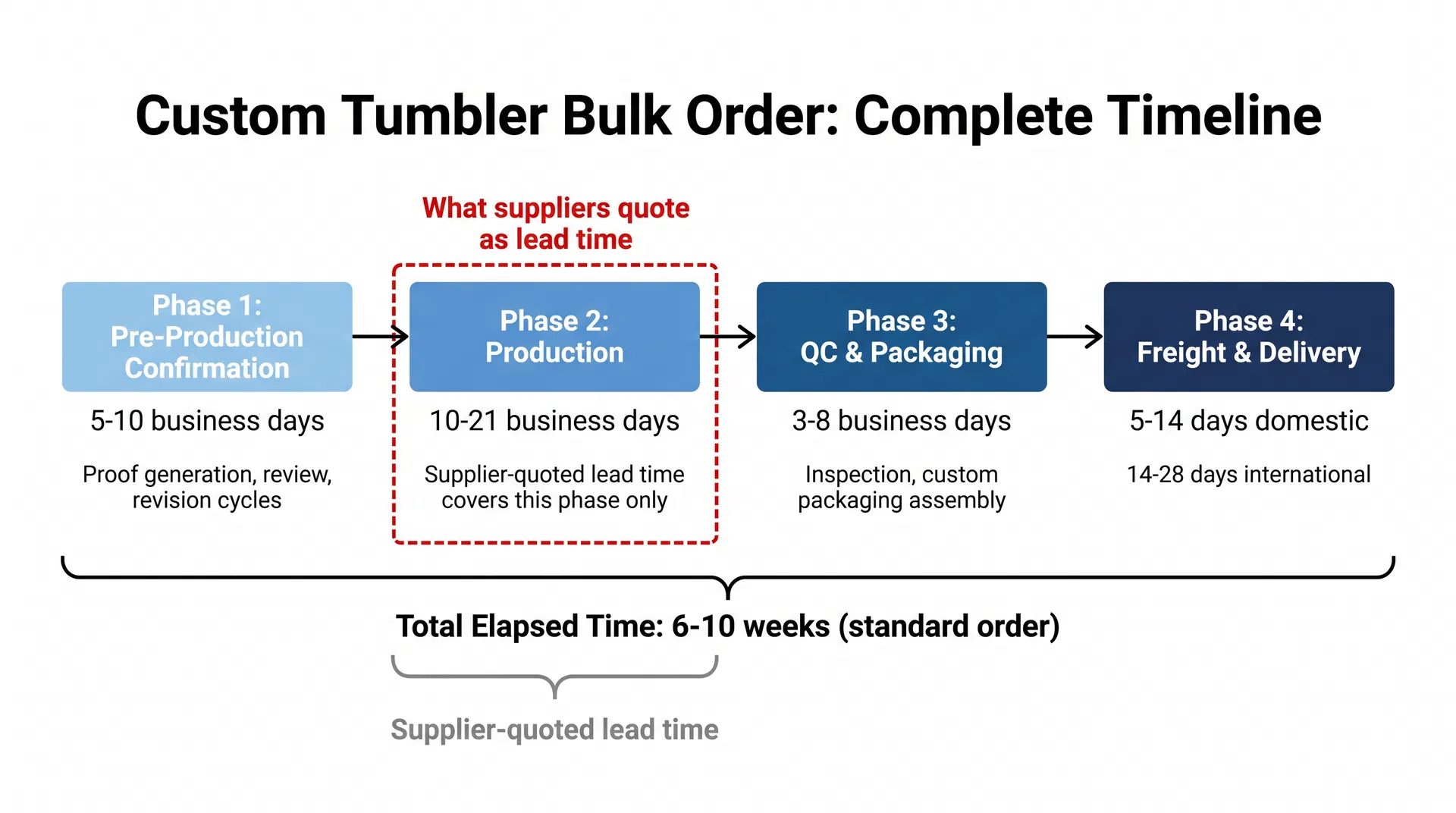
Corporate gift drinkware fulfillment is the process of receiving branded bottles, tumblers, mugs, or gift sets; checking the inventory; assembling the approved kit; packaging it for the delivery channel; and shipping it to the correct office, event, or recipient. A reliable program treats fulfillment as part of the product experience, not as an afterthought after manufacturing.
Quick answer: Plan corporate drinkware fulfillment in seven control points: approved SKU and sample, inbound receiving, inventory count, kitting rules, packaging and insert sequence, address and shipment data, and post-campaign reconciliation. Define who owns each handoff, what evidence proves the kit is correct, and what happens when an item is damaged, missing, personalized incorrectly, or sent to an invalid address.
A branded tumbler can leave the factory in perfect condition and still create a poor corporate gift experience. The lid may be packed separately, the insert may be placed upside down, the recipient address may be outdated, or a carton may arrive after the event. Fulfillment is the operating layer that connects factory quality to the moment when a client, employee, partner, or event attendee opens the package.
What is corporate gift drinkware fulfillment?
Corporate gift fulfillment is the coordinated handling of products, packaging, inserts, recipient rules, inventory, and delivery. For drinkware, it may include receiving finished units, inspecting cartons, storing multiple colors or lid configurations, assembling a bottle with a card and accessory, applying a recipient label, and shipping to one warehouse or many individual addresses.
Kitting is the assembly of two or more items into one defined package. A simple drinkware kit may contain one tumbler, one lid, one cleaning accessory, one message card, and one branded box. A welcome kit may add apparel, a notebook, a badge, or a benefits insert. The kit needs a version because the contents, order, and packaging can change during a campaign.
Fulfillment is broader than kitting. It includes receiving, storage, inventory control, pick and pack, shipment creation, tracking, exception handling, returns, and reconciliation. A company can have correct kitting and still have a fulfillment failure if the wrong recipient file is used or the final shipment count is not reconciled.
| Term | Meaning in a corporate drinkware program |
|---|---|
| SKU | A defined product variation such as body, color, lid, or decoration |
| Kit | The complete set of items packed for one recipient or destination |
| Kitting | Picking and assembling the items into the approved kit |
| Pack-out | The exact sequence and protective arrangement inside the package |
| Ship window | The approved period when packages may leave the fulfillment location |
| Exception | A condition requiring a hold, correction, replacement, or decision |
| Reconciliation | Comparing planned, received, packed, shipped, returned, and remaining units |
The custom drinkware RFQ template should define packaging and delivery assumptions before a supplier quote is approved. The custom drinkware landed cost guide explains why kitting, packaging, fulfillment, and domestic delivery belong in the complete cost model.
What should be approved before fulfillment begins?
Approve the product configuration, kit bill of materials, packaging sample, insert artwork, recipient rules, ship-to file format, quality checkpoints, and escalation contacts before the first campaign units are packed. A fulfillment team should not have to infer which lid belongs with which bottle or whether a card is included for every recipient.
The approved sample should show more than the drinkware body. It should show the lid, accessory placement, unit packaging, insert position, labels, and any protective material. Photograph the approved pack-out from the outside and inside. Record the kit version, approval date, and owner so the warehouse can compare production work against a stable reference.
Create a bill of materials for each kit version. It should identify the quantity of every component, the SKU or revision, the location in the package, and whether the component is universal or recipient-specific. If a campaign has standard, executive, and international versions, treat them as separate pack-out configurations rather than informal variations.
| Approval item | Minimum decision to record |
|---|---|
| Drinkware SKU | Body, capacity, color, lid, decoration, and revision |
| Accessories | Quantity, type, compatibility, and replacement rule |
| Message or insert | Artwork, language, recipient rule, and orientation |
| Unit packaging | Box, sleeve, tissue, protection, and opening experience |
| Master carton | Units per carton, labels, stacking, and handling limits |
| Recipient data | Required fields, validation, privacy owner, and file date |
| Ship window | Earliest ship date, latest ship date, and event or start-date constraint |
| Quality release | Inspection point, photos, sample size, and hold authority |
The sample approval checklist and quality control inspection checklist provide the upstream controls that make the fulfillment approval practical.
How should inbound receiving be controlled?
Receiving should verify what arrived before the goods enter available inventory. Count cartons, inspect visible damage, confirm labels and SKU references, record the condition of pallets or cases, and quarantine exceptions. Do not let an urgent campaign bypass receiving controls; an inaccurate opening count creates downstream shortages that are difficult to diagnose.
Use a receiving record that distinguishes ordered quantity, shipped quantity, received quantity, accepted quantity, damaged quantity, and quarantined quantity. Photograph damaged cartons before opening when possible. When a carton is opened, photograph the internal condition if the damage could have affected the drinkware, box, lid, logo, or insert.
Sample the received product against the approved configuration. Confirm body and lid compatibility, artwork revision, packaging, accessories, and visible finish. If the order contains several colors or SKUs, sample each configuration rather than assuming one checked carton represents every variation.
The receiving decision should be one of four states: accepted into available inventory, accepted with a documented deviation, quarantined pending investigation, or rejected and returned or replaced. The responsible owner should be able to see the quantity affected and the next action.
How should inventory be organized for a drinkware gift campaign?
Inventory should be controlled at the level that changes the pack-out. If the same bottle has two lid colors, three message versions, and two recipient regions, those differences must be visible in the inventory and kit rules. A single generic SKU can create picking errors when the physical items are not interchangeable.
Separate available, allocated, picked, packed, shipped, returned, damaged, and quarantined inventory. Allocation reserves units for a campaign without pretending they have already shipped. Packed inventory has passed a pack-out check. Shipped inventory requires a carrier event or documented handoff. Returned inventory should not automatically return to available stock until it is inspected.
Use location labels and batch identifiers that remain readable after cartons are moved. Record the lot or production reference when the drinkware has different revisions, coatings, lids, or decoration runs. This makes replacement decisions faster when one batch has a quality hold or a recipient reports a missing component.
| Inventory state | What it means | Release rule |
|---|---|---|
| Received | Physically arrived and counted | Not available until inspected and recorded |
| Available | Approved for the campaign | May be allocated or picked |
| Allocated | Reserved for a defined campaign or recipient group | Not available for another program |
| Picked | Components selected for a kit | Requires pack-out verification |
| Packed | Kit assembled and checked | Awaiting carrier handoff |
| Shipped | Carrier or delivery handoff recorded | Tracking or proof required |
| Returned | Came back from a recipient or carrier | Inspect before restocking |
| Quarantined | Held due to damage, mismatch, or uncertainty | Quality or program owner releases it |
The B2B drinkware replenishment strategy is relevant when a campaign stores extra units for future new hires, client gifts, or replacement requests. Reorder stock should remain traceable to the approved configuration rather than becoming an unplanned assortment of similar products.
How should drinkware kits be assembled?
Use a written pack-out sequence and a visual standard. The sequence should specify which component is picked first, where the drinkware is placed, how the lid or accessory is protected, where the insert sits, how the package closes, and where the shipping label is applied. A photograph alone is helpful but cannot explain a conditional rule such as a different message card by recipient group.
A practical pack-out process has three checks. The picker confirms the components. The assembler places them according to the approved kit version. The checker verifies identity, count, orientation, appearance, protection, and label before the package is closed or released. For low-volume premium gifts, the checker may inspect every package. For high-volume programs, the buyer may define a sampling and escalation plan.
Keep personalization separate from universal assembly rules. A standard drinkware kit may be assembled in advance, while a recipient-specific card, name label, size, or destination label is added at the final step. This reduces the amount of inventory that must be rebuilt when an address or recipient file changes.
Pack-out instructions should use plain language and photographs of the approved result. Mark the difference between must-match features and acceptable variation. If the gift is opened at an event or executive meeting, test the opening sequence with the actual package and contents before authorizing full assembly.
How should packaging protect the brand experience?
Packaging should protect the drinkware, preserve the decoration, present the contents in the intended order, and survive the delivery method. A box that looks premium in a studio can fail in a parcel network if the lid presses against the logo, the tumbler moves inside the carton, or the insert shifts under vibration.
Test the final pack-out through the actual distribution channel. A pallet delivery to one warehouse has different handling from individual parcels to remote employees. A multi-location office shipment needs labels and carton rules that support receiving teams. A direct-to-recipient package needs a recipient-safe label, protection against visible damage, and a process for undeliverable shipments.
Packaging materials that contact the beverage or product surface should be identified and used as intended. The FDA defines a food contact substance as a substance that comes into contact with food without being intended to have a technical effect in the food; packaging components, adhesives, colorants, and other materials can fall within that scope.1 The drinkware itself and any contact-related component should have the appropriate documentation for its intended use. Do not turn a general packaging statement into an unsupported regulatory claim.
Use a packaging change-control rule. A different insert, carton, foam, tissue, label, or adhesive can change cost, protection, presentation, or compliance assumptions. The fulfillment partner or supplier should not substitute a package simply because the new item appears similar. Document the change, inspect a sample, and approve the revised pack-out when the difference affects the recipient experience or product protection.
How should recipient data and shipping be managed?
Validate the recipient file before picking begins. Required fields may include recipient name, company, address lines, city, state, postal code, country, phone or email for delivery exceptions, kit version, personalization text, and ship window. Define which fields are mandatory, who may edit them, and when the file is locked for fulfillment.
Remove duplicates and flag incomplete addresses before labels are generated. A duplicate recipient can consume two kits; an invalid apartment or office address can create a return and a replacement cost. Do not solve every address issue manually on the warehouse floor because undocumented edits make reconciliation unreliable.
Group shipments by the rule that matters to the program: office, department, event, recipient type, ship date, country, or kit version. Apply consistent label and carton identifiers so a receiving team can identify the contents without opening every package. For events, define the delivery appointment, on-site contact, count requirement, and backup plan if the shipment arrives early or late.
| Shipping decision | Why it should be set before fulfillment |
|---|---|
| Ship-to boundary | Determines packing, freight, labels, and responsibility |
| Recipient file lock | Prevents late changes from creating wrong labels |
| Grouping rule | Controls batch picking, cartons, and receiving |
| Ship window | Protects event, launch, or employee start-date timing |
| Carrier method | Balances cost, tracking, speed, and handling risk |
| Exception rule | Defines replacement, hold, reroute, or refund decision |
| Tracking owner | Ensures recipients and program managers can see status |
The employee welcome kit guide is a useful related planning reference because onboarding programs often combine drinkware with recipient-specific timing, inserts, and multiple address groups.
How should fulfillment quality control be measured?
Measure the errors that affect the recipient and the program owner. Useful checks include kit accuracy, missing-component rate, wrong-SKU rate, wrong-insert rate, label accuracy, damage rate, on-time ship rate, tracking availability, address exception rate, return rate, and inventory reconciliation variance.
A metric is useful only when its numerator and denominator are clear. “99% accurate” is not enough. Define whether accuracy means every component correct, every package shipped on time, or every recipient address accepted. Report the campaign total, the affected units, the root cause, and the correction.
Use photo checkpoints for premium campaigns. A photo can verify the pack-out, label, carton, or damage condition, but it should not replace a count or system record. For large programs, sample photographs by batch and retain them with the pack-out version and operator or station reference.
| KPI | Basic calculation | What it reveals |
|---|---|---|
| Kit accuracy | Correct kits ÷ checked kits | Component and version control |
| Pack-out variance | Planned units − packed units | Missing or over-packed inventory |
| On-time ship rate | Shipments in window ÷ total shipments | Campaign schedule control |
| Damage rate | Damaged units ÷ units received or shipped | Packaging and handling risk |
| Address exception rate | Exception shipments ÷ total shipments | Data quality and delivery friction |
| Inventory variance | System quantity − physical quantity | Reconciliation quality |
| Return rate | Returned shipments ÷ shipped shipments | Address, carrier, or recipient issues |
Track the reason for every failure. A wrong insert may indicate a version label problem; a missing lid may indicate a component staging problem; repeated carton damage may indicate a packaging design problem. Correcting the symptom without correcting the process produces the same failure on the next campaign.
How should exceptions and returns be handled?
Define exception decisions before the campaign starts. The warehouse should know when to hold a package, replace a component, reroute a shipment, update an address, return a parcel, or notify the program owner. The answer may differ for a high-value client gift, an employee kit, and an event shipment, but the rule should be written.
Create an exception record with recipient or shipment ID, kit version, issue type, photograph or carrier evidence, quantity, owner, decision, cost, and resolution date. Separate product defects from address errors, carrier damage, inventory shortages, personalization errors, and recipient-requested changes.
Returned drinkware should be inspected before reusing or restocking it. Check the package, label, drinkware surface, lid, accessories, and recipient-specific materials. A returned kit may look unopened while a carton has been crushed or a label has exposed personal information. Reconcile returned units separately from available inventory until the quality decision is complete.
Post-campaign reconciliation should compare planned recipient count, received inventory, damaged and quarantined units, packed kits, shipped packages, delivered packages where available, returns, replacements, and remaining stock. Any difference should have a written explanation rather than being absorbed into “miscellaneous.”
How should fulfillment cost be planned?
Fulfillment cost includes receiving, storage, pick and pack, kitting labor, packaging materials, inserts, labels, parcel or freight charges, address corrections, returns, replacements, inventory reporting, and any minimum campaign or storage fee. Request these lines separately so procurement can compare a supplier’s quote with an external fulfillment partner or internal operation.
The landed cost calculator guide explains why fulfillment and domestic delivery belong in the total cost model. A product with a low manufacturing price may have a higher program cost when it requires manual rework, fragile packaging, multiple shipments, or a high return rate.
Model a standard case and an exception case. The standard case includes the planned units, approved kit, normal packaging, and expected shipping. The exception case includes address corrections, replacement units, damaged cartons, partial shipments, and late changes. This helps the program owner decide whether to fund stronger packaging, better data validation, or an additional quality checkpoint.
Corporate gift drinkware fulfillment checklist
| Phase | Release question |
|---|---|
| Scope | Is the product, kit version, recipient group, and ship window defined? |
| Approval | Is the physical pack-out and packaging sample approved? |
| Receiving | Are cartons counted, inspected, photographed, and reconciled? |
| Inventory | Are SKU, lot, kit version, and inventory states traceable? |
| Kitting | Is the bill of materials and pack-out sequence documented? |
| Quality | Are component, appearance, packaging, label, and count checks assigned? |
| Shipping | Is the recipient file validated and grouped by the correct rule? |
| Exceptions | Are hold, replacement, reroute, return, and escalation rules documented? |
| Reporting | Are shipment status, accuracy, damage, returns, and inventory variance reported? |
| Closeout | Are remaining, returned, damaged, and replacement units reconciled? |
Corporate gift drinkware fulfillment works when every handoff has an owner and every important decision has evidence. The factory controls the product configuration. The fulfillment team controls the kit, package, inventory, and shipment. The program owner controls the recipient rules, dates, exceptions, and final release.
The recipient should experience one coherent brand moment, even when the work behind it crosses manufacturing, quality, packaging, logistics, and data operations. A written pack-out, a validated recipient file, a controlled inventory, and a post-campaign reconciliation are what turn a bulk shipment into a dependable corporate gifting program.
References