Cost Analysis
Corporate Gift Fulfillment Cost per Recipient: Complete Guide
企業禮品 fulfillment 每位收件人成本完整指南,涵蓋產品、包裝、kitting、收貨、儲存、配送、退貨、例外處理與買方人工。
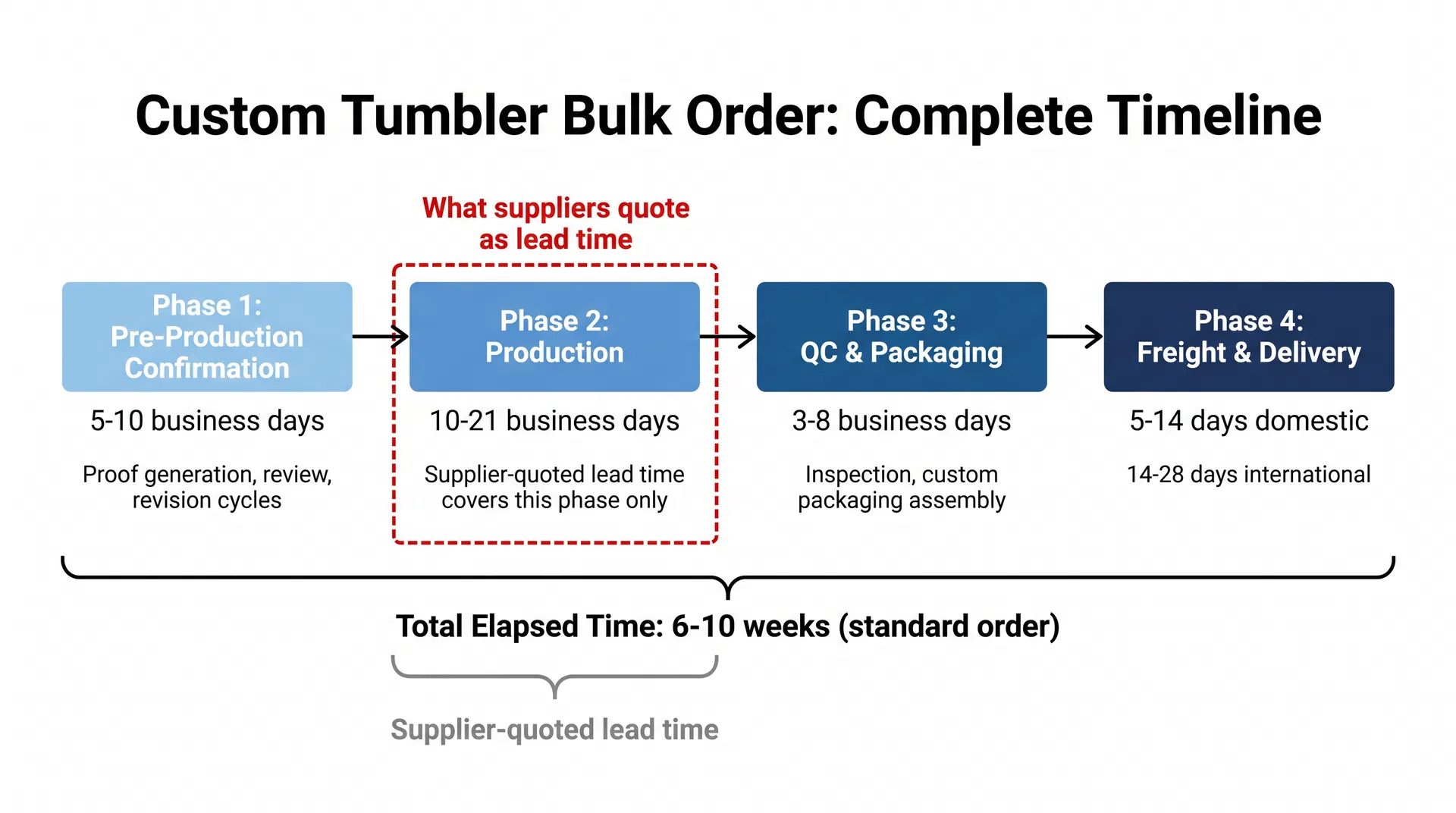
Corporate gift fulfillment cost per recipient is the complete cost of preparing and delivering one approved gift to one recipient or destination. It is broader than the drinkware price and broader than a fulfillment provider’s pick-and-pack fee. A reliable calculation includes the product, decoration, packaging, kitting, receiving, storage, shipping, data handling, exceptions, returns, and any buyer-side distribution labor.
Quick answer: Calculate corporate gift fulfillment cost per recipient by adding product and branding, packaging, kitting, receiving, storage, shipment preparation, freight or parcel delivery, address handling, exceptions, returns, and approved contingency. Subtract documented credits, then divide by the number of successfully delivered or usable gift packages. Show one-time setup costs, recurring costs, and buyer labor separately so the result is comparable across suppliers and fulfillment models.
This number is useful because procurement decisions often compare incomplete costs. One supplier may quote a tumbler and box. Another may quote a finished kit delivered to each employee. A third may quote bulk cartons to headquarters. Those are different commercial boundaries. Cost per recipient creates a common destination-based view while preserving the assumptions that make the calculation trustworthy.
What does corporate gift fulfillment cost per recipient include?
The cost includes every required activity between approved inventory and the recipient-ready package at the agreed destination. Depending on the program, that may include receiving finished drinkware, storing inventory, picking components, assembling a kit, inserting a card, applying a label, packaging for parcel shipment, generating tracking, correcting addresses, processing returns, and reconciling remaining stock.
It can also include buyer-side labor when the buyer chooses bulk shipping. If the supplier ships 500 tumblers to an office and the buyer’s team spends two days sorting, labeling, and distributing them, that labor is part of the program cost even if it does not appear on the supplier invoice.
The boundary should be written in one sentence: “Cost per recipient ends when a complete kit is delivered to the recipient’s address,” or “Cost per recipient ends when a counted bulk carton is delivered to the named warehouse.” Without that sentence, two cost models can use the same label while measuring different outcomes.
| Cost layer | Typical contents | Why it matters |
|---|---|---|
| Product | Bottle, tumbler, mug, lid, accessories | Defines the physical gift |
| Branding | Engraving, printing, setup, proof, color matching | Converts stock product into branded inventory |
| Packaging | Unit box, insert, sleeve, tissue, protection | Controls presentation and damage risk |
| Fulfillment | Receiving, storage, pick, pack, kitting, QC | Converts inventory into a recipient-ready package |
| Delivery | Parcel, freight, fuel, handling, appointment, last mile | Moves the package to its destination |
| Data operations | Address validation, labels, personalization, tracking | Connects the correct kit to the correct recipient |
| Exceptions | Address correction, replacement, rework, return | Captures the cost of normal program risk |
| Program overhead | Setup, reporting, account management, reconciliation | Makes the campaign operable and auditable |
The corporate gift drinkware fulfillment guide explains the operational controls behind these layers. The landed cost calculator guide explains how to place fulfillment and delivery inside a broader procurement cost model.
What is the formula for fulfillment cost per recipient?
A practical formula is: total program cost equals product and branding plus packaging plus receiving plus storage plus kitting and quality control plus shipment preparation plus delivery plus data handling plus exception and return costs plus buyer-side labor plus contingency, less documented credits. Cost per recipient equals total program cost divided by successful delivered packages or another clearly defined usable-unit denominator.
Use two denominators when the program has material loss or exceptions. Cost per planned recipient divides by the approved recipient count and shows the budget required for the campaign. Cost per successful delivery divides by packages delivered and shows the operational cost of the outcome. Cost per usable kit divides by complete kits available after damage, shortage, or rejection.
Do not mix these denominators in one report. A program may appear cheaper when divided by 1,000 planned recipients even if 40 packages required replacement. Showing both figures makes the operational leakage visible.
| Metric | Formula | Best use |
|---|---|---|
| Cost per planned recipient | Total program cost ÷ planned recipients | Initial budget approval |
| Cost per shipped package | Total program cost ÷ packages shipped | Fulfillment and carrier comparison |
| Cost per delivered recipient | Total program cost ÷ successful deliveries | Campaign outcome review |
| Cost per usable kit | Total program cost ÷ complete usable kits | Quality and replacement analysis |
| Incremental cost per recipient | Variable program cost ÷ additional recipients | Scaling and volume decisions |
A cost model should identify whether each input is confirmed, estimated, optional, or unresolved. It should record the source, currency, date, owner, and refresh date. A spreadsheet with many decimal places is not reliable if the shipping boundary and labor assumptions are missing.
Which costs are fixed, variable, or one-time?
Fixed costs do not change directly with recipient count within the agreed program range. They may include artwork setup, packaging development, account setup, inventory system configuration, a minimum storage charge, or a campaign reporting fee. Variable costs move with packages, items, addresses, cartons, or miles, such as kitting labor, labels, parcel shipping, inserts, and address corrections.
One-time costs should not automatically disappear from the cost model after the first order. Show them separately, then present both first-campaign and repeat-campaign cost per recipient. A tooling or packaging development charge may be fully allocated to the first campaign, spread across an approved program, or excluded from the recurring rate only after reuse is confirmed.
| Cost type | Examples | Reporting treatment |
|---|---|---|
| One-time | Artwork setup, packaging design, sample, system setup | Show separately and allocate transparently |
| Fixed recurring | Storage minimum, reporting fee, program management | Allocate across the defined campaign |
| Per-kit variable | Pick, pack, insert, label, QC | Multiply by complete kits |
| Per-address variable | Parcel, residential surcharge, address correction | Multiply by destination profile |
| Exception variable | Replacement, return, rework, reroute | Estimate using scenarios |
| Buyer-side labor | Receiving, sorting, internal distribution | Include when the buyer performs the work |
ShipBob’s fulfillment cost guidance describes receiving, storage, picking and packing, packaging, kitting, returns, and shipping as separate cost areas that can contribute to total fulfillment cost.1 That framework is useful for corporate gifting even when the program is not conventional ecommerce because it prevents the buyer from treating pick-and-pack as the entire cost.
How do product and branding affect cost per recipient?
Start with the complete gift configuration. Include the drinkware body, lid, gasket, straw, carry loop, cleaning accessory, and any component that the recipient is expected to receive. A quoted tumbler body is not the same as a complete corporate gift.
Branding costs may include artwork preparation, laser or print setup, color matching, proofing, sample approval, special finishes, packaging artwork, and a minimum charge. Separate recurring decoration from one-time setup. The custom drinkware RFQ template can be used to request the same cost scope from multiple suppliers.
Packaging can change both the recipient experience and the delivery cost. A compact protective box may have a lower dimensional weight than a large gift box. A premium box may reduce the need for a separate presentation bag but increase carton volume. Model the final approved pack-out, not a preliminary concept.
The product and branding lines should also show whether the unit is sellable. If a batch has rejected decoration, missing lids, or damaged bodies, divide the relevant cost by usable complete kits when calculating the outcome cost. The quality inspection and sample approval articles provide controls that reduce this leakage.
How do fulfillment activities change the per-recipient cost?
Receiving is the labor and system work required to accept inventory into the fulfillment operation. Storage is the cost of holding product, packaging, and assembled kits until release. Picking selects the correct components. Kitting assembles the approved set. Packing protects and presents it. Quality control verifies the contents and pack-out. These activities may appear as separate fees or as one bundled fulfillment rate.
Ask the fulfillment provider to clarify whether the rate includes the first item, additional picks, inserts, custom packaging, kit assembly, photos, labeling, inventory reporting, and quality checks. If the provider uses a bundled rate, request the operational definition of a completed order so that a quote can be compared to a line-item quote.
A simple cost per recipient model can show the following workflow:
- Receive and count the branded drinkware and packaging.
- Inspect the inventory against the approved product and packaging version.
- Allocate units to the campaign, recipient group, or destination.
- Pick the drinkware, lid, accessory, insert, and packaging components.
- Assemble the kit according to the approved pack-out.
- Check count, appearance, component compatibility, label, and personalization.
- Close the package, generate the shipment record, and hand it to the carrier.
- Track delivery, process exceptions, and reconcile remaining inventory.
Each step may create a cost, a control, or both. Prep Partners Group describes corporate gift fulfillment in terms of kitting, packaging, inventory, distribution, personalized inserts, custom shipping rules, returns, and post-campaign reconciliation.2 The buyer should ask which of these capabilities are included in the quoted program and which are add-ons.
How does shipping affect cost per recipient?
Shipping often becomes the largest variable after the product itself, particularly when recipients are distributed across many addresses. Cost depends on package dimensions, billable weight, destination, shipping zone, speed, carrier, fuel or handling surcharges, residential delivery, appointment requirements, and the number of shipment waves.
Do not use an average freight figure without recording its basis. A residential parcel average and a warehouse pallet average describe different operations. Separate consolidated freight, parcel delivery, local delivery, international delivery, and expedited replacement shipments.
Dimensional packaging can materially change parcel cost even when the drinkware is lightweight. The final box size, protective material, and number of packages per recipient should be confirmed before the budget is approved. A two-item gift may be cheaper to ship as one complete kit than as separate packages, but only if the packaging protects both items and the order can be assembled reliably.
| Shipping input | Why it changes the calculation |
|---|---|
| Number of destinations | More addresses create more labels, shipments, and exceptions |
| Package dimensions | Dimensional weight may exceed actual product weight |
| Delivery speed | Expedited service increases variable cost and risk exposure |
| Destination mix | Residential, office, rural, and international delivery differ |
| Shipment waves | Staged releases add handling and inventory management |
| Carrier method | Parcel, freight, local courier, and pickup have different boundaries |
| Replacement shipments | Damage and address failures create additional delivery cost |
The kitting vs bulk shipping comparison explains why consolidated delivery can look cheaper while transferring sorting and distribution work to the buyer. Include that transferred work in cost per recipient when comparing models.
How should buyer-side labor be included?
Buyer-side labor belongs in the calculation when the buyer performs receiving, sorting, packing, labeling, internal delivery, event setup, or returns work that another model would outsource. Use a loaded hourly cost that reflects the responsible team’s compensation and relevant overhead, or report the hours separately when finance requires a different treatment.
For example, a headquarters team may receive 500 drinkware units, sort them by department, add employee cards, and deliver them to offices. The supplier’s invoice may not show any of that work, but the campaign still consumes staff time and space. If a kitting provider can complete the work before shipment, the supplier quote may be higher while the total program cost is lower.
Do not overstate labor savings. Confirm the actual process and required service level. A warehouse employee may be able to sort cartons quickly, while address-level personalization, gift-box assembly, and replacement handling require more specialized work. Separate routine labor from overtime, event labor, and interruption cost.
How do returns and exceptions change cost?
Exceptions include invalid addresses, duplicate recipients, missing components, damaged cartons, wrong kit versions, failed personalization, delayed deliveries, refused packages, and recipient-requested changes. Each exception can create labor, replacement product, packaging, carrier, and customer-service cost.
Model exceptions with a low, expected, and high scenario. Do not hide them in an unexplained percentage. Identify the source of the assumption, the owner of the decision, and the response rule. The program may choose to replace a damaged tumbler, ship a missing lid, reroute a package, hold a kit, or refund a recipient.
Returns require a disposition rule. A returned kit should not automatically go back into available inventory. Inspect the packaging, product, lid, accessory, insert, and label. Decide whether it can be restocked, reworked, repacked, donated, recycled, or discarded. Record the cost and the reason.
| Exception | Direct cost | Operational response |
|---|---|---|
| Invalid address | Correction, relabeling, second shipment | Validate data before label creation |
| Damaged package | Replacement, reshipment, claim | Photograph and document the condition |
| Missing component | Replacement component and labor | Use component-level inventory |
| Wrong kit version | Rework and new packaging | Control version and pick rules |
| Failed personalization | Reproduction or replacement | Approve artwork and check before release |
| Refused or returned package | Return freight, inspection, restock | Define disposition and recipient contact |
| Late delivery | Expedited replacement or event impact | Add schedule buffer and escalation owner |
A high exception rate can make a seemingly low-cost model more expensive than a model with stronger pre-shipment controls. Track exceptions by cause, not only by total count.
How should cost per recipient differ by fulfillment model?
Individual kitting and shipping usually carry more package-level handling, labels, and parcel charges, but they reduce buyer-side distribution work and provide recipient-level tracking. Bulk shipping usually lowers consolidated freight and package-level handling, but it increases receiving, storage, sorting, and internal distribution work. A hybrid model uses each approach where it creates the most operational value.
| Model | Cost advantages | Cost risks | Best fit |
|---|---|---|---|
| Individual kitting | Less buyer handling, recipient-ready presentation | Parcel, address, and exception costs | Remote employees, clients, VIPs |
| Bulk shipping | Consolidated freight, simple destination count | Buyer labor, storage, sorting, local distribution | Events, offices, warehouses |
| Hybrid | Matches model to recipient group | More planning and separate rules | Mixed corporate audiences |
The denominator must match the model. For individual shipping, use delivered recipient packages. For bulk shipping, use complete distributed kits rather than cartons received. If the buyer receives 500 units but only distributes 470 during the event, show the remaining inventory and explain whether it is useful future stock or an unused program cost.
Worked cost-per-recipient example
Assume a company plans 600 branded drinkware gifts. The product and decoration cost is $4.85 per unit. Unit packaging and insert cost $1.05. A one-time artwork and sample charge is $360. Receiving and inventory setup total $300. Kitting and quality control cost $1.25 per kit. Address processing and labels cost $0.35 per recipient. Parcel shipping averages $5.80 per destination in the expected scenario. The program reserves $450 for exceptions and replacement shipments. Buyer-side project management and reconciliation are estimated at $400.
| Cost item | Calculation | Amount |
|---|---|---|
| Product and decoration | 600 × $4.85 | $2,910 |
| Packaging and insert | 600 × $1.05 | $630 |
| Artwork and sample | One-time | $360 |
| Receiving and setup | Program-level | $300 |
| Kitting and QC | 600 × $1.25 | $750 |
| Address processing | 600 × $0.35 | $210 |
| Parcel delivery | 600 × $5.80 | $3,480 |
| Exception allowance | Program estimate | $450 |
| Buyer-side management | Program estimate | $400 |
| Expected program total | Sum of listed lines | $9,490 |
| Expected cost per planned recipient | $9,490 ÷ 600 | $15.82 |
If 588 packages are delivered successfully and 12 recipients require replacement or remain unresolved, the delivered-recipient cost is approximately $16.14 when the same total program cost is divided by 588. The difference is not a recommendation to inflate the budget; it is a signal to investigate the causes of the delivery gap.
This is an illustrative model, not a supplier quote. The shipping average, product price, and exception allowance must be replaced with the buyer’s approved inputs. Show the first campaign cost separately from repeat campaign cost if the artwork and sample charge will not repeat.
How should a procurement worksheet be structured?
Use one sheet for assumptions, one for cost lines, one for recipient or destination groups, and one for reconciliation. The assumptions sheet should state quantity, currency, delivery boundary, fulfillment model, ship window, kit version, sellable-unit rule, and cost scenario.
The cost-line sheet should include description, unit, quantity, rate, extended cost, source, confidence, owner, and repeat status. The recipient sheet should include validated destinations, kit version, label status, shipment status, delivery status, and exception code without exposing unnecessary personal data. The reconciliation sheet should compare planned, received, allocated, packed, shipped, delivered, returned, replaced, damaged, and remaining quantities.
| Worksheet field | Example |
|---|---|
| Program scope | 600 branded tumblers for employee gifts |
| Fulfillment model | Individual kitting and parcel delivery |
| Cost boundary | Delivered complete kit to recipient address |
| Planned recipients | 600 |
| Successful deliveries | Updated after carrier confirmation |
| Kit version | Standard employee kit v3 |
| Currency | USD and exchange-rate date if applicable |
| Exception policy | Replace damaged product; correct valid address once |
| One-time charges | Artwork, sample, setup |
| Repeat charges | Product, packaging, kitting, shipping, storage |
| Review owner | Procurement plus fulfillment lead |
A worksheet is only as useful as the change-control process around it. Refresh freight, address, storage, packaging, and exception assumptions when the recipient file, kit version, destination mix, or ship window changes.
How can a company reduce cost per recipient without reducing quality?
First, reduce avoidable touches. Approve the complete pack-out early, use a clear bill of materials, and stage components by kit version. A missing insert or incompatible lid can create more cost than the small savings from a faster but less controlled pick process.
Second, improve data quality before labels are created. Duplicate and incomplete addresses generate rework, replacement shipping, and recipient frustration. Lock the file at an agreed time and define how late changes are handled.
Third, compare packaging by total delivered cost. A slightly higher box cost may reduce damage and replacement shipments. A smaller package may reduce dimensional weight while still protecting the drinkware. Test the actual channel rather than deciding from a mockup.
Fourth, use a hybrid model when the audience is mixed. Send event inventory in consolidated cartons, while direct-ship remote employees or VIP recipients as complete kits. Avoid paying the highest-touch model for every recipient when the service requirement is not the same.
Fifth, track exceptions by root cause. If most replacements come from address errors, improve validation. If most damage occurs at the lid or logo area, improve packaging. If most shortages occur during internal distribution, use carton identifiers and a receiving count.
Corporate gift fulfillment cost per recipient checklist
| Control question | Evidence to retain |
|---|---|
| Is the cost boundary defined? | Destination and completion rule |
| Is the kit version approved? | Pack-out photo, bill of materials, approval date |
| Are product and decoration complete? | RFQ, proof, sample, production specification |
| Are one-time and recurring costs separated? | Cost worksheet and supplier quote |
| Are receiving and storage included? | Fulfillment scope and inventory report |
| Is kitting or bulk labor assigned? | Pick-pack scope or buyer labor estimate |
| Is shipping based on final dimensions? | Carton data, carrier quote, validity date |
| Are exceptions modeled? | Low, expected, high scenarios and response rules |
| Is the denominator defined? | Planned, shipped, delivered, or usable count |
| Is the campaign reconciled? | Delivery, returns, replacements, and remaining stock |
Corporate gift fulfillment cost per recipient is a management number, not just a shipping number. It connects product selection, packaging, fulfillment, logistics, data quality, recipient experience, and post-campaign accountability. Use it to compare suppliers and models on the same destination boundary.
The best cost model is transparent enough for procurement, finance, marketing, HR, logistics, quality, and the fulfillment partner to challenge the same assumptions. When every input has an owner and every exception has a rule, the company can reduce cost without removing the controls that protect the gift experience.
References