Logistics & Supply Chain
Corporate Gift Drinkware Reorder Point and Safety Stock Guide
Learn how to calculate reorder points and safety stock for corporate gift drinkware using demand, lead time, usable inventory, MOQ, events, quality holds, and supplier risk.
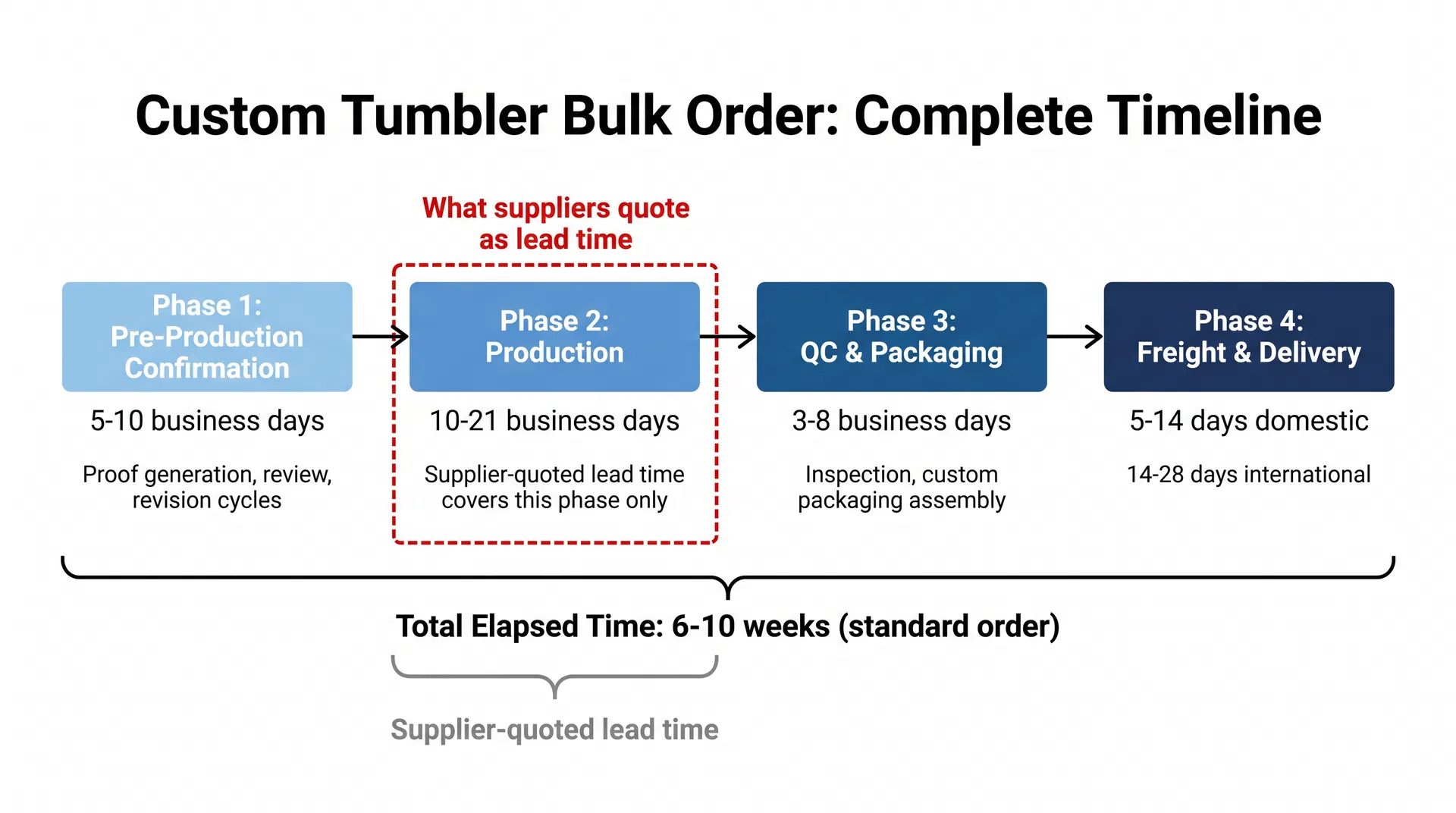
A corporate gift drinkware reorder point is the inventory level that triggers a replenishment order for branded bottles, tumblers, mugs, or gift kits. Safety stock is the extra inventory held to absorb demand spikes, supplier delays, quality holds, address changes, or other uncertainty. A reorder point includes expected demand during replenishment lead time plus the safety stock buffer; it is not the same as the minimum order quantity or the order quantity.
Quick answer: Calculate a corporate drinkware reorder point as average daily usage multiplied by the replenishment lead time, plus safety stock. Use usable inventory—not only physical units—and subtract allocated kits, backorders, quarantined units, and other commitments when calculating inventory position. Review the point when demand, lead time, event timing, product configuration, or supplier performance changes.
This distinction matters because branded drinkware often serves programs with uneven demand. A company may use a few units for replacements in one month and hundreds for a hiring wave, client event, or annual conference in the next. A supplier may quote one production lead time while the actual approval, decoration, inspection, freight, and receiving timeline is longer. A static “keep 100 units on hand” rule can be either excessive or dangerously low.
What is a reorder point for corporate drinkware?
The reorder point, or ROP, is the stock level that triggers a replenishment decision. It answers: “When should procurement start the next order so inventory can arrive before usable stock is exhausted?” The ROP is calculated for a defined SKU or kit version, destination, demand unit, and lead-time boundary.
For branded drinkware, a SKU may be defined by body, capacity, color, lid, decoration, packaging, or kit version. Similar-looking products should not be combined if they are not interchangeable for a recipient program. A black 20-ounce tumbler with a standard lid may not be a substitute for a white 16-ounce tumbler in an approved employee welcome kit.
The reorder point is different from safety stock. Safety stock is a buffer. The reorder point is the trigger that combines expected lead-time demand and the buffer. The order quantity is how many units procurement buys after the trigger. MOQ is the supplier’s minimum order requirement. These numbers can interact, but they answer different questions.
| Inventory concept | Question it answers | Corporate drinkware example |
|---|---|---|
| Reorder point | When should we place the next order? | Trigger at 420 usable units |
| Safety stock | How much uncertainty buffer should we hold? | 120 units for event and lead-time risk |
| Order quantity | How many units should we buy? | 1,000 units for the next program |
| MOQ | What is the supplier’s minimum order? | Supplier requires 500 units |
| Inventory position | What stock is truly available after commitments? | On hand plus open order less allocations |
| Cycle stock | What inventory covers normal expected use? | Units planned for routine replacements |
GAINS Systems describes the reorder point as the remaining stock level at which a new order should be placed and notes that demand and supplier delivery time can change the correct point.1 That is particularly relevant to drinkware programs because a campaign’s demand and production timeline are rarely constant across the year.
The B2B drinkware replenishment strategy provides a broader program framework. This article focuses on the operational calculation that turns usage and lead-time evidence into a replenishment trigger.
What is safety stock for branded drinkware?
Safety stock is extra usable inventory held to protect the program from uncertainty in demand or supply. It can cover a new-hire spike, an unexpected client-gift request, a delayed production run, a quality hold, a freight delay, or a replacement need. It should be connected to a risk and service objective, not chosen as an arbitrary round number.
Safety stock is not “dead stock” by definition. It can protect a campaign from a stockout, but it also consumes cash, storage space, and attention. A high buffer may become obsolete when the logo, packaging, lid, color, compliance documentation, or employee program changes. The right question is not “How much extra can we store?” but “What service risk are we paying to reduce?”
NetSuite describes safety stock as inventory held to mitigate uncertainty in demand and supply, including excess demand, supplier delays, inaccurate forecasts, and untimely reorders.2 For corporate drinkware, the same risks may also include decoration rejection, component mismatch, packaging damage, and event deadlines that cannot move.
| Safety-stock risk | Example in a drinkware program | Possible control |
|---|---|---|
| Demand variability | Unexpected hiring or client-gift request | Use recent demand and planned events |
| Lead-time variability | Production or freight arrives later than average | Use actual historical lead times |
| Quality hold | Logo, lid, coating, or packaging fails inspection | Keep approved replacement or rework buffer |
| Component shortage | Lids or accessories arrive later than bodies | Track component-level availability |
| Event deadline | Conference date cannot move | Add date-specific service buffer |
| Data and returns | Address correction or replacement shipment | Reserve replacement kits |
| Product change | Logo, color, or packaging revision | Limit buffer to approved usable version |
The buffer should be held at the point where it can actually protect the service promise. If remote employees need complete kits, holding extra tumblers without lids, cards, or packaging does not provide complete-kit safety stock. If a regional office can distribute standard drinkware, bulk units may be useful there but not for a personalized direct-ship program.
What is the reorder point formula?
The basic formula is: reorder point equals average daily usable demand multiplied by replenishment lead time in days, plus safety stock. In notation: ROP = average daily usage × lead time + safety stock.
Average daily usage should be based on a defined period and usable units. Lead time should run from the actual reorder decision to usable inventory receipt, not only from factory production start to ex-factory completion. If the program requires artwork approval, production, inspection, freight, customs, receiving, and kit preparation, include those stages or model them separately.
| Formula input | Definition | Common mistake |
|---|---|---|
| Average daily usage | Usable units consumed per day in the chosen period | Using sales without replacements or events |
| Lead time | Days from reorder decision to usable inventory | Using only factory production days |
| Safety stock | Buffer for demand and supply uncertainty | Choosing an unexplained round number |
| Reorder point | Expected lead-time demand plus buffer | Confusing it with order quantity |
| Inventory position | Usable stock after allocations and open commitments | Counting quarantined or reserved units |
For a simple program, use average daily usage and average or approved lead time. For a volatile program, use maximum or percentile demand, lead-time variability, service-level targets, or a scenario range. The formula is a planning tool; it does not replace supplier confirmation, customs advice, quality release, or finance approval.
How should average daily usage be calculated?
Choose a period that reflects the program’s actual behavior. A replacement program may use a rolling 90-day period. An annual client-gift program may require a seasonal history plus a planned event calendar. A new employee kit program may use hiring forecasts rather than historical shipments alone.
Separate ordinary usage from one-time campaigns. If 800 tumblers were consumed during one annual conference, including all 800 in a daily average for the next twelve months may overstate routine demand. Excluding the event entirely may understate the need for the next conference. Show base demand, event demand, and replacement demand as separate planning inputs.
Use usable consumption rather than shipments when possible. If 100 units were shipped to an event but 10 remain in inventory, consumption is not necessarily 100. If 8 units were damaged and replaced, record the replacement demand and the cause. Demand history should show the physical and program reality rather than simply copying an invoice count.
| Demand component | What to capture |
|---|---|
| Routine replacements | Damaged, lost, or new employee replacements |
| New-hire demand | Forecasted starts by month and location |
| Client gifting | Approved account, occasion, and recipient plan |
| Events | Date, attendance, buffer, and historical usage |
| Promotional campaigns | Planned distribution and release waves |
| Returns and rework | Units that become usable again or require replacement |
| Product changes | Demand that cannot be served by the old version |
A demand forecast should state its confidence. “600 units next quarter” may be an approved event plan, a hiring estimate, or an informal sales expectation. Those inputs should not be treated as equally reliable when setting safety stock.
How should replenishment lead time be measured?
Measure lead time from the moment procurement must act to the moment the units are available for their intended use. For direct-ship kits, that may mean complete kits ready for fulfillment. For warehouse inventory, it may mean accepted units in an available location. For an event, it may mean inventory at the venue before the setup date.
A complete timeline may include reorder approval, supplier confirmation, artwork or specification confirmation, material preparation, production, decoration, inspection, packaging, export handling, freight, customs, domestic delivery, receiving, and kitting. The quoted lead-time boundary guide explains why a supplier’s quoted production time should not automatically be treated as the entire recipient timeline.
Track actual lead times by order or batch. Record order date, approval date, production completion, inspection release, ship date, arrival date, receiving completion, and available-inventory date. Then calculate the average, range, and late-tail behavior. A supplier with a 20-day average but several 40-day outcomes may require more buffer than a supplier with a stable 24-day lead time.
| Lead-time milestone | Why it belongs in the review |
|---|---|
| Reorder authorization | Determines when the clock starts |
| Specification approval | Prevents production from beginning on an unstable version |
| Production completion | Shows factory output, not usable inventory |
| Quality release | Identifies holds and rework before shipment |
| Freight departure | Shows logistics start |
| Arrival and customs | Captures border and carrier uncertainty |
| Receiving completion | Makes units available in the system |
| Kit readiness | Matters when the service promise is a complete gift |
Do not use a single supplier promise when the program has multiple suppliers, decoration methods, packaging versions, or destinations. Create a lead-time profile for each operational path.
How should inventory position be calculated?
Inventory position is the quantity that can satisfy future demand after considering usable on-hand units, open purchase orders, allocated units, backorders, quarantined units, and other commitments. A simple version is inventory position equals usable on hand plus confirmed incoming units minus allocated units and backorders. Use the same definition consistently in the replenishment dashboard.
Physical units are not automatically usable units. Exclude damaged, quarantined, obsolete, unapproved, incomplete, or recipient-allocated stock from available inventory. A pallet of tumblers without compatible lids may have physical quantity but not complete-kit availability.
The system should distinguish available, allocated, picked, packed, shipped, returned, quarantined, and obsolete inventory. The corporate gift fulfillment guide details these states and the reconciliation controls needed to keep the count reliable.
| Inventory bucket | Count toward available stock? | Reason |
|---|---|---|
| Inspected, complete, approved units | Yes | Ready for the intended program |
| Allocated for a confirmed future recipient | No for new demand | Already committed |
| Picked or packed kits | No for new demand | In process or committed |
| Quarantined quality hold | No | Cannot be released without approval |
| Damaged or incomplete unit | No | Does not meet the service requirement |
| Confirmed incoming order | Only in inventory position | Not yet physically available |
| Obsolete logo or packaging version | No | Cannot serve the current approved program |
| Usable returned unit | After inspection | Must be released by quality or inventory owner |
If the inventory system reports only “on hand,” create a manual allocation and quality adjustment until the system can represent the full lifecycle. A reorder point based on inflated physical inventory can delay the purchase until the stockout is already unavoidable.
How should safety stock be calculated?
Use the simplest method that matches the quality of the data and the consequence of a stockout. A basic method uses a portion of expected lead-time demand as a buffer. A maximum-minus-average method uses the difference between high-demand/high-lead-time consumption and average consumption. A variability-based method uses demand or lead-time variation and a service-level factor.
For many corporate drinkware programs, the first improvement is not advanced statistics; it is separating routine demand, events, lead-time stages, and usable inventory. A mathematically sophisticated formula cannot correct a lead-time definition that ends at factory completion when the customer promise ends at a delivered kit.
| Method | Suitable when | Limitation |
|---|---|---|
| Simple percentage or days of demand | Data is limited and risk is moderate | Can be arbitrary |
| Average lead-time demand plus buffer | Stable demand and supplier performance | May miss spikes |
| Maximum-minus-average | Historical highs are meaningful | Can overreact to one unusual event |
| Demand variability method | Demand history is robust | Requires clean data and service target |
| Lead-time variability method | Supplier and freight history is available | Requires milestone-level records |
| Scenario range | New product, event, or uncertain program | Produces a range, not one perfect answer |
GAINS Systems presents reorder point as lead-time demand plus safety stock and describes multiple safety-stock approaches for demand and lead-time variability.1 NetSuite similarly identifies demand, lead time, and service-level targets as important factors in safety-stock planning and provides several formulas.2 Use those references as conceptual guidance, then validate the method with the company’s inventory, finance, and procurement owners.
Worked reorder point example for branded drinkware
Assume a company uses 18 complete branded drinkware kits per business day for replacements and employee starts. The replenishment lead time from approved order to usable inventory is 32 calendar days. The program sets safety stock at 220 complete kits because the next quarter includes a hiring wave and the supplier’s actual lead time varies.
The expected lead-time demand is 18 kits × 32 days = 576 kits. The reorder point is 576 + 220 = 796 complete kits. When inventory position falls to approximately 796 usable complete kits, procurement should begin the replenishment review rather than waiting until the warehouse is nearly empty.
| Input | Value |
|---|---|
| Average daily usable demand | 18 complete kits |
| Replenishment lead time | 32 days |
| Expected lead-time demand | 576 kits |
| Safety stock | 220 kits |
| Reorder point | 796 complete kits |
If the warehouse has 500 complete kits, 180 kits are allocated to approved recipients, 50 kits are quarantined, and 400 kits are confirmed on an open purchase order, the inventory position is 500 + 400 − 180 = 720 kits before considering the quarantined stock. That is below the 796-kit reorder point. Procurement should review the order now, even though the physical on-hand number appears to be 500 and an inbound order exists.
The example is illustrative. A real program should verify whether demand is calendar-day or business-day based, whether the 32-day lead time includes inspection and receiving, whether the incoming order is confirmed, and whether 220 kits provides the desired service protection.
How should events and seasonal demand change the reorder point?
Events should be treated as dated demand, not hidden inside a flat average. A conference, client campaign, holiday mailing, or onboarding wave can consume months of routine replacement inventory in a short period. The replenishment plan should place event demand on a calendar and confirm the required arrival date.
Create a separate event requirement: planned units, date, destination, kit version, quality buffer, and contingency. Then test whether current usable stock, open orders, and supplier capacity can cover the event while maintaining the replacement program’s safety stock. If not, the reorder decision may need to occur earlier or use a different product and delivery strategy.
Seasonality can change both demand and lead time. A holiday campaign may increase demand while freight and supplier capacity are constrained. A university or corporate hiring cycle may create a predictable spike. Adjust the demand profile before the spike rather than reacting when the reorder point is already breached.
| Planning condition | Reorder response |
|---|---|
| Routine demand only | Use rolling average and current lead time |
| Approved event | Add dated event quantity and event buffer |
| Forecasted hiring wave | Add forecast by month and confidence level |
| Supplier shutdown | Extend lead time or place order earlier |
| Freight peak | Use a seasonal transit scenario |
| Product revision | Separate old and new version inventory |
| Campaign uncertainty | Use low, expected, and high demand scenarios |
The B2B drinkware replenishment strategies article can support the broader cadence, while this reorder-point model identifies the trigger for a specific approved SKU or kit.
How should MOQ and order quantity interact with reorder point?
MOQ determines the minimum quantity the supplier will accept; it does not determine when procurement should reorder. Order quantity determines how much is purchased after the trigger. If MOQ is larger than the expected cycle demand, the buyer must evaluate storage, cash, obsolescence, and future program certainty.
A reorder point of 796 kits and an MOQ of 1,000 kits does not mean the company should wait until 1,000 kits remain. It means procurement begins when inventory position reaches the trigger and then evaluates whether the 1,000-kit order is commercially and operationally appropriate.
The order quantity may be affected by carton multiples, container utilization, packaging minimums, decoration setup, price breaks, event requirements, and expected future usage. Do not buy excess custom inventory solely to obtain a lower unit price if the logo, color, lid, or packaging may change before consumption.
| Quantity concept | Example | Procurement decision |
|---|---|---|
| Reorder point | 796 complete kits | When to start replenishment |
| MOQ | 1,000 kits | Minimum supplier order |
| Event need | 600 kits by a fixed date | Dated demand requirement |
| Safety stock | 220 kits | Buffer for uncertainty |
| Order quantity | 1,000 or more kits | How much to buy after review |
The custom drinkware RFQ template should request MOQ, carton multiples, setup reuse, production lead time, packaging minimums, and replenishment terms so the inventory model uses actual supplier constraints.
How should quality and compliance affect available stock?
Only approved, complete, and documented units should count as available for a program. A quality hold can reduce inventory suddenly, especially when a logo, coating, lid seal, packaging component, or color batch fails inspection. Safety stock should be defined in complete usable units, not a mixture of components that cannot be issued.
Food-contact documentation can also affect release. Lids, gaskets, straws, coatings, adhesives, and other components may have different intended uses. The FDA food contact information for consumers explains that food contact substances include packaging and components and that certain substances require authorization for their intended use before marketing in the United States.3 Inventory should not be released merely because the physical product arrived if required documentation or review is incomplete.
When a product revision is approved, close the old version deliberately. Mark its inventory as usable only for approved recipients or campaigns. Do not let an automated reorder point combine old and new versions into one stock pool when the recipient experience or compliance documentation differs.
How often should the reorder point be reviewed?
Review the reorder point on a defined cadence and whenever a material change occurs. A monthly review may suit a recurring employee program. A quarterly review may suit lower-volume client gifting. An event-driven review is required when a campaign, supplier, product, packaging, destination, or ship window changes.
Trigger a review when average usage changes materially, the supplier misses lead-time targets, the kit version changes, the MOQ changes, a new event is approved, storage becomes constrained, or the replacement rate increases. Record the old value, new value, reason, data period, and approver.
| Review trigger | Data to examine |
|---|---|
| Demand increase | Usage by SKU, recipient group, and campaign |
| Lead-time delay | Milestone dates and late-tail performance |
| Quality hold | Rejection, rework, and component shortage data |
| Product change | Version, packaging, lid, logo, and documentation |
| New event | Date, units, destination, and service requirement |
| Inventory discrepancy | Physical count, allocations, and open orders |
| Supplier change | MOQ, capacity, price, and replenishment terms |
A reorder point is a living control. GAINS notes that the correct point can change when product popularity or supplier delivery time changes.1 The review should therefore be tied to operating evidence rather than left as a permanent value in a spreadsheet.
Corporate drinkware reorder point checklist
| Control question | Evidence to retain |
|---|---|
| Is the SKU or kit version defined? | Product specification and approved sample |
| Is demand separated by routine, event, and replacement use? | Usage history and demand forecast |
| Is lead time measured to usable inventory? | Order, production, inspection, freight, and receiving dates |
| Is safety stock tied to a risk? | Service target, variability, event, or supplier risk note |
| Is inventory position accurate? | On-hand, allocations, quarantine, backorders, and open orders |
| Are MOQ and order quantity separate from ROP? | Supplier quote and purchase policy |
| Are complete kits counted? | Component and packaging availability record |
| Are quality and compliance holds excluded? | Release status and documentation record |
| Are seasonal events included? | Campaign calendar and dated demand |
| Is the value reviewed? | Change log, owner, date, and approval |
A corporate gift drinkware reorder point protects continuity only when it is based on the inventory that can actually serve the next recipient. Use average demand to estimate what will be consumed during lead time, safety stock to protect against uncertainty, and inventory position to avoid counting units that are already committed or not ready.
The goal is not to hold the maximum possible stock. It is to place the next order early enough to protect the service promise while limiting obsolete branded inventory. A documented formula, complete lead-time boundary, usable-unit definition, and scheduled review give procurement a practical control that can withstand changing demand and supplier performance.
References