Use Case
How to Plan a Trade Show Drinkware Giveaway Without Overstocking
Plan a trade show drinkware giveaway with a demand formula, quantity scenarios, MOQ controls, and a post-event inventory plan that limits leftovers.
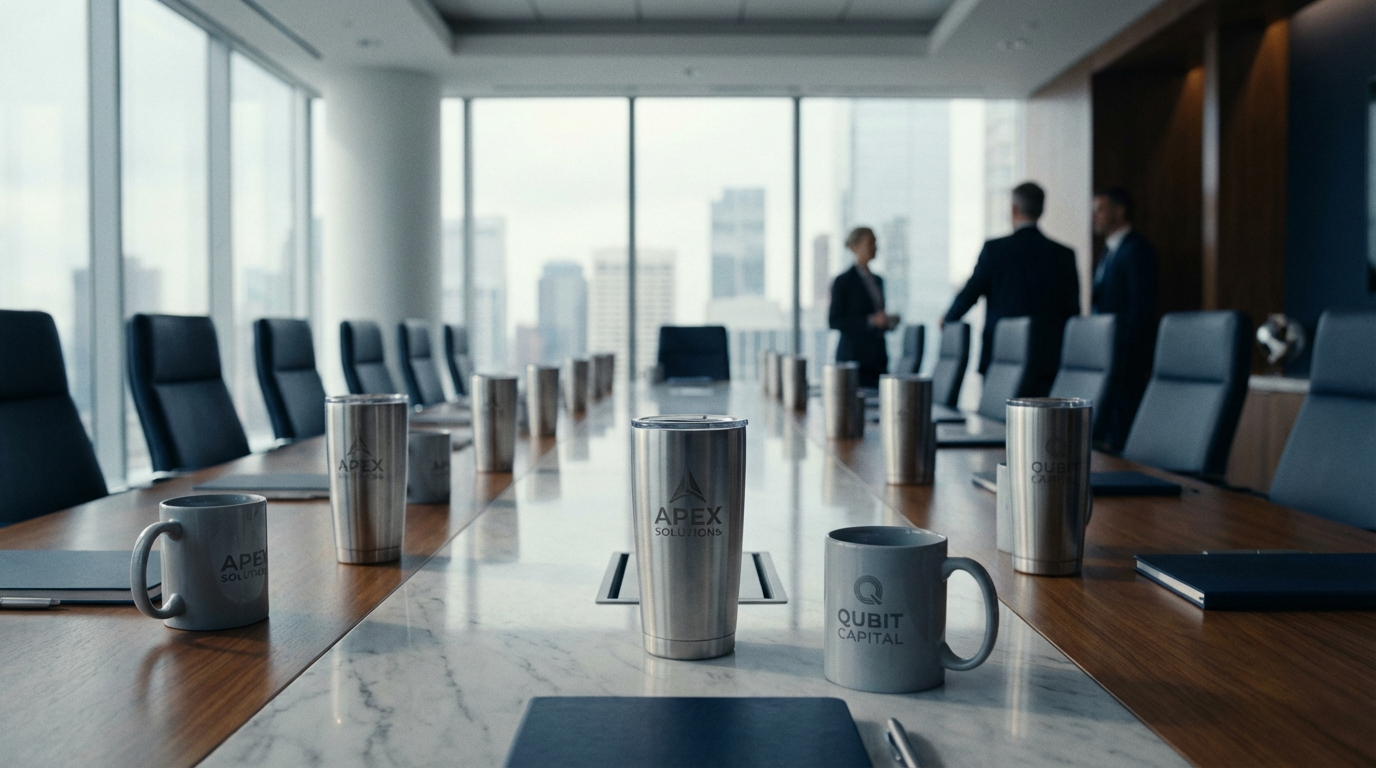
A trade show drinkware giveaway should be sized from qualified booth demand, not the event’s headline attendance. Estimate the people you can realistically engage, set a distribution rule, add a documented contingency, and decide what happens to unissued units before ordering. Then check the result against MOQ, production timing, artwork approval, freight, and usable post-show inventory.
Start with the distribution decision
“Giveaway” can describe several different programs. A bowl of free tumblers for every passerby is not the same operation as one bottle for each qualified conversation, a premium gift for scheduled meetings, or a hydration station that releases units after a scan. Each rule produces a different demand signal.
Write the rule in one sentence before asking for a quote. For example: “One stainless steel tumbler for each completed product conversation, one reserved unit for each confirmed executive meeting, and no automatic handout to unqualified passersby.” This sentence gives marketing, sales, procurement, and the factory the same definition of a distributed unit.
The event organizer’s attendance figure is a planning input, not a purchase quantity. It may include exhibitors, staff, speakers, press, and visitors who never reach your booth. The International Association of Exhibitions and Events describes its CEIR Index as a representative view of U.S. business-to-business exhibitions and includes attendance, exhibitors, revenue, and net square feet across historical and forecast data. That is useful context for event planning, but it does not replace your own booth conversion assumptions. IAEE’s CEIR Index
Define the unit of demand
Before counting, define whether the unit is a drinkware body, a complete drinkware package, or a recipient-ready kit. A tumbler without its approved lid or packaging may not be a usable giveaway. Likewise, a carton held at the venue is inventory, not distribution.
Record these fields in the event brief:
- Event name, venue, show dates, and required arrival date.
- Expected attendance, exhibitor count if known, and booth size.
- Staff count and operating hours.
- Target visitor profile and the qualification action required.
- Product, color, capacity, lid, decoration, and packaging version.
- Distribution rule and who may authorize exceptions.
- Quantity allocated to pre-booked meetings, general qualified leads, staff use, samples, and contingency.
- Return, transfer, donation, or future-use plan for unopened units.
A clean brief prevents a common procurement error: multiplying total attendance by a vague “penetration rate” and then discovering that the chosen product cannot be used for the actual audience or pack-out.
Use a demand formula that exposes assumptions
A practical trade show drinkware giveaway formula is:
Required units = (qualified booth conversations × issue rate) + scheduled-meeting units + staff or demo units + contingency − usable on-hand inventory
The issue rate is the share of qualified conversations that receive the item under the written rule. It is not a guaranteed conversion rate. If historical event data does not exist, build low, expected, and high scenarios instead of presenting an invented benchmark as fact.
For a first-time event, use operational inputs that the team can defend. Suppose the organizer expects 12,000 attendees, but your team estimates 700 meaningful booth conversations. Your rule issues one tumbler to 60% of those conversations. You have 40 scheduled meetings requiring one unit each, 12 staff units, and a 7% contingency on the calculated giveaway quantity. The arithmetic is:
| Demand component | Calculation | Units |
|---|---|---|
| Qualified conversations | Planning assumption | 700 |
| Giveaway issues | 700 × 60% | 420 |
| Scheduled meetings | Confirmed meeting list | 40 |
| Staff and demonstrations | Written booth plan | 12 |
| Base requirement | 420 + 40 + 12 | 472 |
| Contingency | 472 × 7% = 33.04, round up | 34 |
| Planned requirement | 472 + 34 | 506 |
The resulting plan is 506 units before subtracting usable stock. The percentage in this example is a planning assumption, not an industry standard. If the meeting list changes or the qualification rule is stricter, recalculate the line rather than quietly increasing the order.
Build three scenarios, not one false-precision number
A scenario table turns uncertainty into a purchasing decision. Keep the assumptions visible and identify which scenario is approved.
| Scenario | Conversation assumption | Issue rate | Meeting units | Approximate requirement* | Procurement use |
|---|---|---|---|---|---|
| Low | 500 | 50% | 25 | 300 | Protects against weak traffic or strict qualification |
| Expected | 700 | 60% | 40 | 506 | Working production plan |
| High | 900 | 70% | 60 | 720 | Capacity reservation and shortage test |
*The low and high totals assume 12 staff/demo units and a 7% contingency; figures are rounded up after applying the contingency. They are examples, not forecasts of any particular show.
Do not average the three scenarios and call that the order quantity. The business choice might be to produce the expected quantity, reserve capacity for the high case, and define a replenishment or substitution rule if the giveaway accelerates. If the event is strategically important and late replenishment is impossible, the high scenario may be relevant for capacity even when it is not the approved purchase quantity.
Control overstock with allocation gates
Separate inventory into release buckets before cartons leave the factory. A useful structure is:
- Meeting reserve: units assigned to named appointments or account tiers.
- Qualified-lead pool: units released when the stated conversation or scan rule is met.
- Booth operations: staff, product demonstrations, photography, and damage replacement.
- Contingency: held back by the event lead and released only when a trigger occurs.
- Post-show hold: unopened units reserved for a defined next use, not an unowned leftover.
This arrangement prevents the “open every carton on day one” problem. The booth team can report issued units by bucket at the end of each day. If the qualified-lead pool is running ahead of plan, tighten the rule or change the release schedule; if it is underused, retain the units for the next audience rather than pushing them to people who do not fit the program.
The corporate drinkware inventory forecasting and demand planning guide explains why event demand should be kept separate from routine replacements and other campaign categories. For a trade show, the event date, distribution rule, product version, and confidence level are more useful than a single annual usage average.
Choose the product for the movement pattern
Trade show drinkware must work in a crowded, mobile environment. Evaluate the product against how visitors will carry it, where they will place it, and what your team can hand out without slowing the booth.
| Decision | Procurement question | Overstock risk if ignored |
|---|---|---|
| Form factor | Can the visitor carry it with a badge, bag, and literature? | Units remain at the booth because they are inconvenient |
| Capacity and lid | Does the format fit the beverage or refill plan? | Product is unsuitable for the intended activation |
| Decoration | Is the artwork legible at arm’s length and approved on the actual surface? | Rework or unusable branded inventory |
| Packaging | Is individual packaging required, or are controlled bulk cartons acceptable? | Excess packaging or slow handout operations |
| Version control | Are color, lid, logo, and insert fixed before production? | Leftovers cannot support the next event |
| Storage | Can unopened cartons be moved or stored safely after the show? | Damaged or forgotten units become obsolete |
For DrinkwareWorks USA, stainless steel tumblers and water bottles have a 50-unit MOQ and 2–4 week production after approved artwork. Ceramic mugs have a 100-unit MOQ and 3–5 week production. Those are production facts, not delivery guarantees. Add time for specification, proof review, sample decisions where applicable, quality release, packing, freight, receiving, and venue rules. The production clock starts after artwork approval, so a last-minute quantity change can create more risk than the nominal unit count suggests.
The custom tumblers bulk order guide is useful for comparing decoration, packaging, and timeline assumptions. Treat any lead-time statement as conditional on the final specification, capacity confirmation, and approved artwork rather than as a promise for a particular show.
When the product specification is ready, review the custom drinkware product range against the event’s carryability, decoration, and packaging requirements.
Plan artwork and packaging around the next use
Overstock becomes expensive when the item is tied to a date, slogan, booth number, or short-lived campaign. If future use matters, use a durable brand mark and keep event-specific information on a removable card, sleeve, insert, or digital follow-up. That does not make every format suitable for reuse, but it gives procurement a genuine option after the event.
Ask the supplier to identify what is reusable and what is event-specific: drinkware body, lid, carton, individual box, insert, label, and decoration. A reusable body with obsolete packaging is not the same as fully reusable inventory. Record these components separately in the purchase order and in the post-show count.
Be precise with environmental language. The U.S. Environmental Protection Agency recommends bringing drinks in a water bottle or thermos instead of disposable bottles and emphasizes reducing waste and reusing products. That supports a reuse-oriented program design, but it does not prove a specific product’s environmental impact or guarantee that recipients will reuse it. EPA guidance on reducing plastic waste
If the campaign uses words such as “eco-friendly,” “zero waste,” or “recycled,” preserve the evidence behind the exact claim. The Federal Trade Commission says environmental claims need competent and reliable scientific evidence. FTC environmental marketing guidance
Run a simple release process
A production-ready process has five gates:
- Brief gate: confirm audience, qualification rule, product specification, arrival date, and scenario quantities.
- Feasibility gate: check MOQ, capacity, artwork readiness, packaging minimums, freight assumptions, venue receiving, and post-show storage.
- Approval gate: approve the product, decoration proof, packaging, and quantity by named owners. Do not treat a digital logo proof as approval of an unreviewed product configuration.
- Release gate: assign cartons to reserve, lead pool, staff, contingency, and post-show hold. Record opening counts by bucket.
- Closeout gate: reconcile produced, received, damaged, issued, returned, transferred, and remaining units within a defined time after the event.
The corporate gift drinkware fulfillment and kitting guide provides a useful control model for receiving, pack-out, shipment data, and reconciliation. Even a single-booth giveaway benefits from those controls because a missing lid, damaged carton, or wrong logo changes the usable quantity.
Measure the event without creating more stock
Track units issued per day, qualified conversations, meetings completed, lead records accepted, units remaining by bucket, and damage or replacement units. A useful operational measure is usable giveaway rate:
Usable giveaway rate = units accepted and ready for issue ÷ units received
Another is cost per qualified distribution, calculated from the complete event cost divided by units issued under the qualification rule. Include production, packaging, freight, venue handling, storage, and approved replacements when those costs are available. Do not claim a marketing return from item count alone; connect the giveaway to the lead definition and the follow-up process.
At closeout, decide one of four states for every remaining unit: approved for another event, allocated to a known internal or client program, transferred or donated under company policy, or written off because the branding or condition makes it unusable. Assign an owner and a date. “Keep in the warehouse” is not a disposition plan.
FAQ: How many drinkware units should a first-time exhibitor order?
Use a low, expected, and high scenario based on qualified conversations, not total attendance. Subtract usable inventory and then check the result against the applicable MOQ. The correct quantity depends on the distribution rule, meeting schedule, staff needs, contingency, event duration, and whether replenishment is possible.
FAQ: Should every booth visitor receive a tumbler?
Only if the program intentionally funds and manages that volume. A qualification gate may reduce excess and make the giveaway measurable. If every visitor is eligible, model the queue, handling, carton access, carryability, and expected depletion by day before approving production.
FAQ: What if the expected quantity falls below the MOQ?
First check whether the same specification has an approved future use. If it does, document the allocation and storage plan. If it does not, compare a different product or a staged program. Do not order to MOQ solely because the number is available; the excess still has a carrying cost and an obsolescence risk.
FAQ: Can leftover units be reused at another event?
Usually, that depends on the decoration, packaging, condition, and brand message. A timeless logo on a reusable product is more flexible than a dated event mark. Inspect and recount leftovers, separate event-specific components, and obtain marketing approval before transferring them.
FAQ: When should the order be placed?
Work backward from the venue’s required-arrival date. Include artwork and proof approval, production, inspection, packaging, freight, receiving, and a recovery buffer. For the stated DrinkwareWorks USA production windows, the quoted production period begins after approved artwork; it does not cover every step between first brief and booth handoff.
A trade show drinkware giveaway is an inventory decision disguised as a marketing item. The strongest plan makes the distribution rule explicit, exposes the demand assumptions, protects reserved units, checks MOQ and timing, and gives every leftover a next action. That discipline lets the booth team use a useful product without turning uncertain attendance into avoidable branded overstock.