Custom Drinkware Insights
The Specification Documentation Formalization Gap
When a corporate buyer emails their drinkware supplier "Can we change the logo color from Pantone 287 to Pantone 286?" and receives a reply stating "Yes,…
The Specification Documentation Formalization Gap
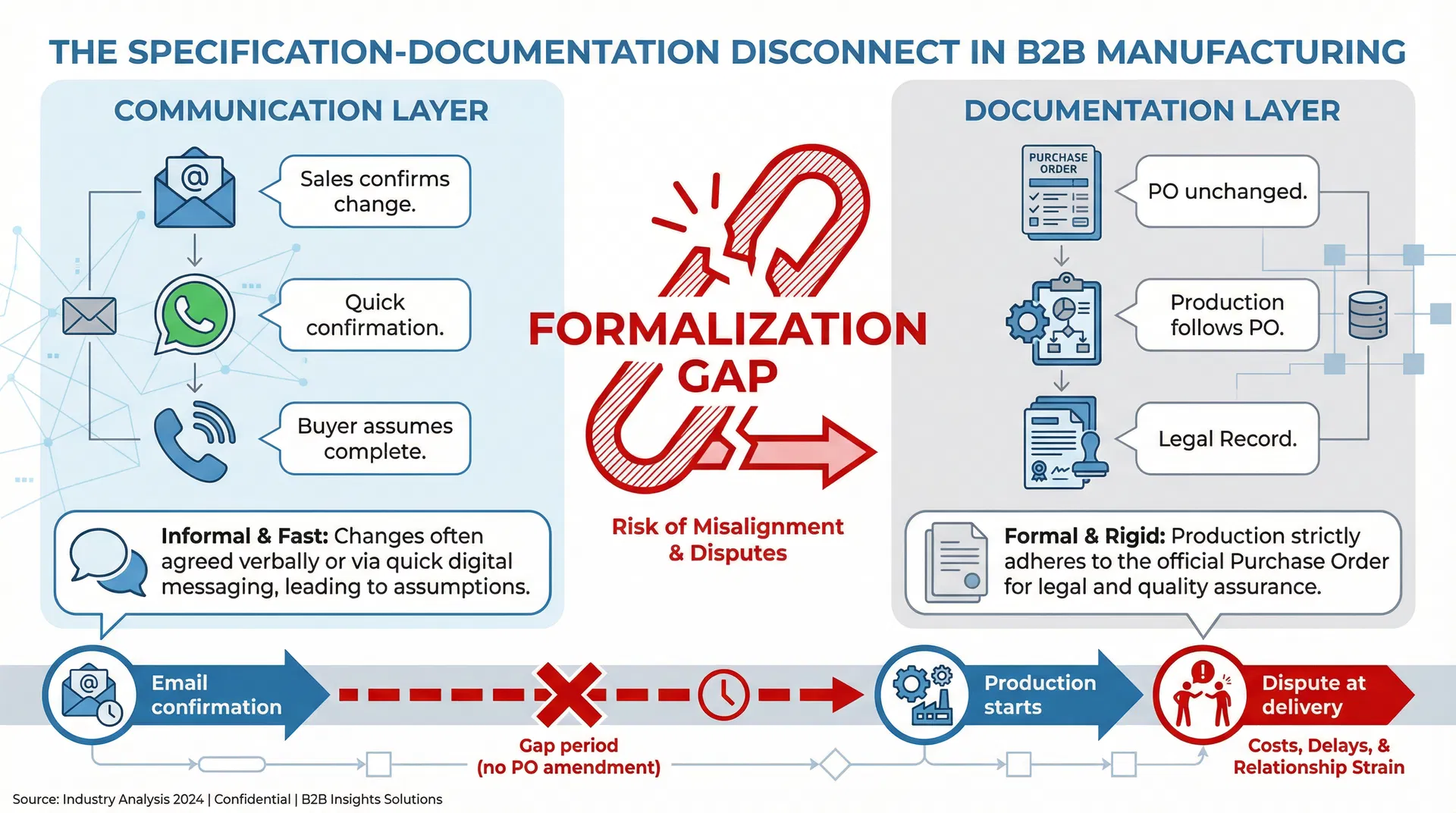
When a corporate buyer emails their drinkware supplier "Can we change the logo color from Pantone 287 to Pantone 286?" and receives a reply stating "Yes, confirmed—we'll update the order," most buyers consider this exchange a completed transaction. The specification has been discussed, the supplier has agreed, and the buyer moves forward with other priorities. Three weeks later, when the 2,000-unit shipment arrives with Pantone 287 (the original specification) instead of the agreed-upon Pantone 286, the buyer contacts the supplier expecting immediate correction. The supplier's response is often unexpected: "Our production team followed the purchase order specification, which shows Pantone 287. We have no record of the color change request in our system."
This scenario represents one of the most financially consequential misjudgments in custom drinkware procurement workflows—the assumption that verbal or email confirmations of specification changes automatically translate into formal production instructions. The buyer possesses email evidence of the agreed change. The supplier possesses an unchanged purchase order document showing the original specification. Both parties believe they are correct, and the resulting dispute typically costs $2,000-5,000 in remake expenses plus 3-4 weeks in delivery delays. In practice, this is often where customization process decisions start to be misjudged—not because either party acted in bad faith, but because the gap between "specification agreement" and "specification documentation" was never formally closed.
The root cause is structural rather than procedural. Corporate buyers operate in communication environments where email confirmations, WhatsApp messages, and phone call summaries constitute binding agreements. In their internal workflows, a confirmed email from a department head authorizes budget allocation, a Slack message from engineering approves a design change, and a verbal confirmation during a Zoom call green-lights a project milestone. This communication-as-documentation model works within organizations because all parties share the same information systems, reporting structures, and accountability frameworks. When buyers extend this model to supplier relationships, they assume that suppliers operate under similar norms—that an email confirmation from a sales representative automatically propagates through the supplier's production planning, quality control, and shipping departments.
Suppliers, however, operate under a different documentation hierarchy. In manufacturing environments, the purchase order document serves as the sole authoritative source of production instructions. This is not arbitrary bureaucracy—it reflects the operational reality of production floors where dozens of orders move through simultaneous workflows, each requiring precise material specifications, decoration parameters, and quality control checkpoints. Production managers do not monitor email threads between sales representatives and customers. They reference the purchase order document, which specifies material grades, Pantone colors, logo dimensions, decoration methods, and packaging requirements. If the purchase order states Pantone 287, the production team manufactures Pantone 287—regardless of what was discussed via email, confirmed over WhatsApp, or agreed upon during a phone call.
The formalization gap emerges at the handoff point between sales and production. Sales representatives, who manage customer relationships and respond to specification change requests, often confirm changes verbally or via email to maintain responsiveness and customer satisfaction. Their incentive structure rewards quick confirmations and positive customer interactions. However, sales representatives typically lack direct access to production planning systems or the authority to modify purchase order documents unilaterally. In well-structured supplier organizations, purchase order amendments require formal approval workflows involving production planning (to verify feasibility), procurement (to confirm material availability), and finance (to adjust pricing if applicable). In less-structured organizations, purchase order amendments may require manual data entry by administrative staff who are not copied on email threads between sales and customers.
The buyer, unaware of this internal workflow complexity, interprets the sales representative's email confirmation as a completed transaction. The sales representative, focused on customer satisfaction, may genuinely intend to update the purchase order but fails to complete the internal amendment process due to workload pressures, system access limitations, or simple oversight. The production team, operating from the unchanged purchase order document, manufactures the original specification. The buyer discovers the discrepancy only upon delivery, at which point the supplier's legal position is defensible—the purchase order, which both parties signed, specified Pantone 287, and the supplier fulfilled that specification accurately.
This creates a predictable dispute pattern. The buyer argues that the email confirmation constitutes a binding modification to the purchase order. The supplier argues that email confirmations do not override formal purchase order documents unless explicitly amended. Both positions have merit. Email confirmations can constitute legally binding contract modifications under common law principles (offer, acceptance, consideration). However, most purchase orders include integration clauses stating that the written agreement supersedes all prior or contemporaneous oral or written communications. These clauses exist precisely to prevent the scenario where informal communications create conflicting production instructions.
The financial consequences extend beyond remake costs. When a buyer discovers that the delivered product does not match the verbally agreed specification, they face three options: accept the incorrect product and distribute it (damaging brand consistency), request a remake at the supplier's expense (triggering a legal dispute over who bears responsibility), or request a remake at the buyer's expense (absorbing $2,000-5,000 in avoidable costs). If the delivery deadline is imminent—such as a corporate event scheduled in two weeks—the buyer may lack time for a remake, forcing acceptance of the incorrect product. If the buyer refuses delivery and demands a remake, the supplier may refuse to bear the cost, citing the unchanged purchase order as evidence of compliance. The resulting negotiation consumes procurement team time, strains supplier relationships, and may require legal involvement if neither party concedes.
The specification documentation formalization gap is particularly acute in three scenarios. First, when specification changes occur late in the production timeline—after the purchase order has been issued but before production has commenced. Buyers perceive this window as "safe" for modifications because production hasn't started, but suppliers perceive this window as high-risk because purchase orders have already been entered into production planning systems, materials have been allocated, and tooling has been prepared. A seemingly simple change (swapping Pantone 287 for Pantone 286) may require re-ordering powder coating materials, recalibrating color matching equipment, and adjusting production schedules—none of which occur automatically based on an email confirmation.
Second, when specification changes involve multiple attributes simultaneously. A buyer might email "Can we change the logo color to Pantone 286 and increase the size from 2 inches to 2.5 inches?" The sales representative confirms both changes, but the internal amendment process only captures the color change, overlooking the size modification. The buyer, having received a blanket confirmation, assumes both changes are documented. The production team, referencing an incompletely amended purchase order, manufactures the correct color but the original size. This partial compliance creates additional dispute complexity—the supplier can demonstrate that they attempted to accommodate the change request (evidenced by the correct color), but the buyer can demonstrate that the confirmation covered both attributes (evidenced by the email thread).
Third, when specification changes are communicated through intermediaries. A corporate buyer might instruct their purchasing department to "confirm with the supplier that we need Pantone 286 instead of 287." The purchasing department emails the supplier's sales representative, who confirms the change. However, neither the buyer nor the purchasing department verifies that the supplier's internal amendment process has been completed. The sales representative, having confirmed the change, assumes the matter is resolved. The production team, never having received an amended purchase order, manufactures the original specification. The multi-party communication chain introduces additional failure points where the formalization step can be overlooked.
The solution is not to eliminate email or verbal communications—these channels provide necessary flexibility and responsiveness in buyer-supplier relationships. Rather, the solution is to establish a formal specification amendment protocol that bridges the gap between communication and documentation. This protocol should include three elements: explicit confirmation that the purchase order document will be amended (not just that the change is "noted" or "confirmed"), a revised purchase order document issued by the supplier showing the amended specification, and buyer acknowledgment of the revised purchase order before production commences.
In practice, this means that when a buyer requests a specification change via email, the supplier's response should state: "We can accommodate the change from Pantone 287 to Pantone 286. I will prepare a revised purchase order reflecting this change and send it to you for approval within 24 hours. Please confirm receipt and approval of the revised PO before we proceed to production." This response makes explicit what many buyers assume is implicit—that the verbal agreement will be formalized in the purchase order document. It also creates a clear checkpoint where the buyer can verify that the change has been properly documented before production begins.
The revised purchase order should highlight the amended specification to ensure visibility. Many suppliers issue revised purchase orders that are identical to the original except for a single line item change, making it difficult for buyers to identify what was modified. Best practice is to include a "Revision Summary" section at the top of the document stating: "This purchase order supersedes PO #12345 dated January 15, 2026. Changes: Logo color updated from Pantone 287 to Pantone 286." This summary allows buyers to quickly verify that the intended change has been captured without comparing the entire document line-by-line against the original.
Buyer acknowledgment of the revised purchase order closes the loop. This can be as simple as replying to the supplier's email with "Revised PO #12345-R1 approved—please proceed to production." This acknowledgment serves two purposes: it confirms that the buyer has reviewed the revised document and verified that it reflects the agreed change, and it creates a clear audit trail showing that both parties operated from the same specification document during production. If a dispute arises later, both parties can reference the revised purchase order and the buyer's explicit approval as evidence of the agreed specification.
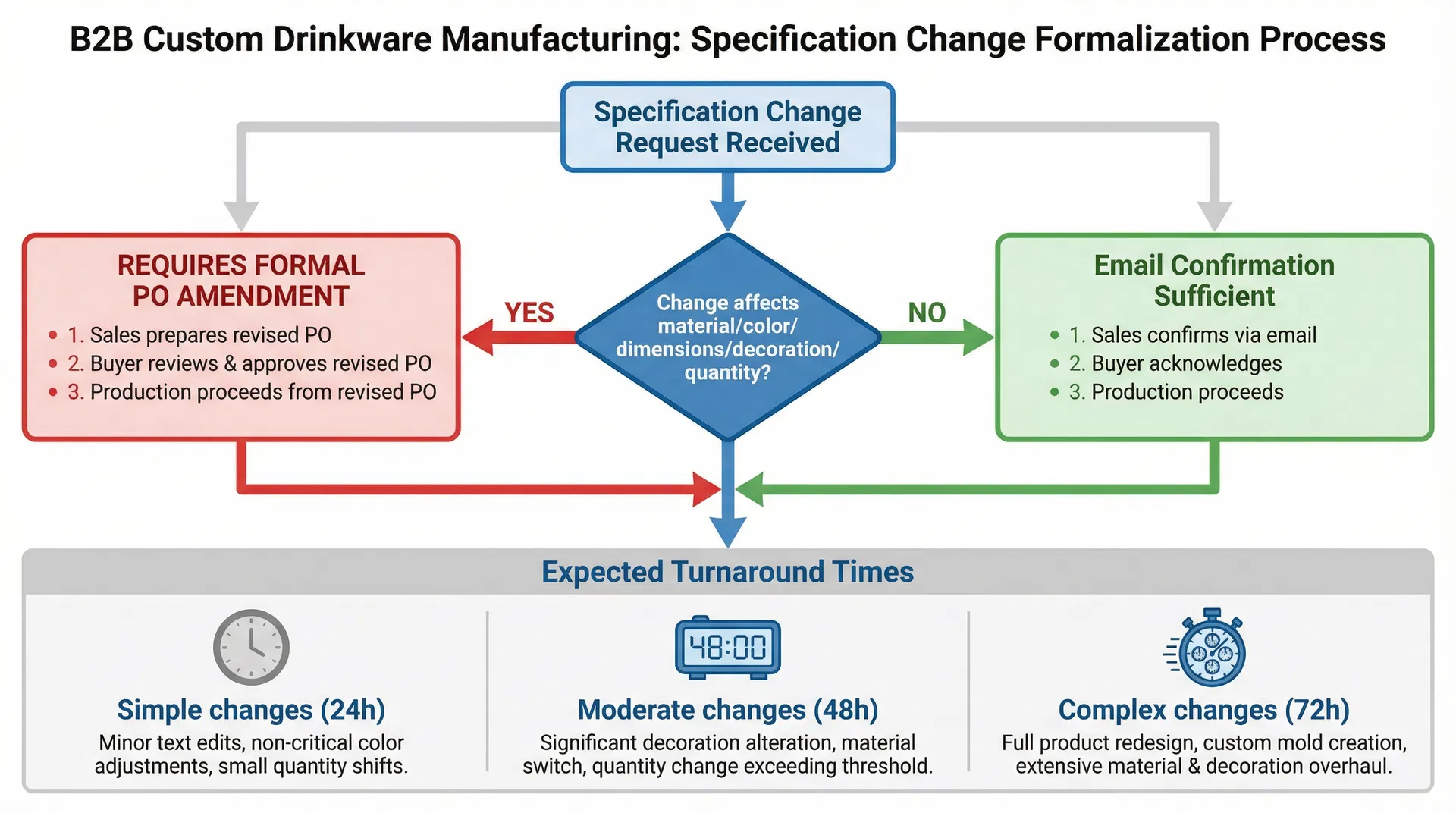
The formalization protocol should also specify which types of changes require formal purchase order amendments versus which can be handled through email confirmations alone. Minor clarifications—such as confirming that "centered" means "centered horizontally and vertically" or that "matte finish" refers to a specific powder coating texture—do not typically require purchase order amendments because they do not alter the core specification. However, any change that affects material selection, color codes, dimensions, decoration methods, or quantities should trigger a formal amendment. Suppliers should provide buyers with a clear policy document stating: "Changes to the following attributes require a revised purchase order: [list of attributes]. Changes to the following attributes can be confirmed via email: [list of attributes]."
This policy prevents ambiguity about when formalization is required. Without such a policy, buyers and suppliers may have different interpretations of which changes are "significant enough" to warrant formal documentation. A buyer might view a color change from Pantone 287 to Pantone 286 (two adjacent shades of blue) as minor, while a supplier views any Pantone code change as significant because it requires different powder coating materials and color matching procedures. Explicitly defining which changes require formalization eliminates this interpretive gap.
The formalization protocol also addresses timing constraints. Buyers often request specification changes with urgent timelines—"We need this change confirmed by end of day so we can proceed with our internal approvals." Suppliers, facing internal workflow constraints, may struggle to complete purchase order amendments within the buyer's timeline. The protocol should specify expected turnaround times for different change types: simple changes (color code swaps, dimension adjustments) within 24 hours, moderate changes (decoration method switches, material substitutions) within 48 hours, and complex changes (multi-attribute modifications, custom tooling requirements) within 72 hours. These timeframes allow buyers to plan their internal approval workflows realistically and prevent the scenario where a buyer assumes a change is documented when the supplier is still processing the amendment request.
For buyers managing multiple concurrent orders with the same supplier, the formalization protocol should include order identification safeguards. When a buyer emails "Please change the logo color to Pantone 286," the supplier should respond with "Confirming: you are requesting a change to PO #12345 (2,000 stainless steel tumblers, delivery March 15). Is this correct?" This confirmation prevents the scenario where the buyer intends the change for one order but the supplier applies it to a different order. In high-volume procurement environments where buyers manage 5-10 simultaneous orders, this order identification step is critical for preventing cross-contamination of specifications.
The formalization gap is not unique to color specifications—it applies equally to all customization attributes. A buyer might confirm via email that "we want the logo moved 0.5 inches higher on the tumbler body." The sales representative confirms the change, but the production team never receives an updated technical drawing showing the revised placement. The delivered product features the logo in the original position. Or a buyer might confirm that "we need the packaging boxes to include our company tagline on the exterior." The sales representative confirms the addition, but the packaging supplier (a third-party vendor) never receives the updated artwork file. The delivered packaging boxes omit the tagline. Each of these scenarios follows the same pattern: verbal agreement without formal documentation, leading to production based on the original specification.
The underlying issue is that customization processes involve multiple handoffs between different functional teams—sales, production planning, procurement, quality control, packaging, and logistics. Each handoff introduces a potential failure point where informal communications fail to translate into updated production instructions. The formalization protocol creates explicit checkpoints at each handoff, ensuring that specification changes propagate through the entire workflow rather than stopping at the sales-production boundary.
For corporate buyers, the practical implication is clear: email confirmations of specification changes should be treated as preliminary agreements, not completed transactions. The transaction is complete only when the supplier issues a revised purchase order document reflecting the change and the buyer approves that revised document. This may feel bureaucratic compared to the informal communication norms of internal corporate workflows, but it reflects the operational reality of manufacturing environments where purchase order documents serve as the authoritative source of production instructions. Buyers who insist on formal documentation before production commences eliminate 90% of specification-related disputes and avoid the $2,000-5,000 remake costs that result from documentation gaps.
Suppliers, for their part, should proactively educate buyers about their internal documentation requirements rather than assuming buyers understand the distinction between email confirmations and purchase order amendments. A simple statement in the supplier's onboarding materials—"All specification changes must be formalized in a revised purchase order before production begins. Email confirmations alone do not constitute production instructions"—sets clear expectations and prevents the misunderstanding that leads to disputes. Suppliers who take this proactive approach build stronger buyer relationships because they eliminate the surprise and frustration that occurs when buyers discover their email confirmations were not translated into production instructions.
The specification documentation formalization gap is preventable, but prevention requires both parties to recognize that informal communications and formal documentation serve different purposes in customization workflows. Informal communications provide flexibility, responsiveness, and relationship-building. Formal documentation provides clarity, accountability, and dispute prevention. The most effective customization processes integrate both—using informal communications to discuss and agree upon changes, then using formal documentation to ensure those changes are accurately captured in the production instructions that guide manufacturing teams. Buyers who understand this distinction, and who insist on formal documentation before authorizing production, protect themselves from the costly remakes and delivery delays that result when verbal agreements fail to translate into documented specifications.