Custom Drinkware Insights
Specification Change Window Illusion Trap
When a corporate buyer receives confirmation that "production hasn't started yet," the natural assumption is that specification changes remain cost-free.…
When a corporate buyer receives confirmation that "production hasn't started yet," the natural assumption is that specification changes remain cost-free. This assumption reflects a fundamental misunderstanding of how custom drinkware manufacturing workflows operate. In practice, the window for penalty-free modifications closes much earlier than buyers expect—not when units begin rolling off the production line, but when the supplier initiates production line setup. This temporal gap, typically spanning two to four weeks, creates a specification change illusion that routinely triggers $2,000-$5,000 in unexpected costs for orders in the 5,000-7,000 unit range.
The confusion stems from how buyers interpret "production start date." Most procurement teams treat this as a binary state: production has either started or it hasn't. Suppliers, however, operate within a more granular timeline where production encompasses multiple sequential phases—artwork finalization, tooling preparation, material procurement, production line scheduling, and finally unit manufacturing. Each phase represents an irreversible resource commitment. Once a supplier converts approved artwork into physical screens for multi-color printing, that $175-$195 per-color investment becomes a sunk cost. If the buyer requests a Pantone modification three weeks later, the supplier must remake the screens, re-schedule production capacity, and absorb the labor already invested in the original setup. These costs get passed to the buyer as "change order fees," often presented as non-negotiable because the supplier has already incurred real expenses.
Consider a scenario that plays out regularly across corporate procurement departments. A marketing manager confirms a 5,000-unit order for custom tumblers with a three-color logo on Monday of Week 1. The supplier acknowledges the order, requests final artwork approval, and begins preparing production screens. By Friday of Week 1, the screens are complete and the supplier has allocated production capacity for Week 5. On Monday of Week 4, the marketing manager emails to request changing one Pantone color because the brand guidelines were recently updated. The supplier responds that "production hasn't started yet," which is technically accurate—no tumblers have been manufactured. However, the screens are already prepared, the production slot is reserved, and material procurement is underway. The supplier quotes a $500 screen remake fee, a $300 re-scheduling fee, and a 10-day delay. The buyer, who assumed changes were still cost-free because "production hasn't started," now faces an unexpected $800 expense and a compressed delivery timeline that may require expedited shipping.
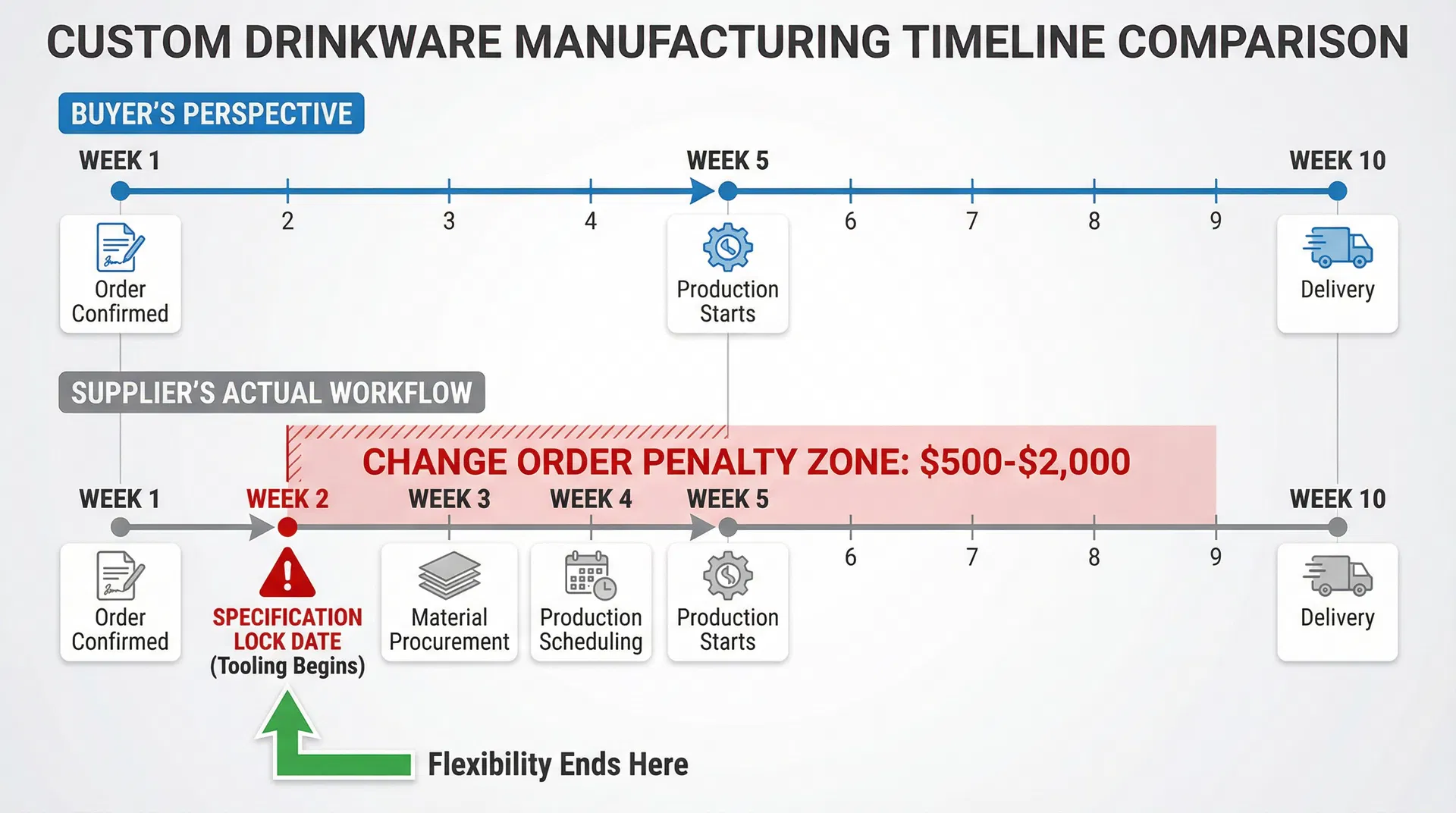
This misjudgment occurs because buyers conflate two distinct milestones: the specification lock date and the production start date. The specification lock date marks the point when tooling and setup begin—the moment when the supplier commits resources based on approved specifications. The production start date marks when finished units begin emerging from the production line. For custom drinkware orders, these dates can be separated by 14-21 days for single-color decoration methods, and 21-35 days for multi-color or complex customization. During this gap, the supplier has already invested labor, materials, and opportunity cost (the production capacity allocated to this order cannot be reassigned without disrupting the schedule). Any specification change during this window is treated as a mid-production modification, not a pre-production adjustment.
The financial impact scales with customization complexity. Single-color screen printing requires one setup pass, so a late specification change might incur a $95-$105 screen remake fee plus a 5-7 day delay. Multi-color screen printing requires separate screens for each color, so changing two colors in a four-color logo could trigger $350-$390 in remake fees plus a 10-14 day delay. Hot stamp decoration, used for complex logos with gradients or fine details, requires custom transfer sheets that cost $400-$600 to produce. If the buyer requests a design modification after the transfer sheets are prepared, the supplier must remake the sheets entirely—there is no partial adjustment option. For orders with custom product colors (where the supplier adds food-safe pigment to the base material during manufacturing), the specification lock date occurs even earlier because pigment procurement requires 8-12 weeks. A buyer who requests changing from navy blue to royal blue four weeks after order confirmation will discover that the navy pigment has already been ordered and cannot be returned or exchanged.
The root cause of this misjudgment is that buyers focus on the visible milestone—production start—while suppliers track the invisible milestones that precede it. When a buyer asks "Has production started?" they are really asking "Is it too late to make changes without penalty?" The supplier interprets the question literally: "Have units begun manufacturing?" These misaligned definitions create the illusion that changes remain cost-free when, in reality, the penalty-free window closed weeks earlier. Suppliers rarely volunteer this distinction because it's not in their interest to highlight the narrow change window. Buyers who don't explicitly ask "When does the specification lock date occur?" remain unaware that their flexibility is already constrained.
The practical consequence is that buyers lose negotiating leverage precisely when they need it most. If a buyer discovers a brand guideline update or a design error three weeks after order confirmation, they face a binary choice: absorb the change order fees and delays, or proceed with specifications they know are incorrect. Neither option is acceptable. The change order fees erode the cost savings that justified selecting this supplier over competitors. Proceeding with incorrect specifications creates downstream problems—distributing tumblers with outdated logos damages brand consistency, and explaining the error to stakeholders (marketing directors, executive sponsors, event planners) consumes internal political capital. In some cases, buyers attempt to cancel the order entirely and re-source from a different supplier, only to discover that the original supplier's terms and conditions include a 30-50% cancellation penalty for orders where tooling has been completed.
This trap is particularly insidious because it exploits the natural rhythm of corporate decision-making. Marketing teams often finalize brand guidelines, event themes, or promotional messaging weeks after procurement has confirmed supplier orders. The procurement team, operating under the assumption that "production hasn't started yet," doesn't escalate the urgency of locking specifications. By the time the marketing team provides updated artwork or revised color codes, the specification lock date has already passed. The disconnect between procurement timelines and creative timelines creates a structural vulnerability that suppliers inadvertently capitalize on through their standard workflows.
The solution requires buyers to reframe how they think about production timelines. Instead of asking "When does production start?" buyers should ask "When does the specification lock date occur?" and "What are the penalty thresholds for changes after that date?" These questions force suppliers to disclose the invisible milestones that determine cost exposure. For multi-color decoration orders, buyers should request a detailed timeline showing when screens will be prepared, when material procurement will occur, and when production capacity will be allocated. This visibility allows buyers to align internal stakeholder approvals with the supplier's workflow, ensuring that final artwork and color specifications are confirmed before the specification lock date.
For orders with custom product colors or complex decoration methods, buyers should negotiate a contractual specification lock date that aligns with their internal approval processes. If the buyer needs four weeks to finalize brand guidelines and obtain executive sign-off, the supplier agreement should specify that the specification lock date occurs no earlier than four weeks after order confirmation. This contractual protection prevents suppliers from initiating tooling preparation prematurely and then claiming that changes are no longer cost-free. Some suppliers resist this arrangement because it reduces their scheduling flexibility, but buyers with sufficient order volume (typically 5,000+ units) can negotiate these terms as a condition of awarding the contract.
Another protective measure is to structure orders in phases when internal specifications are still evolving. Instead of confirming a 10,000-unit order with uncertain artwork, buyers can confirm a 2,000-unit pilot order with locked specifications and a 8,000-unit follow-on order contingent on pilot approval. This approach limits exposure to change order fees while preserving flexibility for specification adjustments. The trade-off is higher per-unit costs (smaller orders typically incur 15-25% price premiums) and extended overall lead time (the follow-on order cannot begin until the pilot is approved). For high-stakes orders where brand accuracy is critical—such as executive gifting programs, major conference giveaways, or employee onboarding kits—this trade-off is often justified by the risk mitigation it provides.
The specification change window illusion also highlights why physical sample approval is non-negotiable for first-time orders with new suppliers. Digital mockups cannot reveal how Pantone colors will appear on powder-coated stainless steel or how laser engraving depth affects logo legibility. If a buyer approves a digital mockup and then requests changes after receiving the physical sample, they have already passed the specification lock date. The physical sample should arrive before tooling preparation begins, allowing buyers to identify color mismatches, placement errors, or finish quality issues while changes remain cost-free. Suppliers who rush buyers through proof approval—offering expedited timelines in exchange for skipping physical samples—are creating conditions for specification change penalties later in the process.
For buyers managing custom drinkware orders with complex timelines, understanding the specification lock date is as important as understanding the production start date. The lock date determines when flexibility ends and penalties begin. Buyers who track only the production start date operate under the illusion that changes remain cost-free, when in reality their window closed weeks earlier. This misjudgment transforms what should be a straightforward specification adjustment into a $2,000-$5,000 change order dispute, eroding both budget margins and supplier relationships. The solution is not to avoid specification changes entirely—business requirements evolve, and brand guidelines shift—but to align internal approval processes with the supplier's specification lock date, ensuring that changes occur while they remain penalty-free rather than after irreversible commitments have been made.
Timeline comparison showing the gap between specification lock date (when tooling begins) and production start date (when units begin manufacturing). Specification changes during this 2-4 week gap incur full change order penalties despite production not yet starting.
 Change order cost escalation framework showing how modification costs increase as the order progresses through artwork finalization, tooling preparation, material procurement, and production scheduling phases. Costs range from $0 (pre-lock) to $2,000-$5,000 (post-tooling).
The specification lock date also interacts with minimum order quantity structures in ways that amplify cost exposure. Suppliers typically offer tiered pricing based on order volume: 1,000-2,499 units at one price point, 2,500-4,999 units at a lower price point, and 5,000+ units at the most competitive rate. When a buyer confirms a 5,000-unit order to capture the volume discount, the supplier allocates production capacity and initiates tooling based on that quantity. If the buyer later requests reducing the order to 3,000 units (perhaps due to budget cuts or event cancellations), the supplier has already committed resources for 5,000 units. The buyer may face both a change order penalty for the quantity reduction and a retroactive price adjustment that moves them into a higher per-unit cost tier. A $14.50 per-unit price at 5,000 units becomes $16.20 per-unit at 3,000 units, creating a $5,100 cost increase ($48,600 total vs $43,500 total) in addition to any change order fees.
This dynamic creates a perverse incentive structure where buyers feel locked into original order quantities even when business conditions change. A marketing director who realizes that a 5,000-unit order exceeds actual distribution needs by 40% may choose to proceed with the full order rather than absorb the change penalties and price tier adjustments. The excess inventory then sits in storage, consuming warehouse space and representing sunk capital that could have been deployed elsewhere. For buyers operating under just-in-time inventory principles or tight budget constraints, this forced over-ordering undermines the cost efficiency that justified the custom drinkware program in the first place.
The specification lock date becomes even more consequential when orders involve multiple customization variables. An order for 5,000 tumblers with a three-color logo, custom product color, and branded packaging contains at least four separate specification lock dates: one for the logo screens, one for the pigment procurement, one for the packaging artwork, and one for the packaging tooling. If these lock dates are not explicitly coordinated, buyers may discover that they can no longer modify the logo (screens already prepared) but can still adjust the packaging (tooling not yet initiated). This creates fragmented flexibility where some specifications remain changeable while others are locked, forcing buyers to make partial adjustments that may not fully address the underlying issue. A buyer who needs to update both the logo and the packaging to reflect a brand refresh may find that they can only change the packaging, resulting in a product where the packaging matches the new brand guidelines but the tumbler logo still reflects the old guidelines—a worse outcome than making no changes at all.
Suppliers rarely provide proactive notification when specification lock dates occur. The buyer receives order confirmation, submits artwork, approves proofs, and then hears nothing until production completion. During this silence, the supplier is progressing through tooling preparation, material procurement, and production scheduling—each step narrowing the window for penalty-free changes. By the time the buyer inquires about making a modification, multiple lock dates have already passed. The supplier's response—"We can accommodate that change for an additional fee"—comes as a surprise because the buyer had no visibility into when the lock dates occurred or what penalties would apply.
This information asymmetry favors suppliers because it allows them to capture change order revenue while maintaining plausible deniability about whether buyers were adequately informed. A supplier can truthfully state that they provided the production timeline in the original quote (showing a 10-week lead time) without disclosing that the specification lock date occurs at Week 2. The buyer, focused on the Week 10 delivery date, doesn't realize that their flexibility expires eight weeks before delivery. When the buyer requests a change at Week 4, the supplier presents the change order fee as a standard industry practice, and the buyer—lacking leverage or alternative options—accepts the fee to avoid further delays.
The solution requires buyers to shift from reactive change management to proactive lock date tracking. At order confirmation, buyers should request a detailed milestone schedule showing not just the production start date and delivery date, but also the specification lock dates for each customization element (logo tooling, product color procurement, packaging preparation). This schedule should specify the penalty structure for changes after each lock date: $0 before the lock date, $X for changes within one week after the lock date, $Y for changes within two weeks after the lock date, and so on. This transparency allows buyers to assess whether their internal approval processes can meet the lock date deadlines, or whether they need to negotiate extended lock dates as a condition of awarding the order.
For enterprise buyers managing multiple concurrent orders with different suppliers, centralizing lock date tracking becomes a procurement operations capability. A shared calendar or project management system that displays lock dates for all active orders allows procurement teams to prioritize internal stakeholder approvals based on urgency. An order with a lock date in three days receives immediate escalation, while an order with a lock date in three weeks can follow normal approval workflows. This systematic approach prevents the common scenario where buyers discover lock dates have passed only after requesting changes, at which point their negotiating position has evaporated.
The specification change window illusion also reveals why supplier selection criteria should include workflow transparency as a weighted factor alongside pricing and lead time. A supplier who provides detailed lock date schedules, proactive milestone notifications, and clearly documented change order policies offers more predictable cost management than a supplier who offers slightly lower per-unit pricing but obscures lock dates until changes are requested. The $0.50 per-unit savings from the lower-priced supplier can be quickly erased by a single $800 change order fee that could have been avoided with better visibility. Buyers who optimize solely on unit price without evaluating workflow transparency are selecting for short-term cost efficiency at the expense of long-term risk management.
In practice, the specification lock date is not a technical constraint but a business policy decision. Suppliers could delay tooling preparation until closer to the production start date, preserving flexibility for buyers. They choose not to because early tooling preparation optimizes their production scheduling efficiency and reduces their own risk of delays. This is a rational business decision, but it transfers specification risk from the supplier to the buyer. Buyers who understand this dynamic can negotiate for delayed lock dates or contractual change windows that better align with their internal approval timelines. Suppliers with excess production capacity or strong interest in winning the order will often accommodate these requests. Suppliers operating at full capacity or with thin margins will resist, signaling that the buyer should either accelerate their internal approvals or consider alternative suppliers with more flexible workflows.
The specification change window illusion ultimately reflects a mismatch between how buyers think about production timelines (as a single linear process from order to delivery) and how suppliers actually manage production (as a series of sequential commitments with escalating irreversibility). Closing this gap requires buyers to adopt the supplier's mental model—tracking lock dates rather than just delivery dates, understanding that "production hasn't started" doesn't mean "changes are still free," and recognizing that flexibility expires incrementally rather than all at once. This shift in perspective transforms specification change management from a reactive crisis response (discovering penalties after requesting changes) into a proactive risk mitigation strategy (aligning internal approvals with lock dates before commitments are made).