Product Selection
Custom Mugs in Bulk: A B2B Buying Guide for Corporate Programs
A practical B2B guide to buying custom mugs in bulk, covering material, size, decoration, MOQ, approvals, quality, packaging, and delivery.
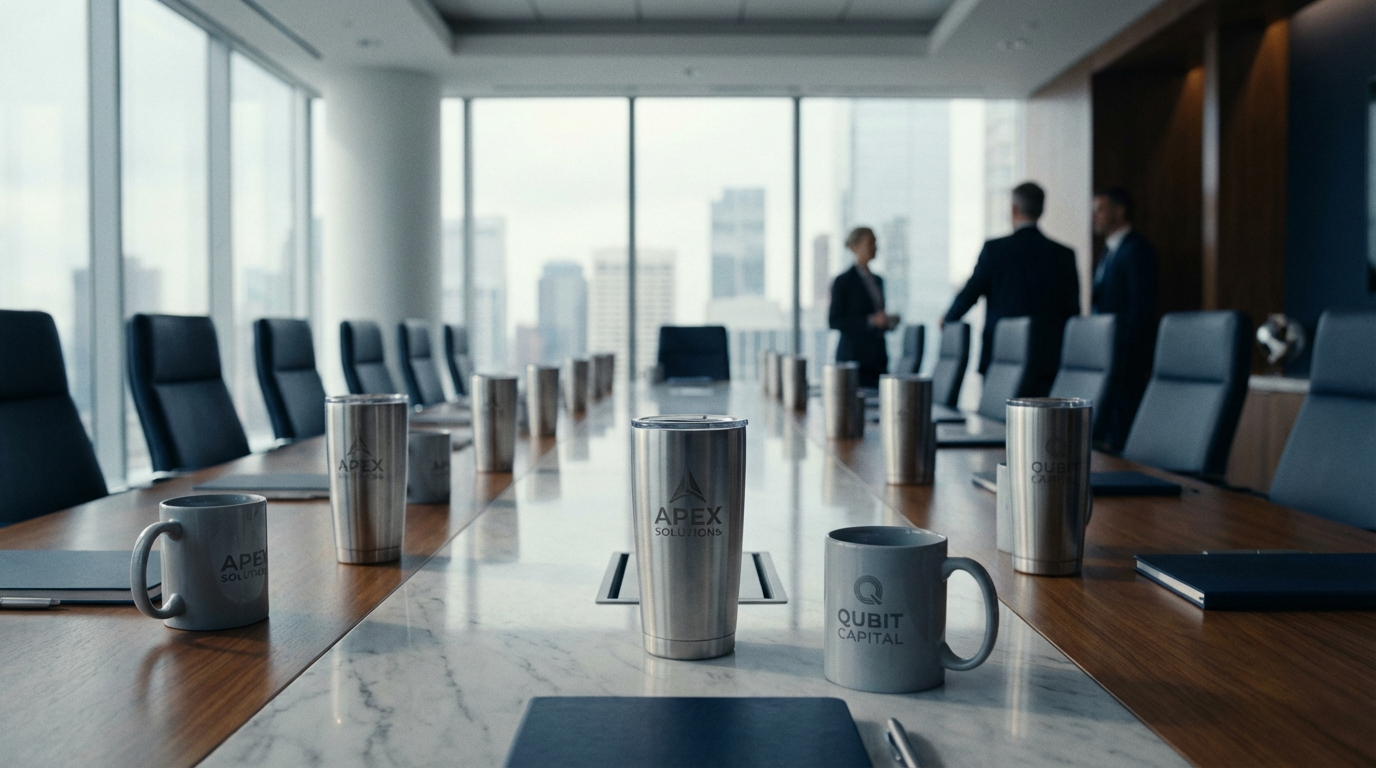
For most corporate programs, custom mugs in bulk should be selected by use case first, then by material, size, decoration, packaging, and delivery plan. Ceramic is usually the practical office choice; stainless steel can fit mobile or premium programs. Confirm the exact configuration, artwork, food-contact documentation, sample, quantity, and acceptance criteria before production.
Start with the program, not the mug
A bulk mug purchase is a small manufacturing program, not simply a larger retail basket. The buyer is specifying a finished assembly, a decoration method, a packaging path, and a delivery boundary. “Custom mug” is not enough for a comparable quote because a ceramic office mug with a one-color mark is a different production problem from a travel mug with a lid, wraparound artwork, and individual gift packaging.
Begin with the recipient and the moment of use. An internal office coffee program prioritizes stable desk use, cabinet fit, comfortable handling, and repeatable decoration. A client gift program may prioritize presentation packaging and a more distinctive finish. A mobile workforce may need a lid and a different cleaning or leakage test. A trade-show giveaway may prioritize portability, carton efficiency, and fast handout rather than maximum capacity.
Write the requirement as a controlled brief: recipient, beverage, location of use, number of locations, distribution date, and whether the item is a gift, employee benefit, event handout, or resale product. That brief prevents a common procurement error: choosing a visually attractive mug before deciding how recipients will actually use and receive it.
Material choice: ceramic, stainless steel, or a hybrid brief
Ceramic mugs are the natural starting point for an office coffee or tea program. They provide a familiar hand feel, a broad printable surface, and a stable desk footprint. Their trade-offs are breakage risk, heavier parcel weight, and the need to define how individual units are protected in transit. Ceramic also requires careful attention to glaze, decoration, and food-contact documentation.
Stainless steel mugs can make sense when the program involves commuting, outdoor work, or a premium mobile gift. They may add a lid, insulation, or a different decoration process. The buyer should not assume that a stainless body makes the entire product equivalent to a stainless-only item: lids, gaskets, coatings, colorants, and adhesives may also matter. Specify every component that can contact the beverage or the user’s mouth.
The FDA describes food-contact substances as substances that come into contact with food without being intended to have a technical effect in the food. Its resources also distinguish food types and conditions of use. For a controlled U.S. procurement file, ask the supplier to identify the relevant components, intended beverage, temperature conditions, and supporting documentation rather than accepting an undefined “FDA approved” statement. See the FDA food-contact substances guidance for the regulatory framework.
For ceramic mugs, ask specifically about glaze and decoration on or near the drinking rim. FDA notes that lead used in pottery may leach into food and publishes guidance for imported pottery and ceramicware. The buyer should request the applicable test or declaration for the actual finished configuration and avoid treating a supplier’s generic material statement as proof for every glaze or print. The FDA pottery safety guidance explains why manufacturing controls and extractable-lead evidence matter.
Size and configuration decisions
Capacity is only one part of fit. Record nominal capacity and, if important, usable fill volume. Measure height, maximum diameter, opening diameter, handle clearance, and base footprint. Then compare those measurements with the recipient’s desk, cabinet, beverage machine, and packaging environment. A mug that fits the cup but not the shipping insert is not a successful specification.
Define the handle opening and grip expectation. A narrow handle can suit a compact office shelf but exclude some users. A wide handle can improve comfort but increase carton width. If the mug will be used for hot beverages, state that use and ask the supplier to identify care limitations. Do not turn an untested assumption into a marketing claim such as “microwave safe,” “dishwasher safe,” or “leakproof.” Those are acceptance requirements only when the program defines the test and the supplier supports the claim.
For travel-style mugs, specify closure type, gasket, mouthpiece, locking feature, and cleaning access. For open ceramic mugs, decide whether a saucer, spoon, coaster, or gift insert is part of the delivered unit. Accessories change both the quote and the packaging geometry.
Decision table for a corporate mug program
| Program condition | Usually prioritize | Questions to resolve before quoting | Likely control point |
|---|---|---|---|
| Office coffee station | Ceramic body, comfortable handle, stable base, easy storage | What size fits the beverage machine and cabinets? | Physical sample and dimensional check |
| Employee welcome kit | Cohesive appearance, gift packaging, repeatable logo | Will every kit receive the same insert and accessory set? | Packed sample and kitting review |
| Client appreciation gift | Finish, decoration quality, presentation, recipient fit | Is personalization by recipient required or only one corporate mark? | Decorated sample and artwork approval |
| Mobile or field team | Lid, grip, transport, cleaning access | What beverage, orientation, and duration define acceptable leakage? | Functional test under written conditions |
| Trade-show distribution | Handling, carton efficiency, quick identification | How many units are needed per event and where will leftovers go? | Carton plan and allocation record |
| Resale or campus store | Consistent SKU, barcode or labeling, replenishment | What packaging, label, and reorder information is required? | Production specification and reorder reference |
This table is a starting filter, not a promise that any configuration is available. Supplier feasibility, decoration area, packaging design, and quantity should be confirmed against the final brief.
Decoration is part of the product specification
Choose decoration after deciding the surface and the use. A logo on glazed ceramic, powder-coated steel, bare steel, a lid, or a silicone component may require different processes and may produce different visual results. Ask the supplier to quote the recommended method for the specified substrate, not merely the cheapest available method.
Define the artwork file, brand color reference, imprint size, placement, orientation, and prohibited areas. “Centered on the front” is not sufficiently precise if the mug has a handle or a seam. State the reference point, distance from the base, relationship to the handle, and whether the measurement is to the artwork edge or visual center. For a wrap, define the start, end, and orientation.
Approve a physical decorated sample when color, finish, registration, or surface curvature matters. A digital mockup can show intended scale and location, but it cannot establish physical color, adhesion, tactile finish, or the effect of cleaning. The internal branding technology guide is useful background when comparing laser, print, and other decoration choices. For the full approval record, use the custom drinkware sample approval checklist.
MOQ, quantity, and the cost calculation
DrinkwareWorks USA’s current program facts are straightforward: ceramic mugs have a 100-unit MOQ and a 3–5 week production window after approved artwork. The window begins after approval, not when an inquiry is sent, and it does not automatically include sampling, artwork revisions, freight, customs, or internal distribution. Confirm the current scope in the quotation.
Treat the MOQ as a configuration threshold. One hundred mugs in one body, color, artwork, and package is not necessarily equivalent to 100 units split across four colors or several logos. Ask how the MOQ applies to each variant, decoration, packaging format, and delivery destination. If the program needs 240 units, ask for the quote at 240 and for the treatment of any future reorder; do not assume a lower unit price merely because the number is larger.
A useful landed-cost model is:
Total program cost = product units × unit cost + one-time setup + samples + packaging + inspection + freight and duties + fulfillment
Cost per delivered recipient = total program cost ÷ delivered recipients
For example, a buyer plans 240 mugs. The supplier quotes hypothetical values of $8.40 per mug, $180 one-time artwork setup, $1.25 individual packaging, and $420 freight. The arithmetic is (240 × $8.40) + $180 + (240 × $1.25) + $420 = $3,228, or $13.45 per planned recipient before any unlisted tax, duty, damage, or last-mile fulfillment. These figures are an illustration of the method, not a DrinkwareWorks USA price quote. Replace every assumption with written quote lines and exclusions.
Compare at least two commercial boundaries: delivered to one warehouse and delivered to multiple locations. A low unit price can be outweighed by extra handling, individual parcels, or protective packaging. Record quote validity, payment milestones, setup reuse on reorders, sample charges, substitutions, and change triggers.
The procurement process that protects the order
-
Write the use case. Name recipients, beverage, environment, quantity, destinations, distribution date, and program objective.
-
Freeze the configuration. Record body, material, capacity, dimensions, handle or lid, finish, color, accessories, and intended care.
-
Issue a comparable RFQ. Ask suppliers to separate recurring unit costs from setup, sample, packaging, inspection, freight, duty, and fulfillment. The custom drinkware RFQ template provides a practical field list.
-
Review compliance evidence. Match documents to the actual body, glaze, decoration, lid, gasket, and intended conditions. Escalate unusual claims or regulated uses to qualified counsel or compliance staff.
-
Approve the physical sample. Check identity, dimensions, handling, decoration, cleaning, packaging, and any functional requirement. Attach the artwork revision and photographs to the approval record.
-
Set acceptance criteria before production. Define critical functional defects, major decoration or alignment defects, minor cosmetic defects, tolerances, inspection timing, and the treatment of substitutions.
-
Plan receipt and reconciliation. Count cartons and units, inspect damage, compare decoration with the approved sample, and document shortages or defects before distribution.
Quality and packaging checks
A production sample confirms the intended setup; it does not prove that every unit in a lot is identical. For ceramic, inspect rim condition, glaze consistency, handle attachment, base stability, print placement, and chips or cracks. For a lidded design, inspect seal components, threads, fit, and cleaning access. Decide in advance which defects are unacceptable and which cosmetic variations can be tolerated.
Approve packaging with the final mug and decoration in place. A presentation box and a master carton perform different jobs. Test whether the mug moves inside its insert, whether the handle is protected, whether printed surfaces rub against packaging, and whether the carton can be labeled and counted at receipt. If the program has both warehouse delivery and direct-to-recipient shipping, assess both paths.
Common buying mistakes
The first is comparing unit prices with different delivery boundaries. The second is assuming one MOQ applies to every color, logo, or package. The third is approving a screen mockup instead of a physical decorated sample. The fourth is asking for “food safe” without identifying the relevant components and use conditions. The fifth is accepting a substitute body, glaze, lid, or decoration process without reopening the affected tests. The sixth is scheduling from the inquiry date while ignoring artwork approval and packaging readiness.
A disciplined buyer also avoids over-specifying features that recipients will not use. More components can create more cleaning work, more packaging complexity, and more points of failure. Select the simplest configuration that satisfies the program’s actual use case, then document why it was selected.
FAQ: Custom mugs in bulk
What is the MOQ for ceramic custom mugs?
DrinkwareWorks USA’s stated MOQ for ceramic mugs is 100 units. Confirm whether the threshold applies per product, color, artwork, or packaging variant before approving a split order.
How long does ceramic mug production take?
The stated production window is 3–5 weeks after approved artwork. Sampling, revisions, packaging, freight, customs, and internal distribution may add time, so schedule backward from the required receipt date.
Should a corporate program choose ceramic or stainless steel?
Choose ceramic when office desk use, familiar handling, and a broad printable surface lead the decision. Consider stainless steel when mobility, insulation, or a lid is central. The right choice depends on use, packaging, decoration, and documented requirements rather than material preference alone.
What should a supplier quote include?
Request the exact product configuration, quantity by variant, decoration method, setup, samples, packaging, inspection, freight, duties or tax assumptions, delivery boundary, lead-time basis, exclusions, and change triggers. This allows procurement to compare total program cost instead of a partial factory price.
Is a digital proof enough to approve bulk production?
No. A digital proof can confirm artwork direction, but a physical decorated sample is the safer control for scale, color, placement, finish, and interaction with the mug surface. Record the approved revision and require written approval for substitutions.
Next step
If the specification is ready, compare the required configuration with the ceramic mugs product page and submit the same brief for a written feasibility and quotation review. Keep the request specific: quantity by variant, artwork status, intended use, packaging, ship-to boundary, and required receipt date.