Corporate Gifting
Relationship Stage Budget Inversion Trap
There is a budget allocation pattern that appears in corporate gifting programs with enough regularity to suggest it is not a mistake but a structural…
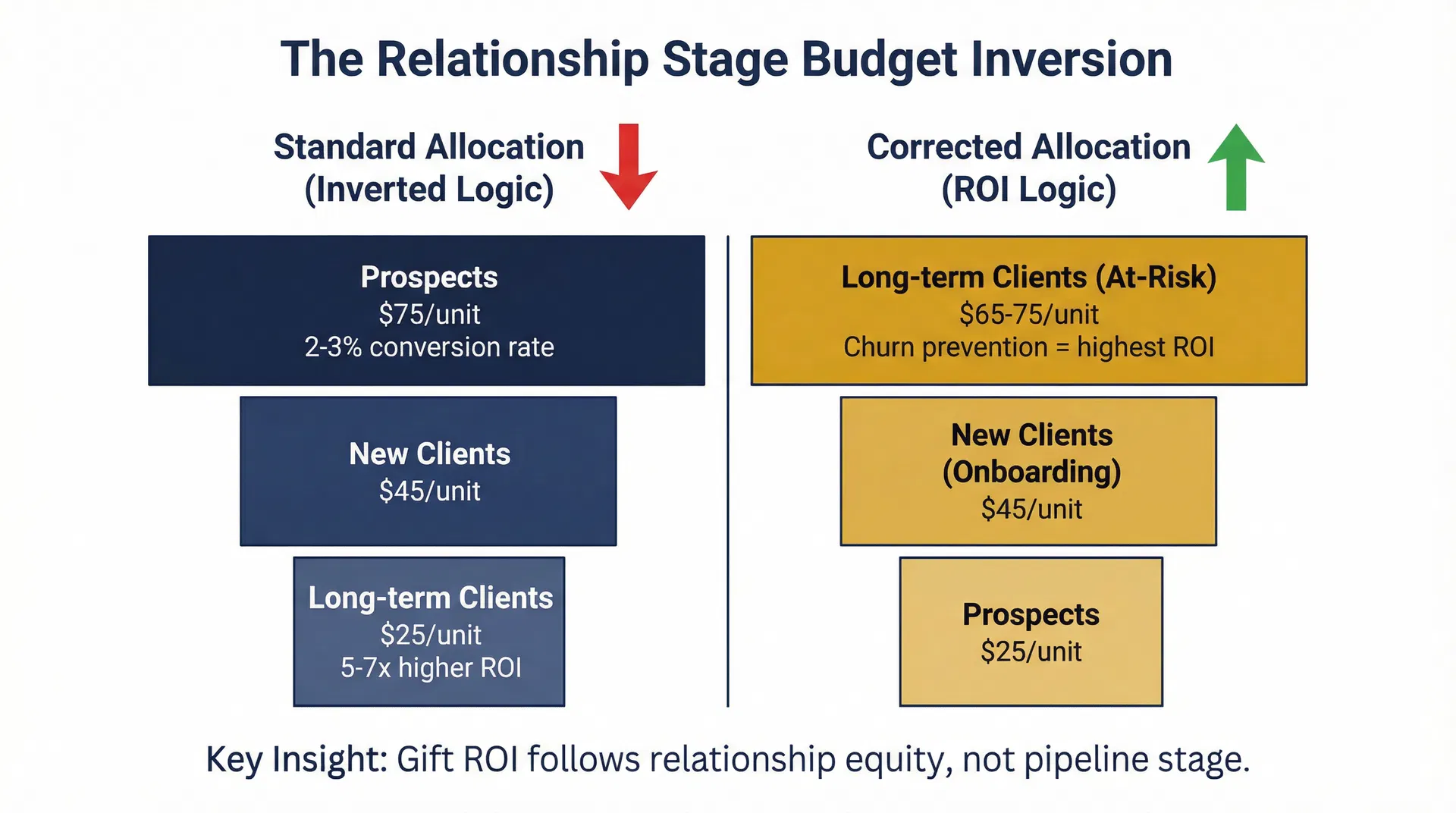
There is a budget allocation pattern that appears in corporate gifting programs with enough regularity to suggest it is not a mistake but a structural feature of how procurement teams are trained to think. Companies routinely spend two to three times more per unit on gifts for prospects than on gifts for existing long-term clients. The logic, when examined, borrows directly from sales pipeline economics: invest heavily where you are trying to win, spend conservatively where you have already won. This reasoning is sound when applied to sales travel, client entertainment, and marketing campaigns. When applied to corporate gifting, it produces the opposite of the intended outcome.
The inversion is not immediately visible because the failure mode is delayed. A $75 custom tumbler sent to a prospect who has attended two discovery calls generates a polite acknowledgment and, in 2-3% of cases, contributes to a conversion. The same $25 ceramic mug sent to a client who has renewed their contract for four consecutive years generates a different kind of signal—one that the client reads as an accurate reflection of where they stand in the vendor's priority hierarchy. The problem is that neither outcome is tracked against the gifting program's budget allocation. The prospect conversion gets attributed to the sales team's follow-up cadence. The client churn, when it eventually happens, gets attributed to competitive pricing or a change in the client's internal team. The gifting program's role in either outcome remains invisible.
What makes this misjudgment particularly consequential is the asymmetry in the underlying economics. Acquiring a new client costs five to seven times more than retaining an existing one. A gifting program that allocates $3,750 to 50 prospects and $5,000 to 200 existing clients is, in aggregate, spending more on retention than on acquisition. But the per-unit allocation—$75 versus $25—communicates the opposite priority to every individual recipient. The prospect receives a gift that signals "we want your business." The existing client receives a gift that signals "you are a line item in our annual gifting budget." These are not equivalent messages, and the client who has been generating $200,000 in annual revenue for four years is capable of reading the difference.
The structural cause lies in how gifting budgets are owned and measured. In most organizations, the corporate gifting program is managed by marketing, which is evaluated on new business metrics: pipeline contribution, conversion rates, and cost per acquisition. Existing client relationships are managed by account teams, which typically do not control the gifting budget and are not consulted when gift tiers are assigned. The result is a program designed around the metrics of the team that owns it, rather than around the relationship economics that determine its actual value. Marketing optimizes for prospect impression. Account management absorbs the consequences when existing clients feel undervalued.
This is where the question of which types of corporate gifts are best for different business needs becomes a question about relationship stage, not just recipient type. The distinction matters because the same product—a custom insulated tumbler, for example—carries entirely different relationship signals depending on the context in which it is received. A $65 laser-engraved tumbler sent to a prospect who has never signed a contract reads as a sales gesture. The same tumbler sent to a client who has renewed three times, with their name engraved alongside the company logo, reads as a recognition of a specific, valued relationship. The product is identical. The signal is not.
The practical consequence of the inversion becomes measurable when gifting programs are analyzed against churn data. Clients who receive gifts that are materially lower in perceived quality than the gifts they observe being sent to prospects—through industry events, referral networks, or simply by comparing notes with peers—frequently cite the discrepancy as a contributing factor in their decision to evaluate alternatives. They do not frame it as "the gift was too cheap." They frame it as "we felt like we were no longer a priority." The gift, in this context, is functioning as a relationship signal rather than a product transaction. Procurement teams that evaluate gifts as product transactions miss this entirely.
The correction requires a reorientation of the budget allocation framework. Rather than assigning gift tiers based on pipeline stage—prospect, qualified lead, new client, existing client—the more accurate framework assigns tiers based on relationship value and churn risk. A client generating $500,000 in annual revenue who has shown early signs of reduced engagement warrants a higher gift investment than a prospect who has attended one webinar. An existing client celebrating a five-year anniversary with the company warrants a more significant recognition than a prospect who has just entered the pipeline. These are not intuitive conclusions when viewed through a sales pipeline lens. They are obvious conclusions when viewed through a relationship economics lens.
Custom drinkware occupies a specific position in this reorientation because it is a daily-use item with a long display life. A custom stainless steel tumbler used every morning for two years generates approximately 500 brand impressions per year at a per-impression cost that no other gifting category can match. For existing client programs, where the objective is sustained relationship reinforcement rather than a single impression event, this characteristic is directly relevant to the ROI calculation. The gift that sits on a client's desk every day for two years is doing different work than the gift that generates a single moment of appreciation and then disappears. Procurement teams that evaluate gifts on unit cost alone are measuring the wrong variable.
The inversion trap is most visible in year-end gifting programs, where budget allocation decisions are made in bulk across the entire client and prospect portfolio. A company that sends $75 gifts to 50 prospects and $25 gifts to 200 existing clients has made 250 individual relationship statements in a single program cycle. The 200 existing clients who receive the lower-tier gift have each received the same signal: you are worth less to this company than someone who has not yet given us any revenue. Whether or not that signal was intended, it is the signal that was sent. Correcting it requires not just a different product selection, but a different budget allocation logic—one that treats relationship retention as the primary investment objective and prospect acquisition as the secondary one.
The organizations that have corrected this inversion typically do so not through a formal policy change but through a shift in how gifting program success is measured. When account teams are given input into gift tier assignments for their clients, and when churn prevention is included as a metric alongside new business conversion, the budget allocation naturally reorients toward the relationships that carry the highest revenue risk. The prospect gifting program does not disappear—it simply stops receiving a disproportionate share of the per-unit budget at the expense of the clients who are already generating revenue.
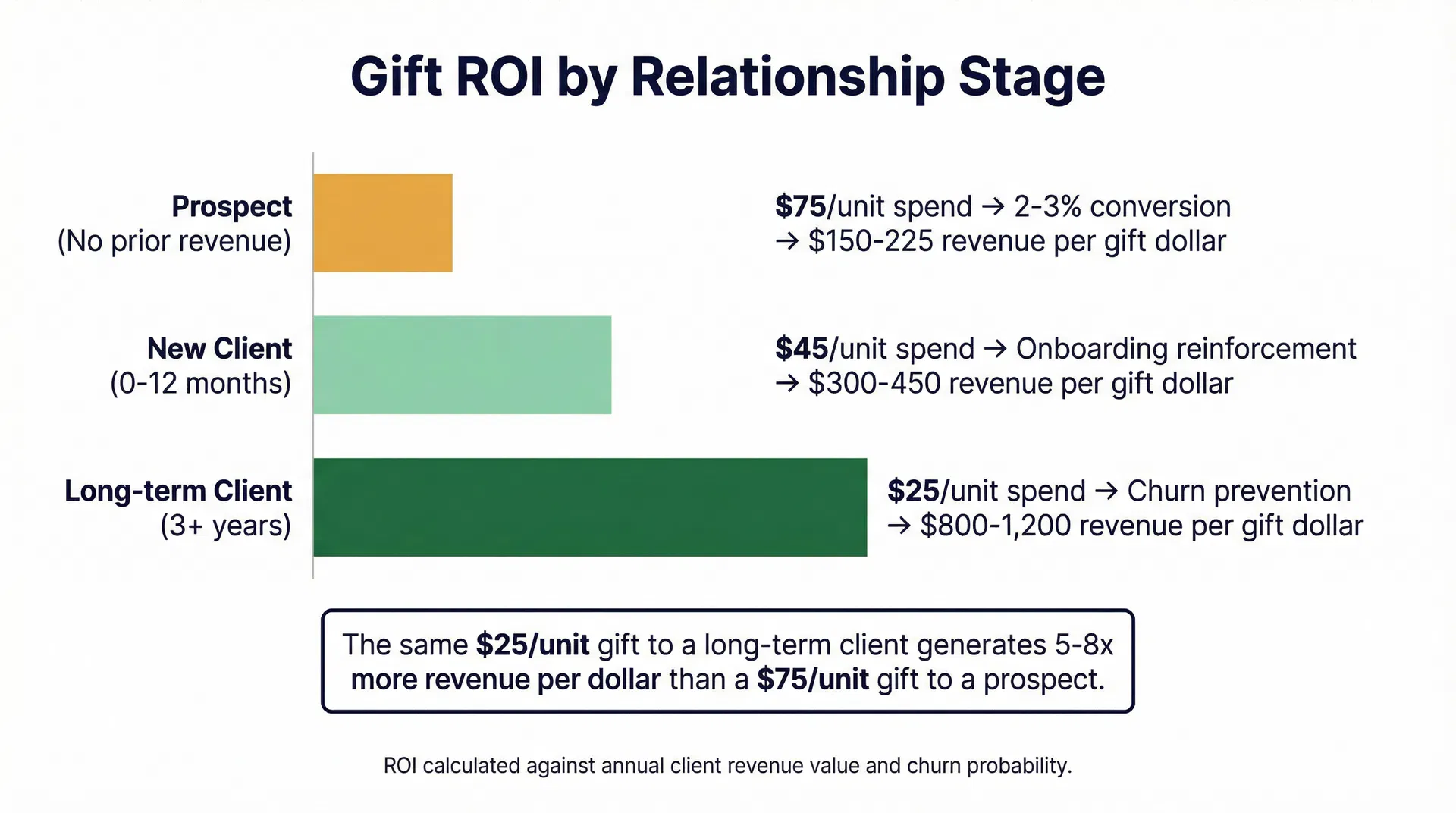
What remains after this reorientation is a gifting program that is still capable of making a strong impression on prospects, but that reserves its highest-quality, most personalized gifts for the relationships that have already demonstrated their value. The custom tumbler with a prospect's company logo is a sales gesture. The custom tumbler with a long-term client's name, sent on the anniversary of their first contract, is a relationship investment. The difference in unit cost between these two gifts is far smaller than the difference in what they communicate.