Corporate Gifting
The Recipient Role Conflation Trap: Why a Uniform Gift List Undermines Diverse Relationships
企業禮品採購中,將決策者、影響者與使用者混入同一份名單並以相同規格處理的常見誤判。本文從工廠端專案經理視角,分析為何這種名單管理邏輯會導致關係投資的次優結果。

The list is usually where the problem starts. Not the product selection, not the budget, not the supplier — the list. When a gifting program is assembled, someone compiles a set of names and sends it to procurement. Procurement treats the list as a uniform input: a defined quantity of recipients, each requiring one unit of the selected product. The custom insulated tumblers are ordered, branded, and shipped. The program is executed on time and within budget. And yet the relationship outcomes across that list vary enormously — not because of quality variation in the product, but because the list contained multiple distinct recipient roles that were never differentiated, and the single-specification order could not serve all of them equally well.
This is the conflation that most gifting programs carry without knowing it. A corporate gift recipient list is rarely a homogeneous group. It typically contains at least three structurally different roles: decision-makers who control contract renewals and budget approvals, influencers who shape internal recommendations without holding final authority, and champions or daily-contact users who interact with the sender's team regularly and whose goodwill affects execution quality. Each of these roles has a different relationship dynamic with the sender, a different set of expectations about what a gift signals, and a different threshold at which a gift either reinforces or undermines the relationship. Treating all three with the same product, the same packaging, and the same personalization level is not a neutral choice. It is a choice that optimizes for one role at the expense of the others.
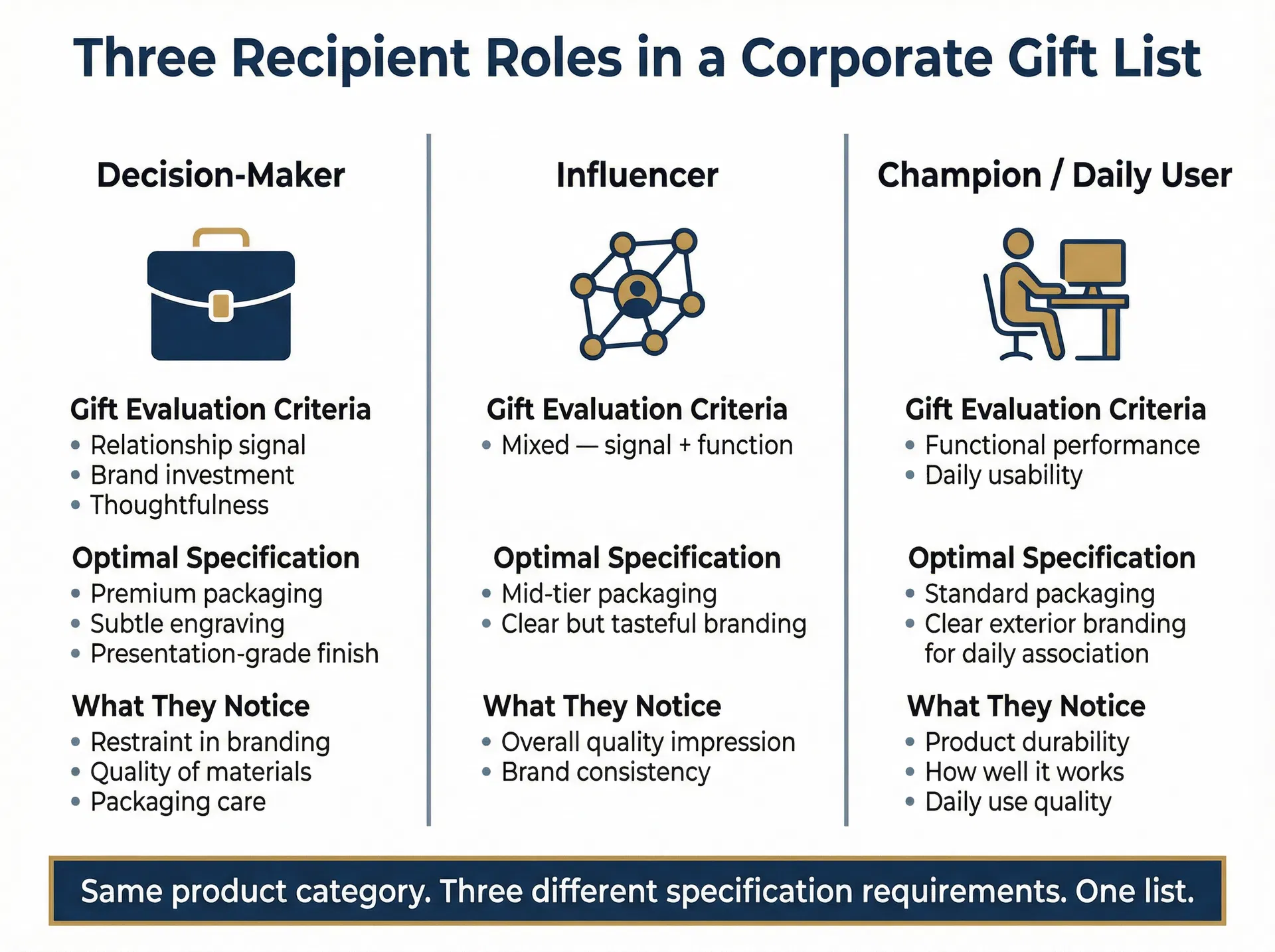
The decision-maker role is the one most procurement processes are implicitly designed around. The gift is intended to reinforce a strategic relationship, signal investment, and remain memorable. For this role, the product quality, the packaging presentation, and the restraint of the branding all carry weight. A premium custom stainless steel tumbler with subtle engraving and a considered gift box communicates exactly the right message: the sender values the relationship enough to invest in it thoughtfully. The gift is evaluated as a signal of how the sender views the relationship, not as a functional object.
The champion or daily-contact user operates under entirely different evaluation criteria. This is the person who actually uses the product, who will carry the tumbler to meetings, who will mention it to colleagues, and whose daily positive association with the sender's brand is the actual mechanism of value for this role. For this recipient, the functional quality of the product matters more than the packaging presentation. A well-made, durable tumbler that performs reliably is the right specification. The gift is evaluated primarily as an object: does it work, is it well-made, will I use it every day. The elaborate gift box that signals investment to the decision-maker is largely irrelevant here — and the budget spent on it is budget that could have been allocated to product quality instead.
The influencer role sits between these two. This recipient shapes internal recommendations and can accelerate or delay decisions, but does not hold final authority. The gift needs to be good enough to be memorable and to signal that the sender takes the relationship seriously, but the specification requirements are different from both the decision-maker and the champion. The influencer is evaluating the gift partly as an object and partly as a signal — and the weighting between those two evaluations depends on the specific relationship context and industry norms.
In practice, this is where gifting programs start to be misjudged. The procurement brief specifies one product, one packaging standard, and one personalization level for the entire list. The vendor produces exactly what was ordered. The decision-maker receives a gift that is adequate but not particularly differentiated from what they receive from every other vendor. The champion receives a gift that is over-packaged relative to their evaluation criteria, with budget allocated to presentation elements they do not value. The influencer receives something that falls between the two without fully serving either objective. The program was executed correctly. The relationship outcomes were suboptimal across all three roles.
The structural reason this happens is that recipient lists are assembled by people who know the relationships — account managers, sales directors, relationship owners — and then handed to procurement as a quantity input. The relational nuance that the account manager holds about each recipient does not transfer with the list. Procurement sees names and addresses. The specification decision is made at the program level, not the recipient level, because that is how procurement processes are designed to operate efficiently. The gap between the relational knowledge held by the account manager and the specification decision made by procurement is where the conflation occurs.
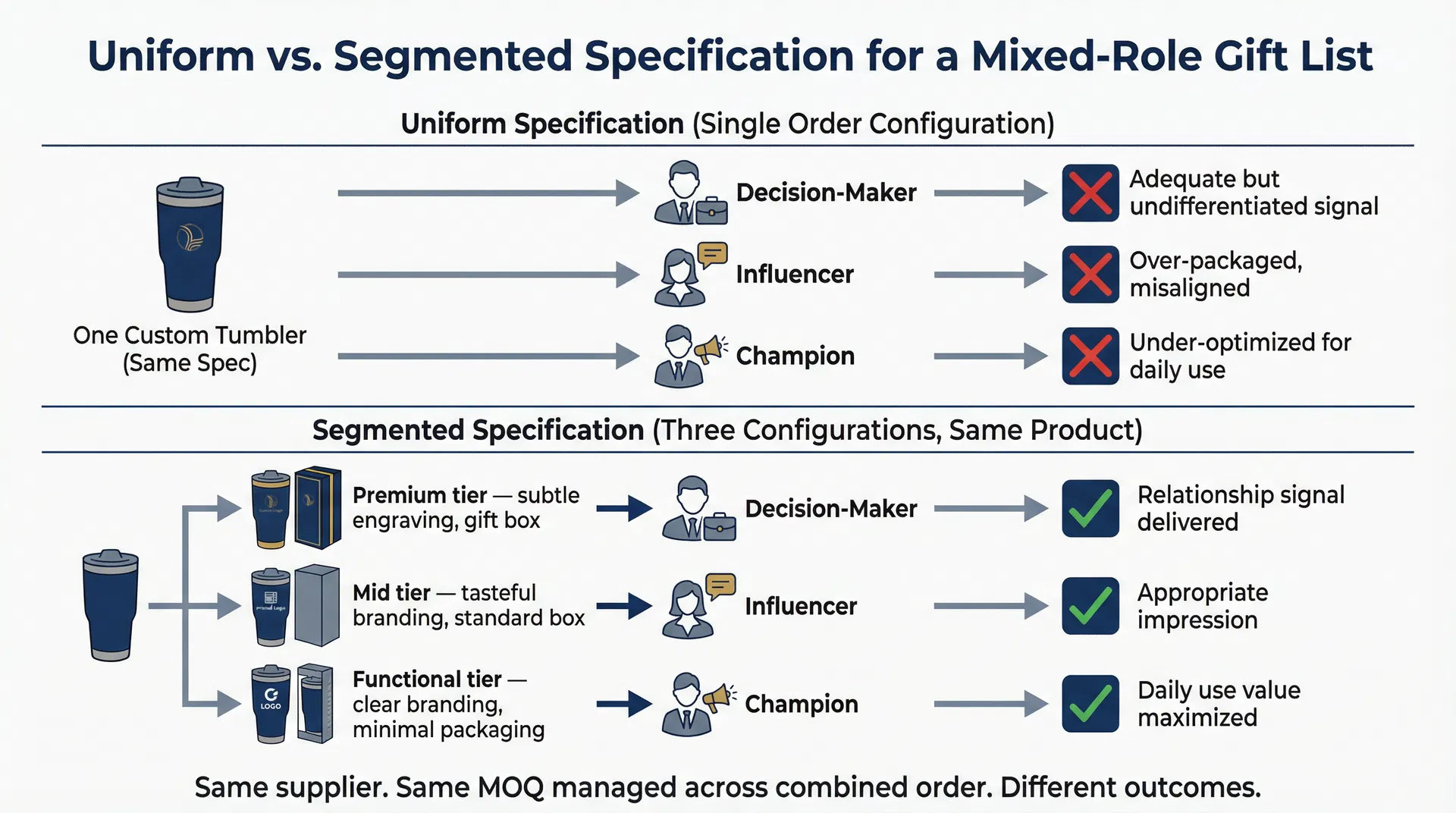
The correction does not require a different product for every recipient. It requires a different specification framework for each recipient role. For a custom drinkware program, this might mean the same tumbler model ordered in three configurations: a premium packaging tier with subtle engraving for decision-makers, a standard packaging tier with clear exterior branding for champions who benefit from daily brand association, and a mid-tier configuration for influencers. The product is the same. The supplier relationship is the same. The MOQ is managed across the combined order. What changes is the specification applied to each segment of the list — and that change requires the account manager's relational knowledge to be captured as a procurement input rather than lost in the handoff.
The question of which gift types genuinely serve different business needs is frequently answered at the product category level: drinkware for one program, notebooks for another. The more consequential answer, for programs that include multiple recipient roles within the same list, is at the specification level within a single product category. A gifting program that orders one custom tumbler configuration for a mixed-role list is not making a neutral efficiency choice. It is making a specification decision that will systematically underserve at least two of the three recipient roles it was designed to strengthen.
The companies that avoid this outcome are not necessarily running more complex programs. They are running programs where the account manager's knowledge of recipient roles is treated as a procurement input, not as context that gets lost in the handoff. The list is segmented before it reaches the vendor, not after the gifts have been delivered and the relationship outcomes have been assessed. That sequencing is the difference between a gifting program that executes correctly and one that actually works.