Brand Activation
Promotional Drinkware: How Businesses Choose Products That Get Used
A procurement-led guide to choosing promotional drinkware by use case, recipient context, decoration, quality, compliance, and program economics.
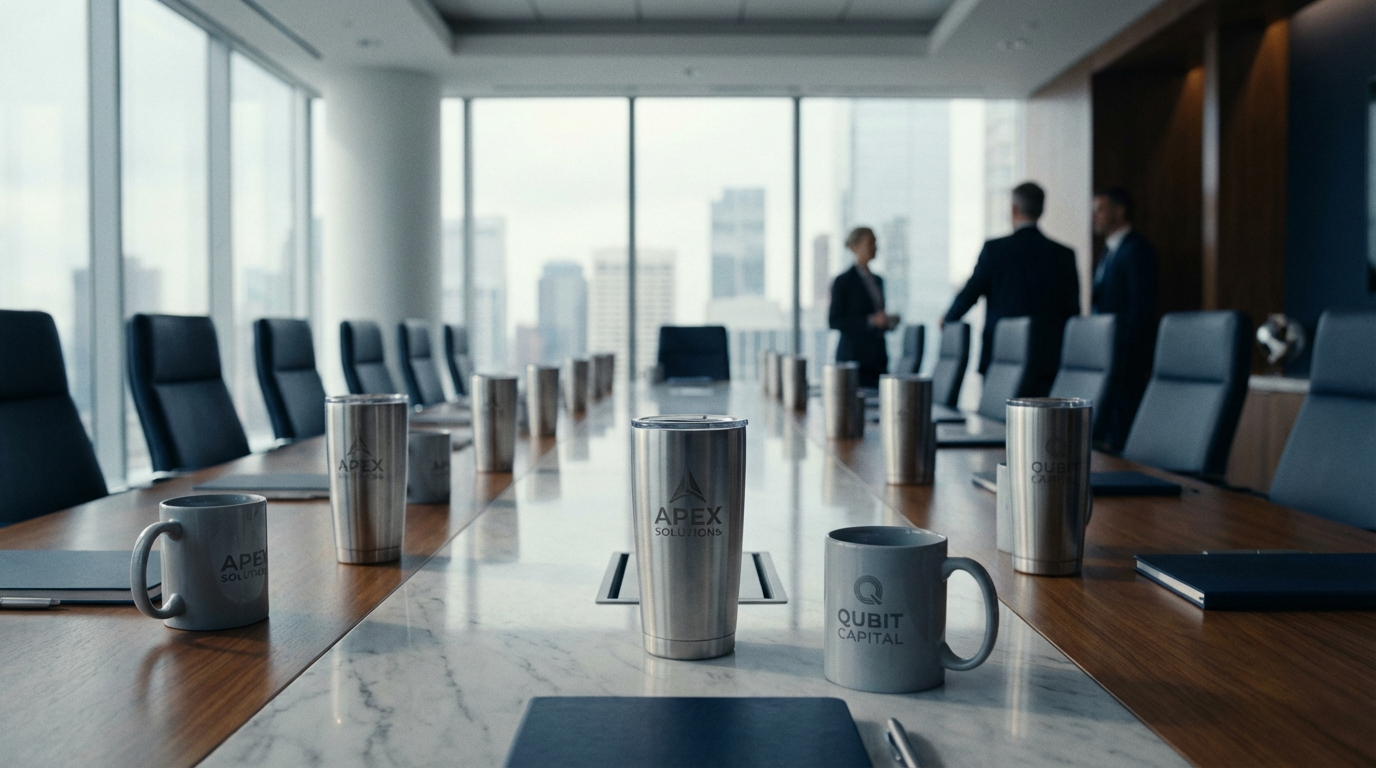
Promotional drinkware works when it fits a real drinking routine, survives that routine, and presents the brand clearly without creating friction. Businesses should choose by recipient, setting, cleaning and carrying habits, decoration durability, food-contact documentation, order quantity, and fulfillment plan—not by appearance or unit price alone. The result is a useful product people keep within reach.
Start with the use case, not the product catalog
A promotional item is a small piece of operational design. The recipient has to lift it, open it, clean it, store it, and decide whether to carry it again. If any of those actions conflict with the setting, the logo becomes irrelevant. A procurement brief should therefore describe the moment of use before it names a vessel.
For a trade show, the job may be a portable reminder that fits in a tote and does not spill while a prospect walks between booths. For an employee program, the job may be repeated desk or commute use. For a client gift, the job may be a more deliberate unboxing and a finish that matches the relationship. These are different requirements even when the same logo appears on all three.
Define the recipient and the distribution moment in one sentence: “A bottle for field staff who refill during a shift,” or “A tumbler handed to prospects after a scheduled meeting.” That sentence exposes the decisions that matter: capacity and grip, lid operation, temperature expectation, surface area, packaging, and whether the item needs to travel before it is used.
What “gets used” means in procurement terms
“Used” is not a vague quality compliment. For a business buyer, it is a set of observable conditions:
- The form fits the recipient’s routine and storage environment.
- The opening, lid, and cleaning instructions are understandable.
- The decoration remains legible under the expected handling and washing conditions.
- The product is acceptable for its intended food or beverage contact and the supplier can explain the documentation scope.
- Quantities, artwork, packaging, and delivery destinations are controlled well enough for distribution.
This is why a visually impressive sample can fail a program. A narrow logo area may look elegant but become invisible on a desk. A lid may photograph well but be awkward for a user wearing gloves. A dark finish may suit the brand while making a light mark hard to read. These are specification questions, not taste questions.
Product selection by context
| Business context | Primary use requirement | Product direction to evaluate | Common procurement failure |
|---|---|---|---|
| Trade show or event | Carryability, fast handoff, recognizable branding | Lightweight bottle or tumbler with a simple opening and durable mark | Choosing a large item that attendees will not carry |
| Employee onboarding | Repeated daily use and easy allocation | Stainless steel bottle or tumbler matched to desk and commute habits | Treating every employee as if they has the same routine |
| Field, construction, or outdoor teams | Grip, robustness, access during work, and clear identification | Stainless steel bottle or tumbler with a secure lid and high-visibility decoration | Prioritizing finish over handling and cleaning |
| Client or executive gift | Perceived quality, presentation, and restrained branding | Premium-finish tumbler or ceramic mug, depending on the recipient’s setting | Adding features that do not support the recipient’s actual use |
| Office or hospitality program | Shared-space practicality and repeat replenishment | Ceramic mug or bottle selected around storage, washing, and break-room workflow | Ignoring cabinet, dishwasher, or replacement processes |
The table is a starting screen, not a promise that one format will work for everyone. Ask users where the item will be stored, how it will be washed, whether it travels, and what beverage temperature matters. If the answer is unknown, record it as an open requirement instead of silently assuming a universal product.
Material and format decisions
Stainless steel tumblers and water bottles are often evaluated for durability, portability, and a broad range of branding treatments. DrinkwareWorks USA’s current planning facts are a 50-unit MOQ and 2–4 week production after approved artwork for these categories. Those are production windows, not delivery guarantees; artwork approval, sampling, freight, and distribution still affect the program schedule.
Ceramic mugs support office, hospitality, and desk rituals where a handle, familiar shape, and cabinet storage matter. The current planning facts are a 100-unit MOQ and 3–5 week production after approved artwork. A mug can be the better choice when the use environment is a staffed break room or a reception area. It is not automatically the better choice for a mobile workforce.
Material language must stay precise. “Reusable” describes intended repeat use; it does not prove that every recipient will reuse the item or that a program eliminates disposable products. If a company makes an environmental claim, the Federal Trade Commission’s environmental marketing guidance says claims should be supported by competent and reliable scientific evidence. Procurement should send proposed wording through the brand or legal review process rather than turning a product feature into an unsupported impact claim.
Decoration is part of the use experience
Logo visibility depends on contrast, viewing angle, surface curvature, finish, and handling. Start with a controlled decoration brief:
- Mark the primary viewing side and any secondary mark separately.
- State the maximum imprint area without assuming the entire vessel is printable.
- Identify required colors and whether a single-color mark is acceptable.
- Specify the smallest text that must remain readable.
- Define the expected exposure: hand contact, bags, shelves, commercial washing, or ordinary home washing.
- Approve a physical sample or a documented proof that shows placement, scale, and color expectations.
A decoration that survives production may still be a poor brand asset if it is placed where a hand covers it. For practical examples of placement trade-offs, compare the internal guide on logo placement for custom drinkware. For method-specific questions, the internal laser engraving versus printing guide explains why color, contrast, and surface matter.
Avoid treating “dishwasher safe” as a universal shortcut. The vessel, coating, decoration, detergent, temperature, and wash cycle may all matter. The purchase specification should state the intended care conditions and ask the supplier to confirm what has actually been evaluated. Do not add a care claim to packaging until it has been approved for the exact product and decoration combination.
Quality and food-contact documentation
Quality assurance and quality control are related but different procurement activities. The American Society for Quality explains that quality assurance provides confidence that requirements will be fulfilled, while quality control focuses on fulfilling those requirements through operational techniques and inspection. For a drinkware order, that means writing requirements before production and then checking representative units against them.
A usable pre-production specification should identify the vessel, material description, finish, lid components, decoration, packaging, quantity, acceptable variation, and care instructions. A receiving or third-party inspection plan can then check obvious defects, function, decoration placement, packaging damage, and quantity. Review the internal custom drinkware quality-control inspection checklist when converting those requirements into an inspection record.
Food-contact language also needs discipline. The U.S. Food and Drug Administration explains that food-contact substances that are food additives must be authorized through an applicable pathway, and that food-contact notifications are specific to the submitting company and specified intended use. A buyer should request documentation for the actual components and intended conditions of use, including relevant coatings, seals, lids, and decoration where applicable. Do not claim “FDA certified” merely because a supplier uses that phrase; ask what document, component, use, and authorization it refers to.
A decision process that survives internal review
- Write the use brief. Name the recipient, setting, beverage, carrying behavior, cleaning environment, distribution date, and quantity range.
- Shortlist two or three formats. Compare stainless steel tumbler, stainless steel bottle, and ceramic mug only where each can meet the use brief.
- Build a requirement sheet. Record dimensions, lid or handle, finish, imprint area, artwork colors, packaging, care, documentation, and acceptance checks.
- Review physical samples. Check grip, opening, stability, logo position, color contrast, odor, finish, and packaging. Ask a representative user to handle the sample.
- Approve artwork and evidence. Lock the proof, care language, component documentation, and inspection approach before production.
- Plan allocation. Separate production quantity from event or employee quantity. Include a conditional reserve only if the budget and storage plan support it.
- Inspect and learn. Record defects, missing units, recipient feedback, and actual distribution. Use those observations in the next reorder.
This process keeps marketing, procurement, operations, and compliance from making separate assumptions. It also makes a quote comparable because every supplier is responding to the same requirements.
A simple program calculation
Suppose a team expects to distribute 240 units at an employee event. The approved design requires 220 recipient units, and the team wants a conditional 5% handling reserve for replacements or late additions. The planning quantity is:
220 × 1.05 = 231 units
Because 231 is above the current 50-unit stainless steel MOQ, the quantity clears that threshold. It is also above the current 100-unit ceramic mug MOQ. The calculation does not establish a price, guarantee availability, or replace a supplier quotation. It simply separates intended distribution from a documented operational reserve. If the event is uncertain, the buyer should test a lower commitment, staged release, or different allocation rather than automatically ordering the largest plausible quantity.
Track cost on a delivered-recipient basis when comparing programs:
delivered cost per recipient = (product + decoration + packaging + freight + handling) ÷ recipients who receive an item
Use actual quoted values for each term. If 20 units remain in storage, they are inventory, not delivered recipients. This distinction prevents an attractive unit quote from hiding over-ordering or fulfillment loss.
Checklist before purchase order
- Recipient and use setting are written in operational terms.
- Format, capacity, opening, handle or grip, and storage constraints are recorded.
- Logo placement, size, colors, and minimum readable detail are approved.
- Care instructions match the exact product and decoration.
- Food-contact documentation request names the components and intended use.
- MOQ and production window are confirmed for the selected category.
- Artwork approval date and inspection point are assigned.
- Packaging and destination allocation are clear.
- Quantity calculation distinguishes recipients, reserve, and leftover inventory.
- Environmental wording has evidence and internal approval before publication.
Questions procurement teams ask
What is the best promotional drinkware product? There is no universal best product. Choose the format that removes the most friction from the recipient’s routine while meeting decoration, care, documentation, quantity, and distribution requirements.
Should a business choose a tumbler or water bottle? Choose a tumbler when the dominant routine is desk, vehicle, or coffee use; choose a bottle when refill, carrying, and all-day hydration are the stronger requirements. Validate the lid, grip, storage, and cleaning conditions with actual users.
Are the listed production windows delivery promises? No. Stainless steel tumblers and water bottles currently plan at 2–4 weeks after approved artwork, while ceramic mugs plan at 3–5 weeks. Freight, approval timing, capacity, packaging, and final distribution remain separate schedule variables.
What should we request for food-contact compliance? Request documentation tied to the actual vessel components and intended conditions of use. Clarify whether the evidence covers the body, coatings, lids, seals, and decoration rather than accepting an unqualified compliance label.
How can we reduce unused promotional inventory? Start with a recipient-based quantity model, separate confirmed distribution from a documented reserve, and stage quantities when event attendance or workforce allocation is uncertain. Measure delivered recipients and leftover units after the program.
A product gets used when procurement treats the recipient’s routine as a design requirement. The strongest promotional drinkware brief is not the one with the most features; it is the one that makes use, care, branding, evidence, quantity, and distribution easy to execute. That discipline turns a logo-bearing object into a dependable brand activation asset. Review the available custom drinkware products against the approved brief before requesting a quote.