Corporate Gifting
The Personalization Proxy Trap: Why a Name on a Tumbler Isn't True Connection
企業禮品採購中,將姓名印刷視為個人化終點的常見誤判。本文從資深企業採購顧問視角,分析為何這種表面個人化無法傳遞真正的關係信號,並導致個人化預算的低效運用。

There is a version of personalization that procurement teams execute correctly from a process standpoint and incorrectly from a relationship standpoint. It involves adding the recipient's name to a custom stainless steel tumbler or engraved ceramic mug, confirming that the spelling is accurate, and marking the personalization step as complete. The product is genuinely personalized in the literal sense — it carries information specific to one individual. But the relationship signal it sends is not the signal that personalization is supposed to send, and understanding why requires separating the act of personalization from the function it is meant to perform.
Personalization in a B2B gifting context works as a signal of relational knowledge. Its value to the recipient is not the name itself — the recipient already knows their own name — but the inference the name's presence invites: that the sender invested attention in treating this person as an individual rather than as a member of a category. The signal is credible only to the degree that it requires genuine knowledge to produce. A name printed on a tumbler requires no knowledge beyond what appears on a business card or a CRM contact record. It is, in signal terms, a low-cost gesture — not because it is inexpensive to execute, but because it requires nothing that the sender would not already possess as a baseline operational fact.
This is where the misalignment between procurement logic and relationship logic becomes consequential. From a procurement standpoint, adding name personalization to a batch order of custom drinkware is a meaningful upgrade. It requires additional setup, increases per-unit cost, and introduces a data management step — collecting and verifying recipient names, formatting them for production, and confirming the output before the production run begins. The procurement team has done more work and spent more money. The gift is, by any operational measure, more personalized than a standard logo-printed item. But the recipient's experience of the gift does not track the procurement effort. It tracks the inference the gift supports about the sender's knowledge of them as a person.
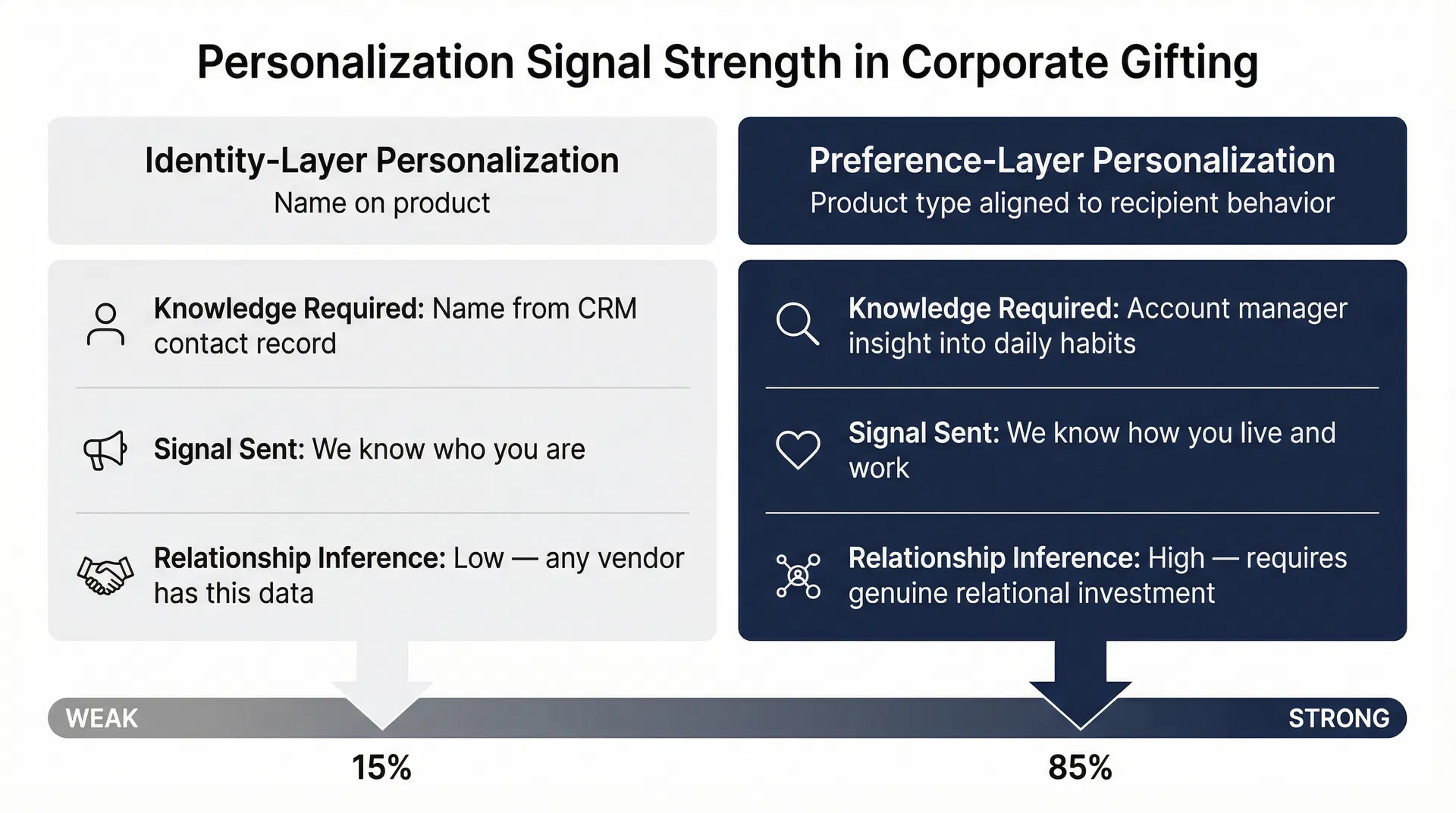
The distinction that procurement teams rarely articulate is the difference between personalization at the identity layer and personalization at the preference layer. Identity-layer personalization — name, title, company — uses information that exists in every contact database and requires no relational investment to obtain. Preference-layer personalization — product type, capacity, finish, use context — requires actual knowledge of how the recipient lives and works. A procurement team that knows a client's senior account lead commutes by train and drinks coffee throughout the morning has the information needed to select a 20-ounce insulated tumbler with a leak-proof lid rather than a standard 16-ounce desk mug. That selection communicates something a name on the side of the mug cannot: that someone on the sender's team paid enough attention to know something specific about this person's daily routine.
The practical consequence of confusing these two layers is that organizations spend the incremental cost of name personalization without capturing the relationship benefit that genuine personalization produces. The budget line for personalization is present. The relationship signal that budget line is supposed to generate is absent. Recipients receive a product that is technically addressed to them but experientially indistinguishable from a well-executed batch gift. The name confirms that the sender knows who they are. It does not confirm that the sender knows anything about them.
In practice, this is often where corporate gift type decisions start to be misjudged at scale. When a program covers fifty or a hundred recipients, the operational pressure to standardize is real. Collecting preference-layer data for a hundred people requires account manager input, which requires time and coordination that procurement teams often cannot secure within their planning window. The path of least resistance is to standardize the product and differentiate at the identity layer — same tumbler, different names. The program appears personalized. The relationship signal it sends is not.
The more useful question for procurement teams to ask is not "how do we personalize this gift?" but "what do we know about this recipient that we could encode in the gift selection?" For a segment of recipients where genuine preference-layer knowledge exists — typically the highest-value accounts where account managers have direct relationships — that knowledge should drive product type selection, not just surface treatment. A recipient who has mentioned preferring cold beverages to hot ones, or who works primarily outdoors, or who has expressed a preference for minimalist design, has provided the raw material for a gift selection that communicates genuine attention. The name on the side of the tumbler adds nothing to that signal. In some cases, it dilutes it by making the gift look like a production run item that happened to include a name field.
Understanding how different gift types serve different relationship objectives is the prerequisite for making this distinction operational. The gift type decision — what category of product, what specification level, what use context — carries more relational information than any surface treatment applied after the fact. A correctly selected product type communicates preference-layer knowledge even without a name. An incorrectly selected product type with a name on it communicates identity-layer knowledge and nothing more.
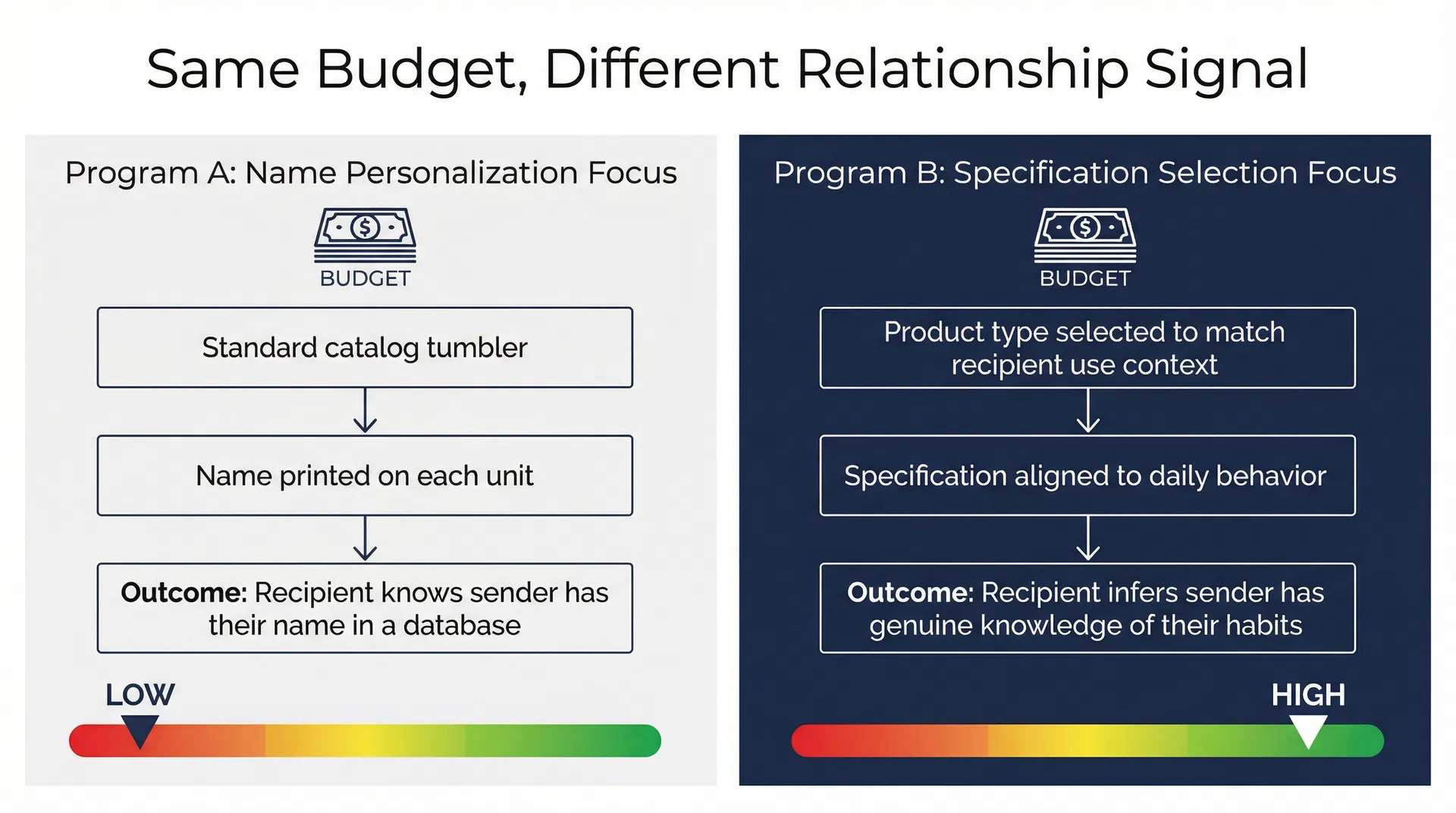
The structural reason this trap persists is that procurement teams are evaluated on execution quality — accuracy, on-time delivery, budget compliance — rather than on relationship signal quality. Adding name personalization is a measurable, verifiable execution step. Selecting a product type that encodes genuine preference-layer knowledge is not measurable in the same way, and the account managers who hold that knowledge are rarely integrated into the procurement workflow at the point where product selection decisions are made. The knowledge exists in the organization. It does not reach the procurement decision. The name goes on the tumbler. The relationship opportunity does not.