Corporate Gifting
The Logo Visibility Inversion Trap: When a Bigger Logo Means a Smaller Impact
企業禮品採購中,將品牌標誌曝光度作為所有禮品統一標準的常見誤判。本文從品質/合規顧問視角,分析為何在高管客戶禮品上,顯眼 logo 反而會降低禮品的感知價值。

There is an assumption embedded in most corporate gifting briefs that rarely gets examined: that the purpose of a branded gift is to maximize brand visibility, and that a larger, more prominent logo on the product surface is therefore always better. This assumption is not unreasonable. It follows the same logic that governs outdoor advertising, trade show booths, and sponsorship placements — more visibility, more impressions, more return. The problem is that this logic applies to one category of corporate gift and actively undermines another. When procurement applies it uniformly across all gifting programs, the result is a systematic inversion of the intended brand signal in precisely the relationships where the signal matters most.
The inversion works like this. A custom stainless steel tumbler with a large, prominently placed logo on the exterior is functioning correctly as a promotional distribution item. The recipient at a trade show booth understands the transaction: they are receiving a useful object, the sender is receiving brand exposure, and both parties accept this exchange without any ambiguity. The logo is the point. Its visibility is the mechanism by which the gift generates value for the sender. A recipient who uses that tumbler at the gym, at the office, or on a commute is delivering exactly the impression the sender paid for.
The same tumbler, ordered with the same large exterior logo and sent to a senior procurement director at a company the sender has been cultivating as a strategic account for eighteen months, communicates something entirely different. The recipient does not experience the gift as a gesture of relationship investment. They experience it as a branded item — functionally identical to the trade show giveaway, differentiated only by the delivery method. The logo, which was the mechanism of value in the promotional context, has become the mechanism of devaluation in the relationship context. It signals that the sender's primary concern is visibility, not the recipient's experience. At the senior level, that signal is read immediately and accurately.
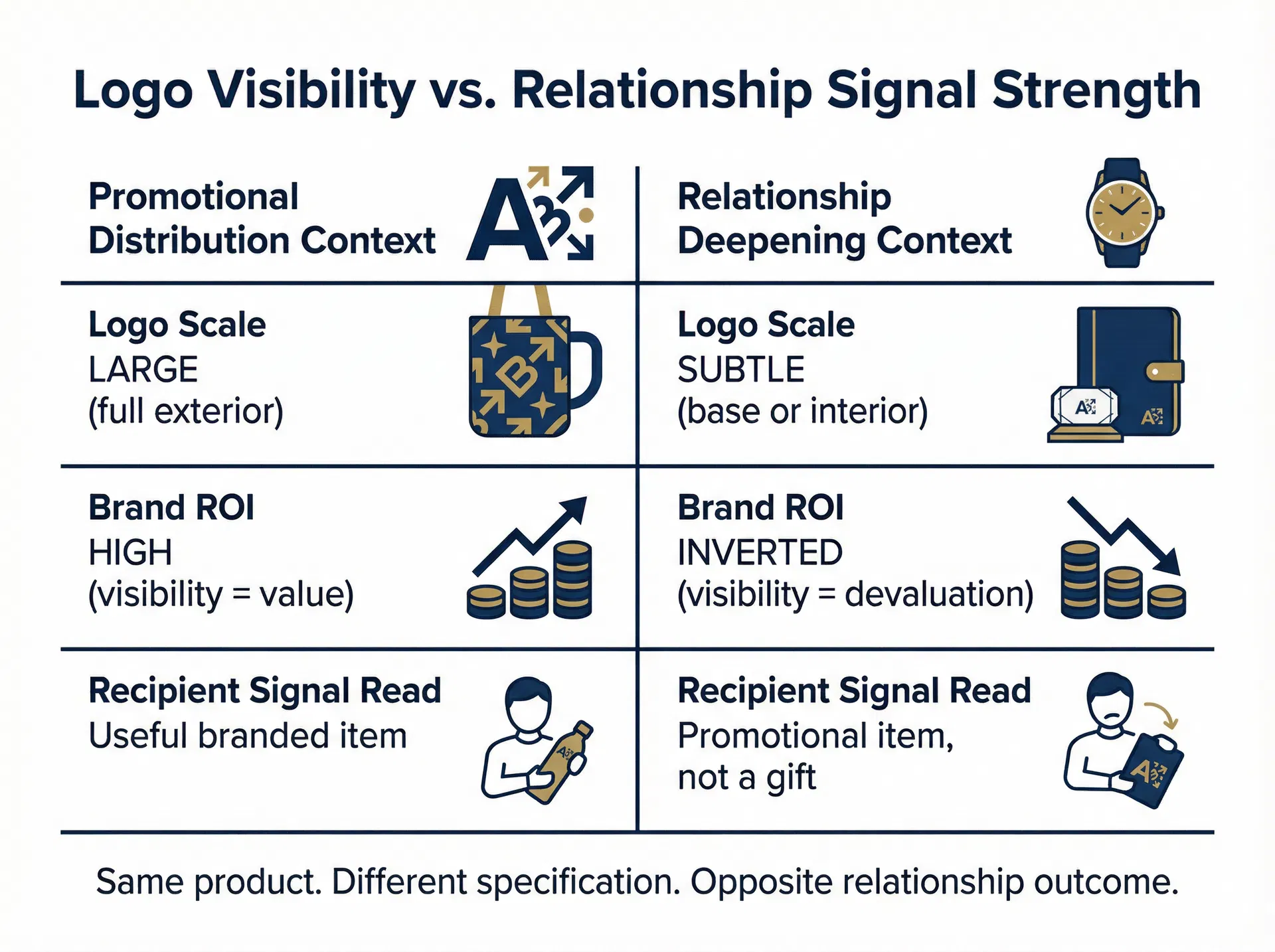
This is not a subjective aesthetic preference. It reflects a structural difference in how branded objects are evaluated in different relationship contexts. In a promotional distribution context, the recipient has no prior relationship with the sender, or a relationship too early-stage to carry personal weight. The gift is evaluated as an object: is it useful, is it well-made, will I use it. The brand presence is incidental to that evaluation. In a relationship-deepening context, the recipient has an established or developing professional relationship with the sender. The gift is evaluated as a signal: what does this tell me about how this company sees our relationship, how much thought went into this, does this reflect the kind of partner they claim to be. The brand presence is not incidental to that evaluation — it is central to it. And a large, prominent logo answers that question in a way that most senders do not intend.
The procurement decision that creates this inversion is rarely made with awareness of the distinction. Most gifting briefs specify the product category, the unit count, the budget, and the logo file. They do not specify the intended relationship signal, because that is not a standard procurement input. The vendor receives a valid specification and produces exactly what was ordered. The logo is placed prominently, as it would be on any branded item, because no alternative instruction was provided. The gift arrives at the recipient's office looking precisely like every other branded item that arrived that week from every other vendor trying to maintain visibility. The sender spent the budget. The relationship signal was not delivered.
The correction is not to remove branding from relationship gifts entirely. That is a different conversation, and one that depends on the specific relationship context and industry norms. The more practical correction is to treat logo placement and scale as a specification decision that is downstream of the relationship objective, not upstream of it. For a custom insulated tumbler intended as a relationship-deepening gift to a named senior contact, the specification should include not just the logo file but the intended placement, scale, and finish — a laser-engraved mark on the base or the interior of the lid, a debossed initial rather than a printed logo, or a subtle tonal treatment that is visible on close inspection but does not announce itself from across a conference table. These are execution decisions that require explicit instruction. They will not happen by default.
The distinction between a promotional specification and a relationship specification for the same product category — custom drinkware — is a detail that most procurement processes are not designed to capture. The purchase order fields do not include a field for "intended relationship signal." The vendor's standard decoration options default to the most visible placement because that is what most buyers want most of the time. The gap between what the buyer intends and what the vendor produces is not a quality failure. It is a specification failure — and it is a failure that compounds in proportion to the seniority of the recipient and the strategic importance of the relationship.
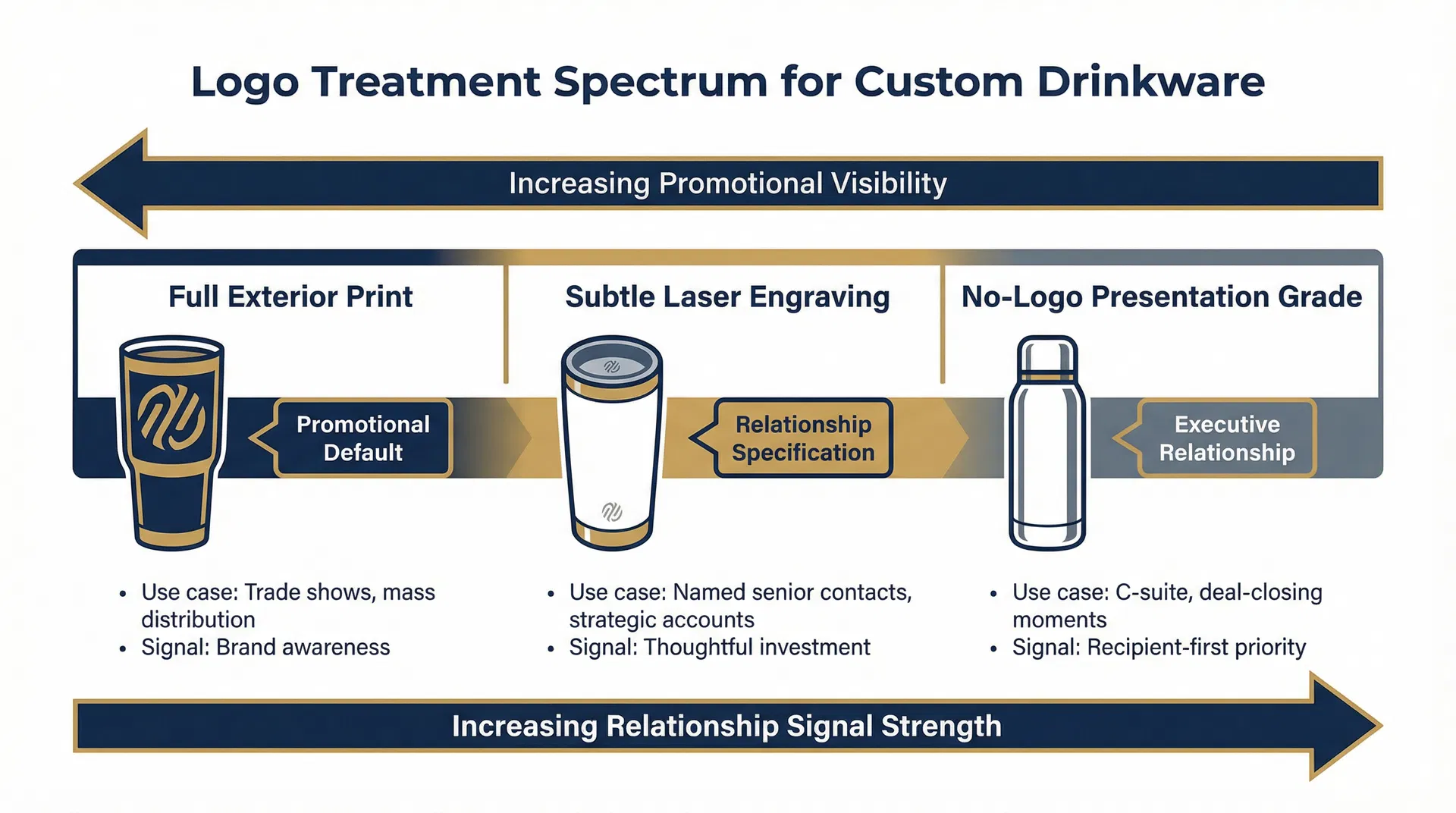
The underlying question of how different gift types serve different business relationship objectives is often framed as a product selection question. In practice, for custom drinkware programs, the more consequential question is frequently a decoration specification question. The same product, executed with different logo treatment, delivers a fundamentally different relationship signal. A procurement process that treats logo placement as a default rather than a decision variable will consistently produce gifts that perform well as promotional items and poorly as relationship investments — regardless of the product quality, the budget, or the intent behind the program.
The companies that manage this well do not necessarily spend more. They specify more precisely. They treat the decoration brief as a relationship brief, and they ensure that the vendor's execution reflects the relationship objective rather than the promotional default. For the senior contact who receives a custom tumbler with a quietly executed mark that rewards close attention rather than announcing itself from a distance, the signal is clear: this was made for you specifically, not distributed to everyone who walked past a booth. That distinction is the entire point of the gift. It is also the detail most likely to be lost in a procurement process that was never asked to preserve it.