Custom Drinkware Insights
Gift Program Scaling Inflection Point Trap
There is a structural assumption embedded in most corporate gifting programs that goes unexamined until it fails: that a program which works well at fifty…
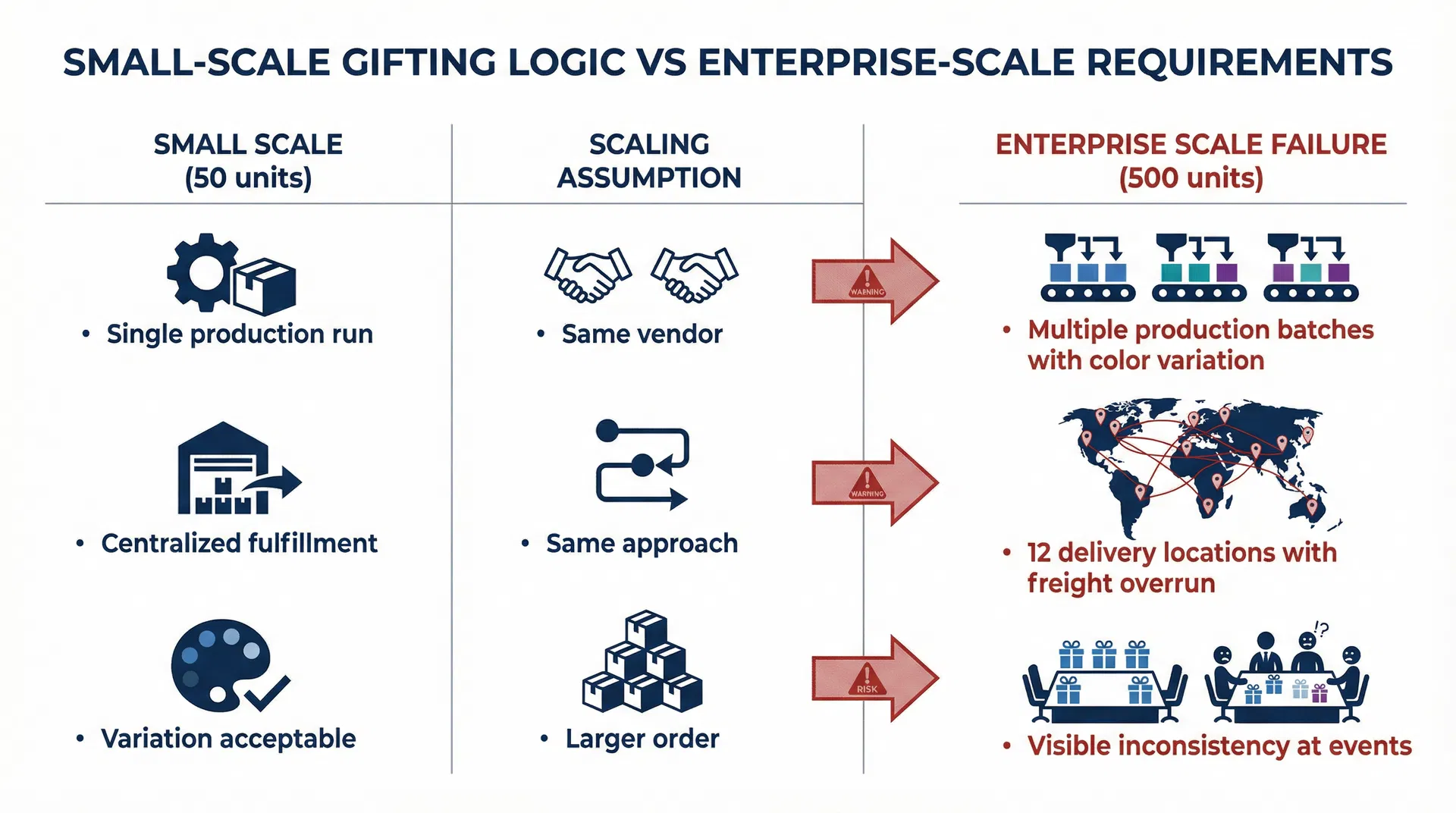
There is a structural assumption embedded in most corporate gifting programs that goes unexamined until it fails: that a program which works well at fifty recipients will work equally well at five hundred. The assumption is understandable. If the vendor delivered on time, the product looked good, and recipients responded positively, the logical conclusion is that scaling the order volume will produce the same outcome at larger scale. In practice, this is precisely where gifting decisions start to be misjudged — not because the vendor changes or the product quality declines, but because the program architecture was never designed for enterprise-scale requirements.
The distinction matters because the failure mode at scale is not obvious. It does not announce itself as a vendor problem or a product problem. It surfaces as a series of compounding inconsistencies that are individually explainable but collectively signal a structural mismatch. A slight variation in logo placement across two production batches. A color tone difference between the units shipped to the East Coast office and those shipped to the West Coast. A per-unit shipping cost that was never in the original budget because the vendor's quote assumed a single delivery address. Each of these is a symptom of the same underlying issue: the program was scaled in volume without being redesigned for scale.
From a production standpoint, the inflection point is not a volume threshold — it is a structural transition. A custom branded tumbler order of fifty units is typically fulfilled from a single production run, which means the logo application, color calibration, and surface finish are consistent across all units. When the same program scales to five hundred units, the vendor may fulfill the order across two or three production runs, particularly if the factory's standard batch size is 200-300 units. Each production run involves a fresh setup of the decoration equipment, which introduces tolerance variation. For laser engraving, this variation is minimal. For pad printing or UV printing, the color output can shift by 5-10% between runs — a difference that is invisible when comparing any two individual units but becomes apparent when a recipient in Chicago compares their tumbler with a colleague's in Dallas and notices the logo looks slightly different.
This is not a quality failure in the conventional sense. Both units meet the product specification. The vendor did not make an error. The variation falls within standard manufacturing tolerances. The problem is that the program was designed with a small-scale assumption — that all units would come from a single production run — that does not hold at enterprise volume. A procurement team that understood this structural transition would have specified batch consistency requirements in the purchase order, or selected a vendor with the production capacity to fulfill the entire order in a single run.
The fulfillment architecture problem is similarly invisible until it creates a cost overrun. At fifty recipients in a single office, centralized fulfillment is efficient: the vendor ships one consolidated order, and internal distribution handles the last mile. At five hundred recipients across twelve regional offices, the same approach creates a logistics bottleneck. The vendor's quoted shipping cost assumed one delivery address. Fulfilling to twelve addresses adds $8-12 per unit in freight cost — a $4,000-6,000 budget variance on a program that was approved based on a per-unit cost that did not include distributed fulfillment. The procurement team did not make a calculation error. They applied the correct logic for the program scale they had previously managed, to a program scale that required different logic.
The customization standardization requirement is the third structural incompatibility that emerges at scale. For a small gifting program, slight variations in product execution are acceptable because recipients rarely compare units. A ceramic mug where the logo is positioned 2mm lower than specified is not a problem when only fifty people received the gift. At five hundred recipients, the same variation becomes visible at team meetings, client events, and industry conferences where multiple recipients are present simultaneously. The brand signal that the gift was intended to send — that the company invests in quality and attention to detail — is undermined by visible inconsistency across units. This is particularly consequential for branded drinkware, where the logo placement and finish quality are the primary signals of brand investment.
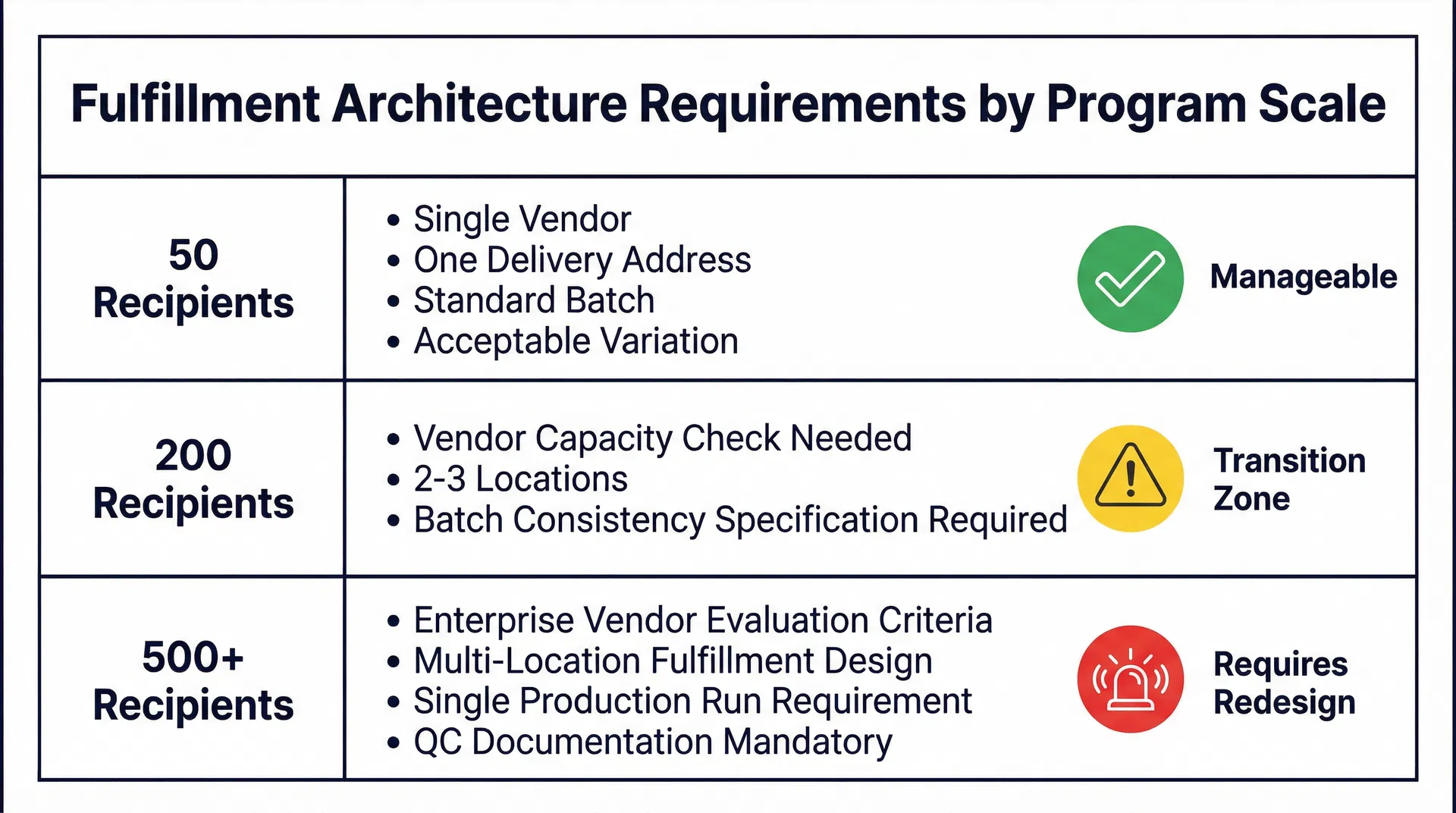
The underlying question of which gift types are actually appropriate for different business contexts is often framed as a product selection question — should we choose tumblers or mugs, engraving or printing, premium or standard? But at enterprise scale, the more consequential question is whether the program architecture — vendor selection criteria, production run specifications, fulfillment design, and quality control requirements — has been redesigned to match the scale of the program. A premium product delivered inconsistently across twelve locations sends a weaker brand signal than a standard product delivered with perfect consistency.
The procurement teams that navigate this transition successfully typically do so by treating the scaling decision as a program redesign rather than a volume increase. They evaluate vendors not on their ability to deliver fifty units well, but on their production capacity to fulfill five hundred units in a single run, their fulfillment infrastructure for multi-location delivery, and their quality control documentation for batch consistency. For branded drinkware programs specifically, this means requesting production capacity data, asking about batch size limits for consistent decoration output, and specifying fulfillment requirements by delivery location before finalizing vendor selection.
The programs that fail at scale typically do so because the procurement decision was made by extrapolating from small-scale success. The vendor delivered well at fifty units, so the assumption is that they will deliver equally well at five hundred. The product looked good in the sample, so the assumption is that it will look equally good across multiple production batches. The fulfillment was straightforward at one location, so the assumption is that it will be equally straightforward at twelve. Each assumption is individually reasonable. Collectively, they represent a structural mismatch between the program design and the program scale — a mismatch that becomes visible only after the order has been placed and the first batch of inconsistencies begins to surface.
For procurement teams managing gifting programs that are approaching or have already crossed the enterprise-scale threshold, the most useful reframe is not "how do we order more of what worked before" but "what does this program need to look like at this scale to deliver the same outcome it delivered at smaller scale." The answer almost always involves different vendor evaluation criteria, different production specifications, and different fulfillment architecture — not simply a larger purchase order to the same vendor using the same approach.