Corporate Gifting
The Gift Function Classification Trap: Why Not All 'Custom Drinkware' Serves the Same Purpose
企業禮品採購中,將促銷曝光型產品與關係深化型禮品混為一談的常見誤判。本文從工廠端視角,分析為何兩種本質不同的業務目標需要截然不同的採購邏輯。

When a procurement team submits a request for custom branded tumblers, the specification sheet typically includes unit count, logo file, color preference, and a delivery deadline. What it rarely includes is a statement of intent — a clear description of what the gift is supposed to accomplish in the relationship it enters. From a factory standpoint, that absence is not a problem for production. We can manufacture to specification without knowing whether the order is destined for a trade show booth, a C-suite client visit, or a new employee onboarding kit. The problem surfaces later, when the delivered product is evaluated against an unstated objective it was never designed to meet.
This is the classification trap. It is not a specification error in the conventional sense. The product is correct. The logo is accurate. The quantity is right. The failure is that the procurement decision treated two functionally distinct categories of corporate gift as interchangeable, and applied the same evaluation criteria — unit cost, MOQ threshold, lead time — to a decision that required a different framework entirely.
The distinction between a promotional distribution item and a relationship-reinforcing gift is not primarily about price. It is about the structural role the item plays in the business relationship it enters. A custom insulated tumbler ordered at 500 units for a regional trade show is functioning as a brand impression vehicle. Its job is to carry a logo into environments where the company has no other presence, generate repeated visual exposure over its useful life, and create a low-friction brand association at minimal cost per impression. The evaluation criteria that matter for this function are reach efficiency, unit cost at volume, and logo visibility. A tumbler that costs $8.50 per unit and generates 3,000+ impressions over its lifetime is performing well against those criteria, regardless of whether the recipient ever develops a meaningful association with the brand behind it.
A custom insulated tumbler ordered at 50 units for delivery to senior procurement contacts at five target accounts is functioning as a relationship signal. Its job is to communicate that the sending company understands the recipient's professional context, invests in quality as a proxy for how it operates, and values the relationship specifically enough to distinguish it from mass distribution. The evaluation criteria that matter for this function are perceived value, presentation quality, and specificity of execution. A tumbler that costs $8.50 per unit and arrives in a poly bag with a packing slip fails against these criteria regardless of how well it performs as a brand impression vehicle.
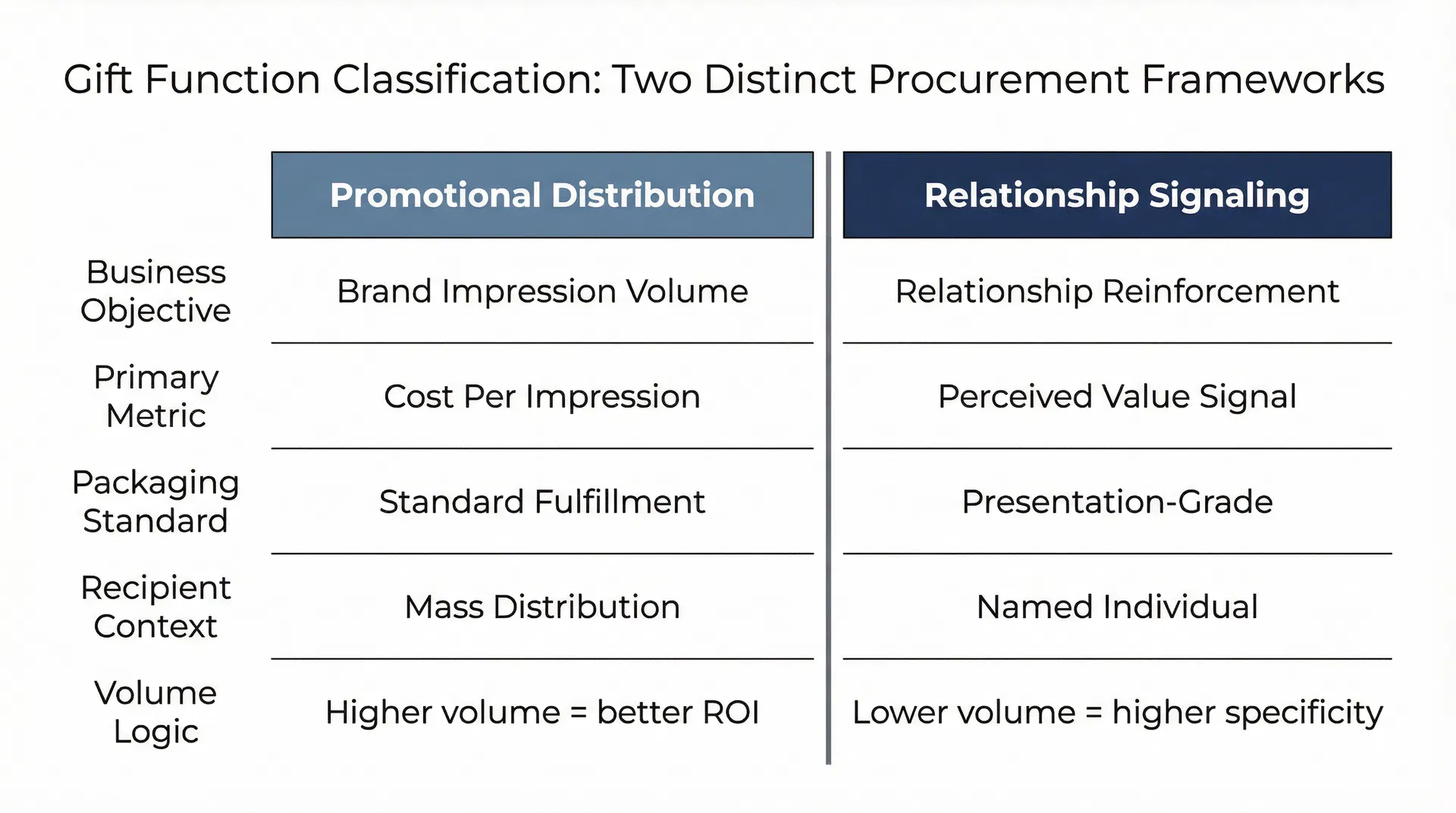
The misjudgment happens when procurement applies the same sourcing logic to both categories. This is more common than it appears, because the product category is identical. Both orders are for custom branded drinkware. Both require a logo file, a color specification, and a delivery address. The procurement workflow that handles one will handle the other without flagging the functional distinction, because procurement systems are designed to process specifications, not intent. The buyer who submits both orders through the same vendor portal, using the same approved supplier, with the same packaging default, has not made an error within the procurement system. The error is that the procurement system was never given the information it needed to differentiate the two.
From a production standpoint, the consequences of this classification error are predictable and specific. When a relationship-signaling gift is processed through a promotional distribution framework, several things happen automatically. The packaging defaults to whatever the vendor's standard fulfillment format is — typically a plain white box or poly bag — because no packaging upgrade was specified. The presentation insert, if any, defaults to a generic thank-you card rather than a personalized message, because personalization was not included in the purchase order. The product itself may be identical in quality to what a premium relationship gift requires, but the surrounding execution signals mass production rather than individual attention. The recipient receives a product that is technically correct and functionally identical to what was intended, but experientially indistinguishable from the promotional items they receive from every other vendor at every trade show they attend.
The inverse error is less common but more financially consequential. When a promotional distribution item is processed through a relationship-signaling framework — premium packaging, individual personalization, elevated unit cost — the result is a gifting program that consumes three to four times the budget required to achieve its actual objective. A trade show giveaway that arrives in a branded gift box with a personalized card and a $35 per unit cost has not become a relationship-reinforcing gift by virtue of its packaging. The recipient at a trade show booth is not in a relationship-evaluation context. They are in a brand exposure context. The additional investment in presentation does not change the functional role the item plays, and therefore does not generate the return that justifies it.
The practical challenge is that the functional classification of a corporate gift is not always obvious at the time of procurement. A single order of 200 custom tumblers might include 150 units for a company-wide employee appreciation program and 50 units for delivery to key client contacts. The 150-unit portion is functioning as an internal engagement tool. The 50-unit portion is functioning as a relationship signal to external stakeholders. Processing both portions through a single purchase order, with a single packaging specification and a single per-unit cost target, produces a result that is optimized for neither function.
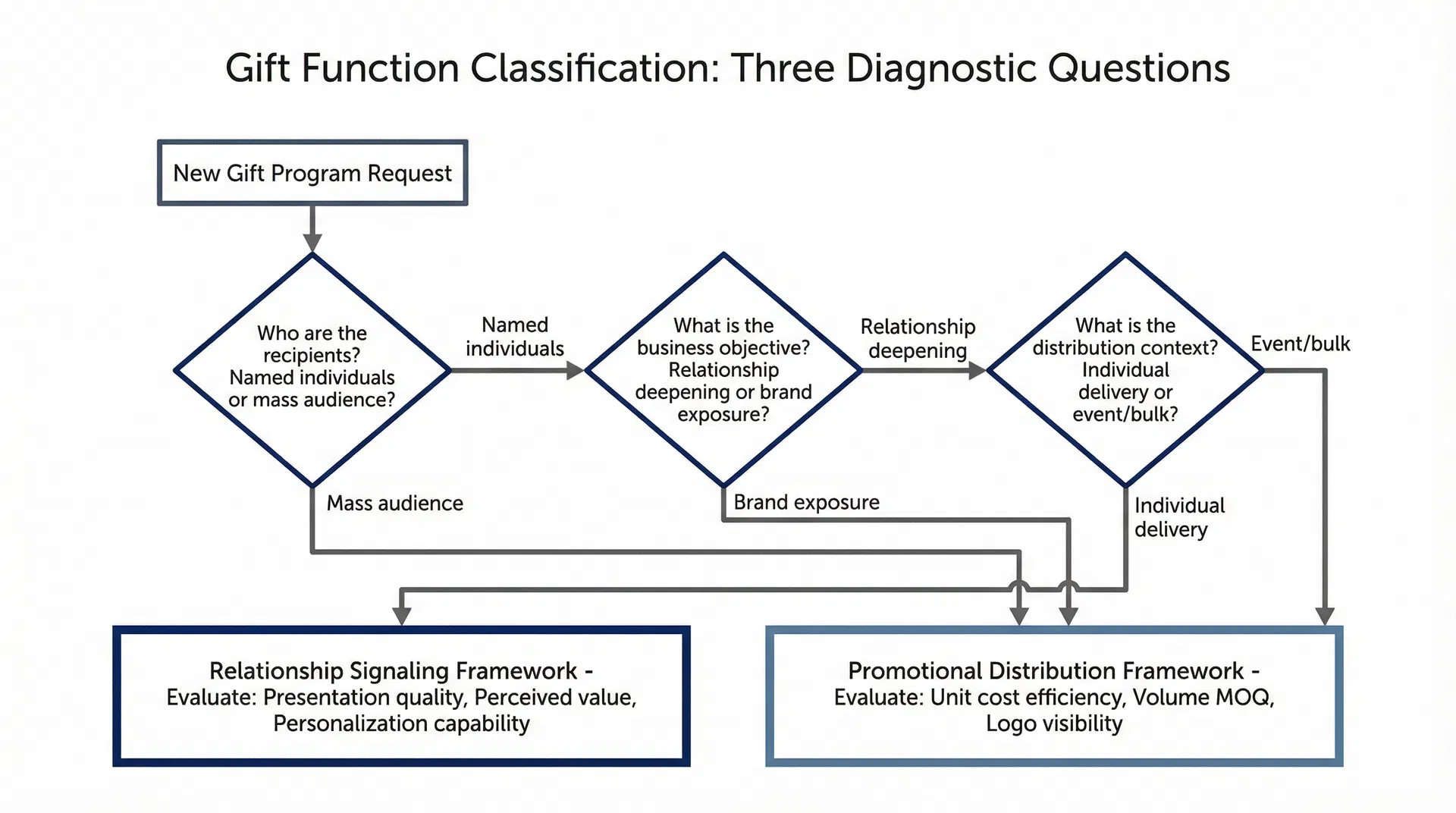
The resolution is not to create separate procurement categories for every gifting scenario. It is to treat the statement of intent as a required input in the procurement process, with the same weight as unit count and delivery date. When a buyer specifies that 50 units are intended for senior client contacts at target accounts, that specification should trigger a different set of vendor evaluation criteria, packaging defaults, and presentation standards than a specification for 500 units for event distribution. The product category may be identical. The procurement framework should not be.
For custom drinkware specifically, this distinction has direct implications for how the order is structured. A relationship-signaling gift program benefits from individual packaging, presentation inserts, and a per-unit cost that reflects the full execution rather than just the product. A promotional distribution program benefits from consolidated fulfillment, standard packaging, and a per-unit cost that reflects volume efficiency. Understanding which gift types serve which business needs is ultimately a question of function, not product category — and the procurement decision that fails to distinguish between the two will consistently underperform against whichever objective it was actually trying to serve.
The classification trap persists because it is invisible within the procurement system that enables it. The vendor receives a valid purchase order. The factory produces a correct product. The delivery arrives on time. The failure is not in the execution — it is in the framing that preceded the execution, and that framing is rarely examined after the fact because the product itself is not defective. What is defective is the match between the gift's functional role and the procurement logic used to source it. That mismatch does not appear on any quality inspection report.