Corporate Gifting
The Decoration Method Substitution Trap: Why 'Looks Similar' Is a Recipe for Brand Erosion
企業禮品採購中,在成本壓力下接受 UV 印刷替代雷射雕刻的常見誤判。本文從工廠端專案經理視角,分析為何這種替換決策在短期內看似合理,卻在長期使用中導致品牌形象的系統性損害。

When a supplier proposes substituting UV printing for laser engraving on a custom stainless steel tumbler order, the cost reduction is real and the visual difference in the sample photographs is minimal. From a procurement standpoint, this looks like a straightforward value optimization: the same product, the same logo placement, the same delivery timeline, at a unit cost that is 15 to 25 percent lower. The decision gets approved. The order gets placed. The tumblers arrive looking exactly as expected. And then, over the following months, the problem becomes visible in ways that no sample photograph could have predicted.
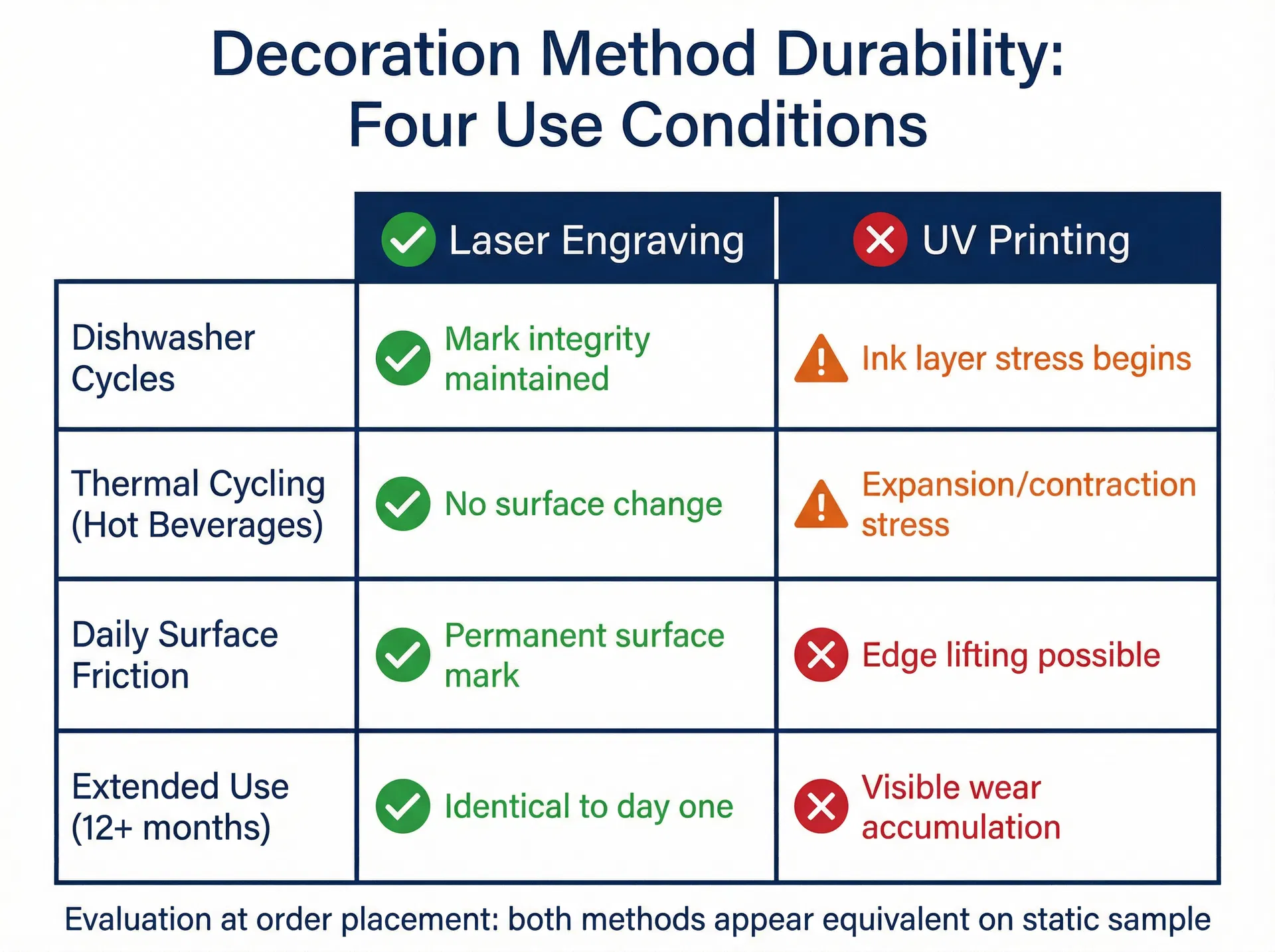
The distinction between laser engraving and UV printing is not primarily a visual distinction. It is a durability distinction that only manifests under conditions of actual use. Laser engraving on stainless steel is a physical process: the laser removes material from the surface, creating a permanent depression in the metal. There is no coating, no ink layer, no adhesive bond. The engraved mark is structurally part of the product. It cannot fade, peel, or wear away because it is not a layer on top of the surface — it is the surface itself, modified. UV printing, by contrast, deposits a cured ink layer onto the exterior of the tumbler. The bond between that ink layer and the stainless steel surface is strong under controlled conditions, but it is a surface bond. It is subject to the same mechanical and thermal stresses that the exterior of the tumbler experiences in daily use: dishwasher cycles, thermal expansion from hot liquids, the friction of being placed on desks and carried in bags, the oils and pressure from repeated handling.
The procurement error is not in choosing UV printing per se. UV printing is the appropriate decoration method for certain product types, certain use contexts, and certain gifting objectives. The error is in treating the decoration method as a cost variable that can be substituted without changing the product's functional specification. For a promotional item intended for a single event — a conference giveaway, a trade show distribution — the durability horizon is short, and UV printing's cost advantage is entirely legitimate. The item serves its purpose within a timeframe where surface wear is unlikely to become visible. For a corporate relationship gift intended to remain in daily use on a client's desk for two or three years, the durability horizon is fundamentally different. The decoration method is not a finishing choice. It is a specification decision that determines whether the gift continues to represent the sender's brand accurately over the product's entire useful life.
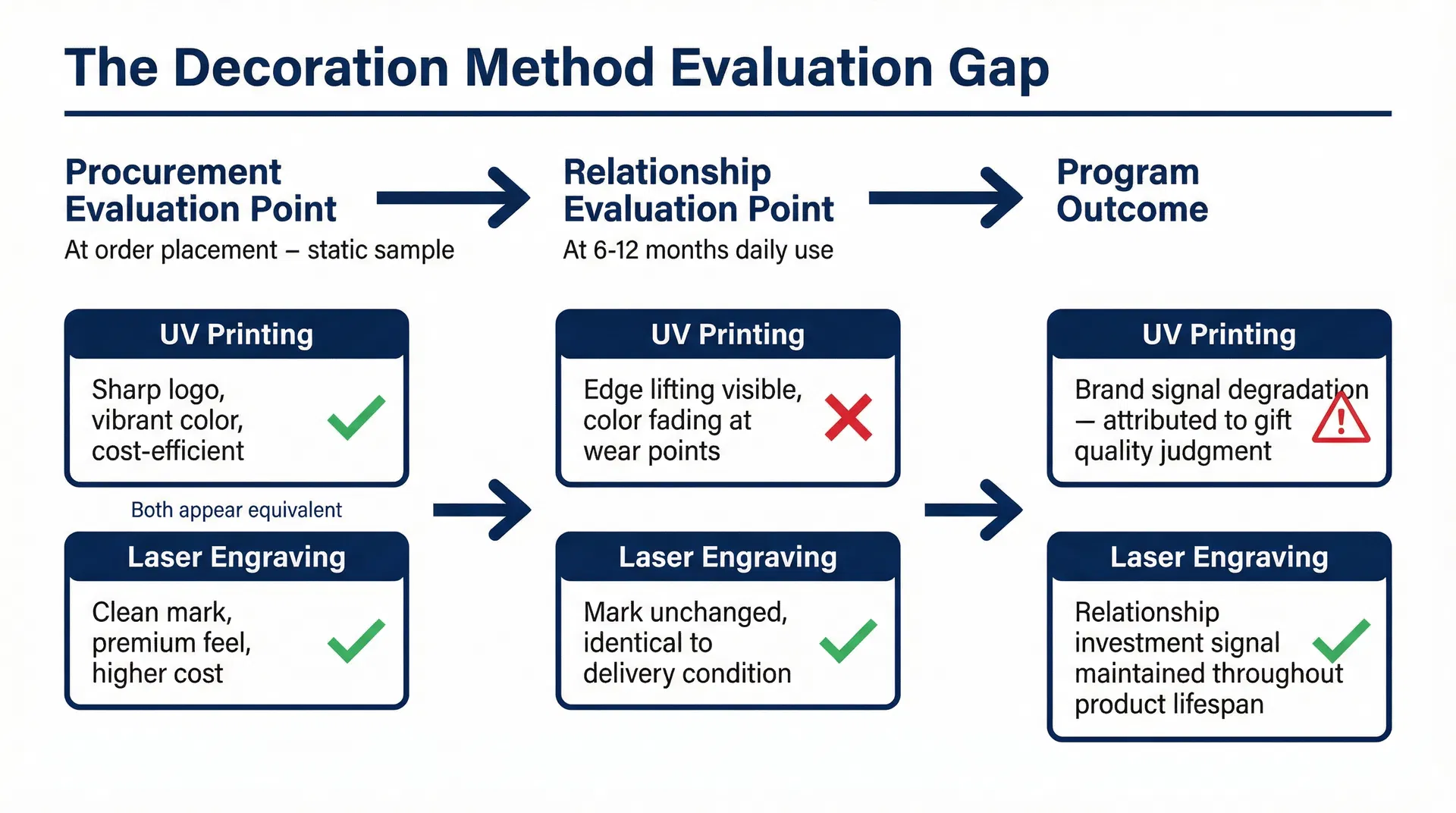
This is where the substitution decision is most commonly misjudged. The procurement team evaluates the decoration method at the point of ordering, which means they are evaluating a static sample under controlled conditions. The client who receives the gift evaluates it continuously, over months of daily use, under conditions that the sample was never subjected to. A UV-printed logo that looks sharp on delivery may show visible edge lifting after six months of dishwasher cycles. A laser-engraved mark on the same tumbler will look identical on day one and on day five hundred. The difference is not apparent at the point of purchase. It becomes apparent at the point of use — and by then, the procurement decision has already been made and cannot be reversed.
The relationship consequence of this failure is asymmetric and delayed. The gift was sent as a relationship investment. The recipient used it, perhaps daily, and at some point noticed that the logo was beginning to show wear. The physical degradation of the decoration is read as a signal about the quality of the product, and by extension, about the quality of the sender's judgment in selecting it. This is not a rational inference — the product itself may be performing perfectly — but it is a predictable one. The decoration is the most visible element of the customization. When it fails, the failure is attributed to the entire gift, not to a specific production decision made under cost pressure months earlier.
The correction requires treating the decoration method as part of the product specification, not as a finishing variable. For a custom drinkware program where the intended use context is daily office use over a multi-year relationship horizon, laser engraving is not a premium option — it is the specification that matches the product's intended lifespan. The cost differential between laser engraving and UV printing needs to be evaluated against the full cost of the program: the cost of the product, the packaging, the logistics, and the relationship value the program is designed to deliver. A 20 percent reduction in decoration cost that produces visible brand degradation within the first year of use is not a cost saving. It is a deferred cost that arrives as a relationship problem rather than an invoice.
The question of which gift types best serve different business objectives is often answered at the product category level — tumbler versus mug, stainless steel versus ceramic. In practice, the decoration method is an equally consequential specification decision that operates on a different timeline. The product category determines the gift's initial signal. The decoration method determines whether that signal remains intact over the duration of the relationship the gift was intended to support.
In production terms, the substitution is easy to make and easy to reverse before the order is placed. After the order is placed, it cannot be reversed without restarting the production cycle. The window for catching this error is narrow: it is the specification review stage, before the purchase order is issued. Once the order is in production, the decoration method is fixed. The tumblers will arrive looking correct. The problem will not be visible for months. And when it becomes visible, it will be attributed not to a procurement specification error made under cost pressure, but to the quality of the gift itself — which is the one attribution that does the most damage to the relationship the program was designed to strengthen.