Corporate Gifting
The Budget Approval Timing Displacement Trap: Why Q4 Budgeting Kills Q2/Q3 Quality
企業禮品採購中,預算審批週期與最佳採購窗口的結構性錯位。本文從品質/合規顧問視角,分析為何這種錯位每年系統性地導致品質壓縮、成本溢價和交期延誤。

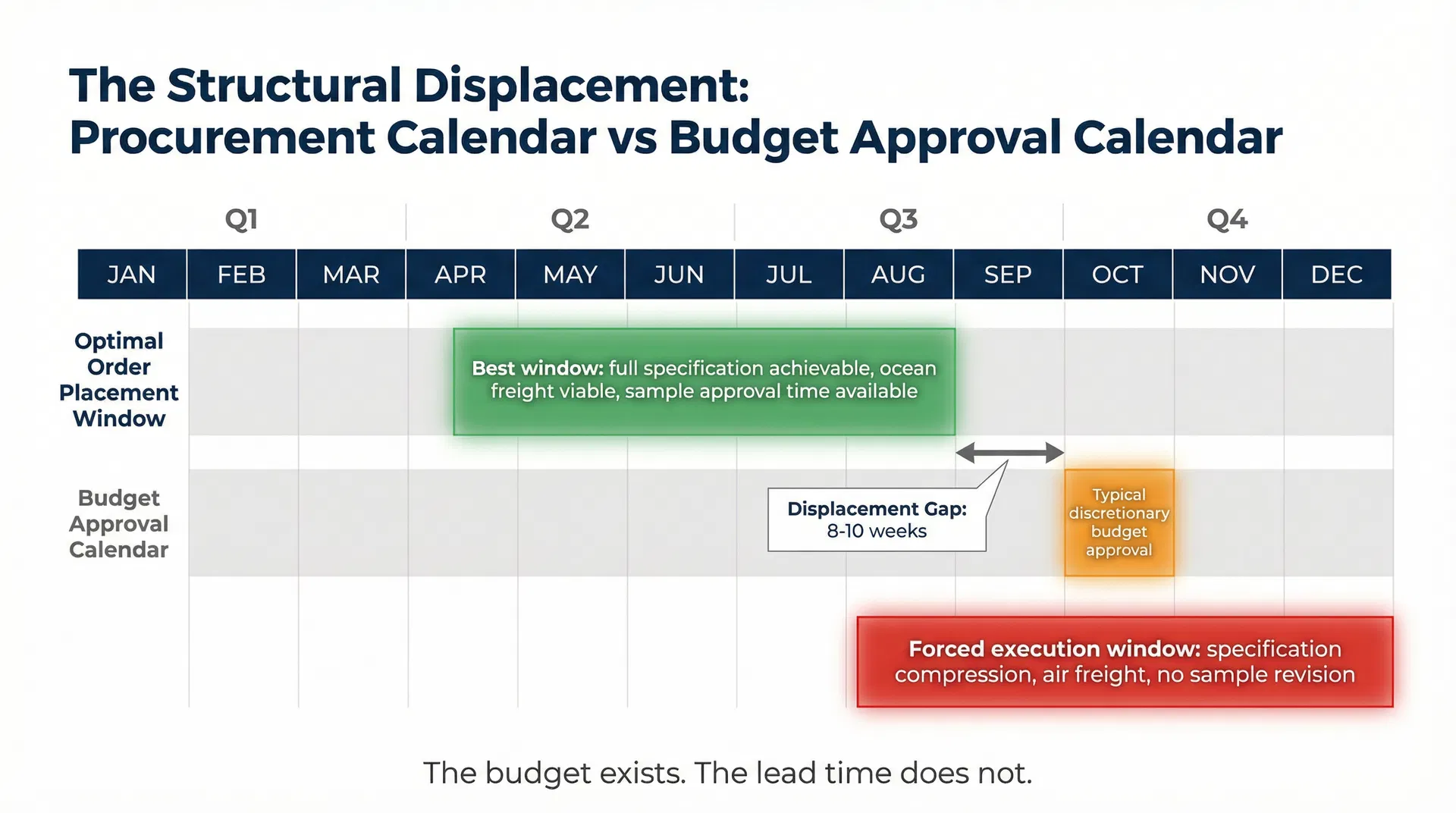
The structural problem with most corporate gift programs is not that the people running them make poor decisions. It is that the decisions they are allowed to make are constrained by an approval process that was designed for a different kind of procurement. Budget cycles in most organizations are built around fiscal quarters, with discretionary spending categories — which is where corporate gifting typically sits — receiving final approval in Q3 or early Q4. For a program that orders branded stationery, printed materials, or off-the-shelf items with two-week lead times, this timing works adequately. For a program that orders custom stainless steel tumblers or laser-engraved ceramic mugs with eight-to-twelve-week actual elapsed times, it produces a systematic quality failure that repeats every year without anyone identifying the root cause.
The displacement works like this. The procurement team knows, from experience, that they should place custom drinkware orders early. They have likely been told this by suppliers, and they may have experienced a late delivery in a previous cycle. But the budget for the current year's program is not approved until October, or sometimes November. The event or distribution window is in December. The arithmetic is straightforward: there is not enough time to execute the program at the specification level that the budget would otherwise support. The team does not reduce the budget. They reduce the specification.
What gets compressed first is almost always the customization depth. Instead of a laser-engraved design with a custom color match and a branded gift box, the program defaults to a UV-printed logo on a catalog item with standard packaging. The unit cost is similar. The perceived value to the recipient is not. The procurement team made a rational decision given their constraints, but the constraint was structural — created by the approval timeline — not by the budget itself. The same budget, deployed in July, would have produced a meaningfully different program.
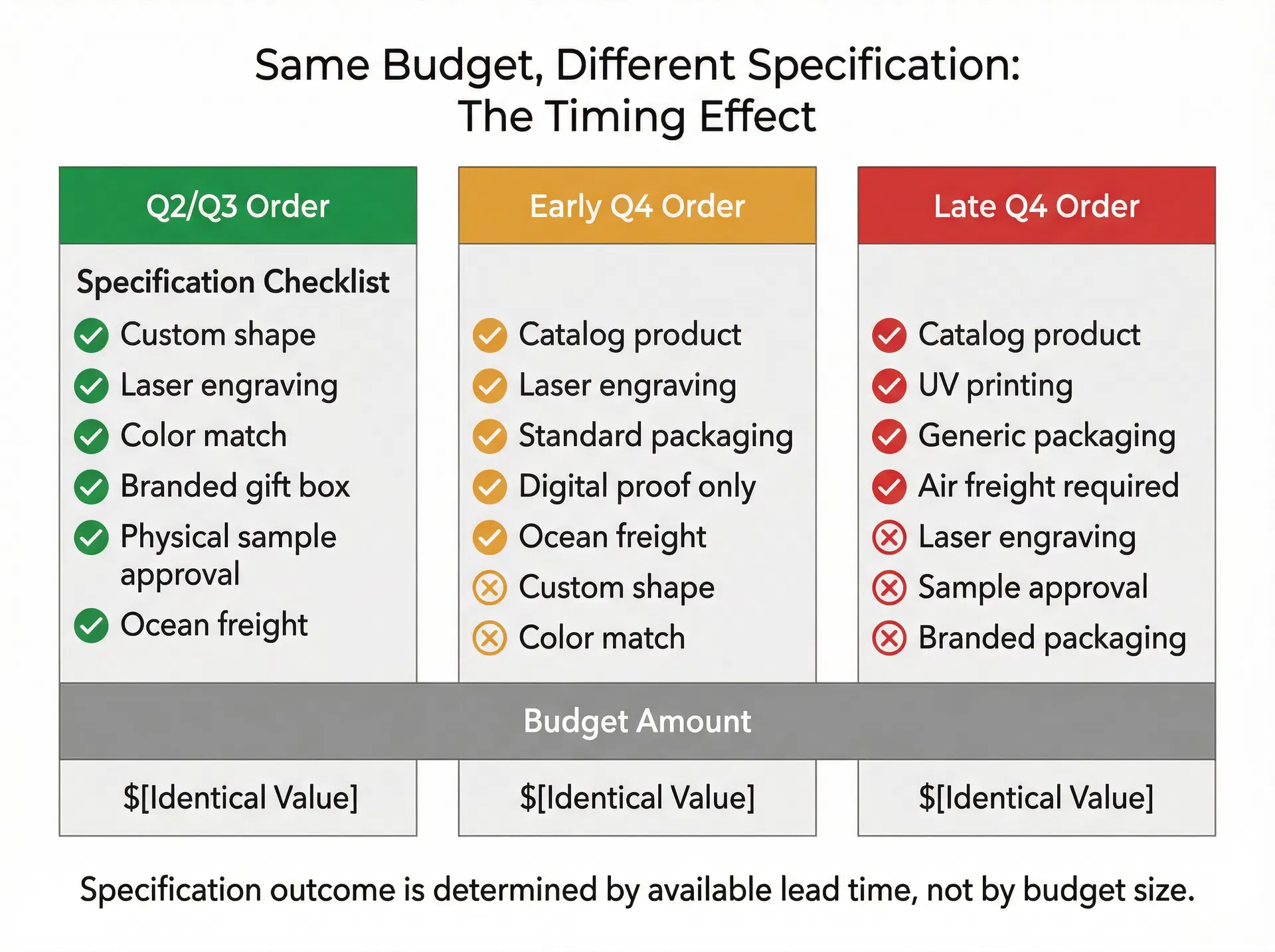
The second compression point is the sample approval cycle. When time is adequate, a procurement team can review a physical sample, request adjustments to the logo placement or engraving depth, and approve a revised sample before committing to full production. This cycle typically takes one to two weeks but produces a result that is visually and tactilely aligned with the program's intent. When the order is placed in late Q4, there is no time for a sample revision cycle. The team approves the first sample or approves a digital proof without a physical sample at all. The production run proceeds on the basis of an approval that was made under time pressure rather than on the basis of quality judgment. The finished product may be acceptable. It is rarely optimal.
The third and least visible consequence is the logistics cost escalation. A program ordered in July can use ocean freight, which takes three to four weeks but costs a fraction of air freight. A program ordered in November, with a December delivery deadline, has no choice but to use air freight. The freight cost difference for a 500-unit order of stainless steel tumblers can range from $800 to $3,000 depending on weight and destination. This cost is typically absorbed into the program budget, which means it displaces spending that could have gone toward a higher-specification product. The program ends up paying more for logistics and less for product quality — the opposite of the intended allocation.
What makes this trap particularly difficult to address is that the people who control the budget approval timeline are rarely the same people who manage the supplier relationship or understand the production calendar. A finance team approving discretionary spending in Q4 is operating within a legitimate organizational process. They are not aware that the approval date has a direct effect on the specification level achievable within the approved budget. The procurement team, for their part, typically does not surface this connection explicitly because the specification compression happens quietly, as a series of small adjustments rather than a single visible decision.
The correction requires a structural intervention rather than a behavioral one. The most effective approach is to separate the budget approval from the order placement by building a provisional commitment mechanism into the planning cycle. This means requesting budget pre-approval or a spending authorization in Q2 for a program that will be executed in Q4, with the final recipient list and quantity confirmed closer to the distribution date. Some organizations accomplish this by treating the custom drinkware component of their gifting program as a capital-adjacent procurement — one that requires a longer planning horizon — rather than as a discretionary expense that can be approved and executed within the same quarter.
The gift type selection decision is directly affected by this timing structure. Products that require significant pre-production work — custom shapes, proprietary color matches, multi-component packaging — need the longest lead times and are the most sensitive to late budget approval. Products with shorter pre-production requirements are more forgiving of compressed timelines but typically produce a lower relationship signal. Understanding how different gift types serve different business relationship objectives is a prerequisite for making the budget timing argument internally, because the argument only works if the procurement team can demonstrate what is lost when the timeline is compressed — not just in abstract terms, but in specific specification terms that a decision-maker can evaluate.
The pattern that repeats across organizations that have not resolved this structural problem is consistent: the program runs, the gifts are delivered, the recipients receive them, and no one flags the outcome as a failure because the gifts arrived and were not defective. The quality compression is invisible to everyone except the procurement team, who know what the program could have been. The relationship signal sent is adequate rather than intentional. The budget was spent. The opportunity was not fully used.